.png)
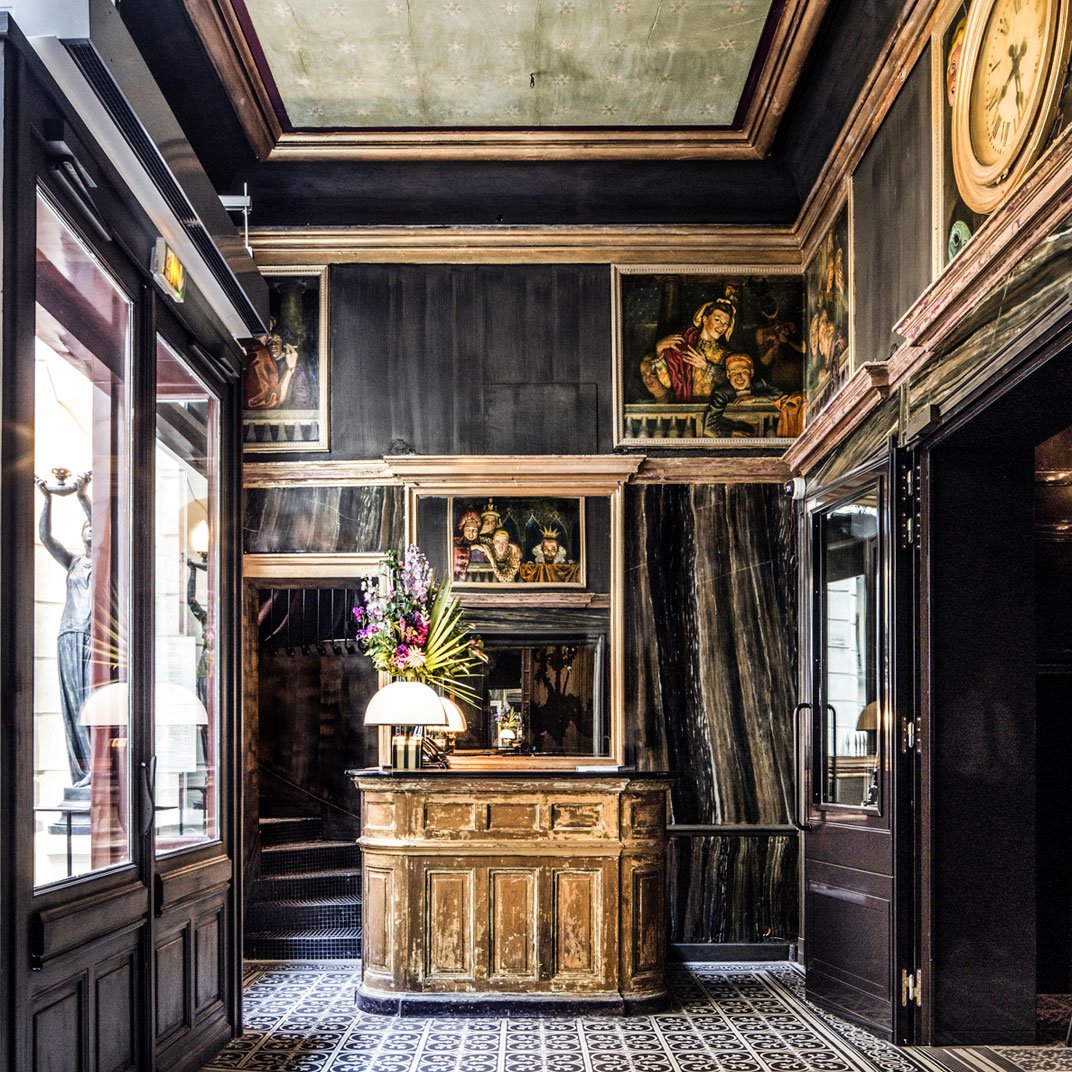
Set in a cobbled courtyard within the Marais Dance Centre, GrandCœur holds a Michelin Plate (2025) for modern cuisine shaped by Mauro Colagreco's influence, where classic Gallic recipes meet Mediterranean and Italian accents. The exposed beams, marble tops, and velvet upholstery of the dining room give way to a terrace that few addresses in the 4th arrondissement can match. A Google rating of 4.4 across more than 1,700 reviews confirms consistent execution at the €€€ price point.
A Courtyard Address in the Heart of the Marais
There is a particular register of Paris dining room that announces itself before a menu arrives: aged stonework underfoot, beams overhead, and the low hum of a room where the architecture does the heavy lifting. GrandCœur, at 41 Rue du Temple in the 4th arrondissement, operates in exactly that register. Housed within the Marais Dance Centre, its cobbled courtyard terrace sits behind a facade that the neighbourhood has been polishing for centuries. Inside, exposed beams meet marble tabletops and velvet upholstery in a combination that reads as contemporary comfort without abandoning the fabric of the building. The effect is less design statement than considered layering, which suits the cooking's own approach to combining traditions.
Where Gallic Recipes Meet the Mediterranean Rim
The cooking at GrandCœur proceeds from a clear premise: classical French technique applied to ingredients and flavour combinations that carry Italian and broader Mediterranean DNA. This is not a new idea in Paris. The city's most ambitious modern kitchens have long treated the French-Italian border as permeable, drawing on Piedmontese, Ligurian, and Provençal pantries almost interchangeably. What distinguishes the approach here is the pedigree behind the concept. GrandCœur is the brainchild of Mauro Colagreco, whose own trajectory from the Franco-Argentine south to [Mirazur in Menton](https://www.enprimeurclub.com/restaurants/mirazur-menton-restaurant) has made him one of the figures most associated with that border-crossing sensibility. The Paris address extends that thinking into a more accessible, neighbourhood-anchored format.
Dishes illustrate the method concretely. A stuffed confit of lamb in a Provençal sauce arrives with Taggiasche olives, the small, black, low-acid Ligurian variety that appears in sophisticated kitchens specifically because their flavour is assertive without overwhelming surrounding elements, and a gravy built for depth rather than elegance. The pairing of southern French technique with a quintessentially Ligurian ingredient is not decorative: it is a position on how those two culinary traditions share vocabulary. This is the kind of cooking that rewards comparison across the table rather than solitary analysis.
For readers mapping Paris modern cuisine across price tiers, the context matters. The three-star addresses operating in this city at the €€€€ bracket, among them 114, Faubourg, the productions at Alléno Paris au Pavillon Ledoyen, Kei, and Le Cinq at the Four Seasons George V, ask considerably more per cover and deliver the full ceremony of that tier. GrandCœur's €€€ positioning places it inside a different peer set: restaurants where a serious cooking team works at sustained quality without requiring the guest to commit to a two-hour tasting sequence and a significant outlay. The Michelin Plate recognition in 2025 signals that the guide's inspectors consider the kitchen consistent and cooking at a level worth noting, a credential that places the restaurant above the reliable neighbourhood category without claiming starred status.
The Team Dynamic Behind a Consistent Room
A Michelin Plate at this level is rarely the product of one person's decisions. The format at GrandCœur, a room that balances a terrace crowd with an interior dinner service inside a working cultural complex, demands coordination between the kitchen's output and a front-of-house capable of reading a guest's pace and adjusting accordingly. The Colagreco concept sets the culinary direction, but the execution depends on a team that understands both the register of the dishes and the character of the room. That balance shows in the Google review average: 4.4 across 1,710 ratings is a signal of consistent delivery rather than the occasional outstanding performance that pulls a lower average upward. Consistency at this scale is a management achievement as much as a culinary one.
The wine dimension at a Franco-Italian address of this style typically reflects the same border-crossing logic as the food. Ligurian whites, southern Rhône reds, and northern Italian producers occupy natural positions alongside Loire and Burgundy options in a room where the cooking asks for wines that can move between registers. The sommelier's role, matching that Italian-inflected Provençal cooking to a list that a largely Parisian clientele expects to be grounded in French wine traditions, requires the same kind of informed flexibility the kitchen demonstrates.
The Marais at This Tier
The 4th arrondissement contains some of Paris's most visited streets and some of its most quietly serious restaurants. The Marais's density of galleries, the ongoing pull of the Place des Vosges a few minutes east, and the neighbourhood's status as one of the city's most walked areas mean that a terrace on a cobbled courtyard here draws a genuinely mixed crowd: local regulars, visitors staying nearby, and the kind of wandering afternoon visitor who converts to a dinner booking once the setting registers. For the kitchen, that mix is a challenge. For the address, it is a form of quality control: a room that survives sustained tourist-adjacent footfall at a 4.4 average is earning its score honestly.
Comparable addresses in the city at the same price tier, including Accents Table Bourse, Amâlia, and Anona, each work their own editorial angle within Paris modern cuisine. GrandCœur's distinguishing factor is the combination of courtyard setting and a culinary concept with documented international reach through Colagreco's broader body of work, including the three-star standing of Mirazur and the formal recognition accumulated across his projects. That reach does not automatically transfer to a Paris bistro-scale address, but it does set a floor for ambition and technique that informs what the kitchen attempts.
Planning Your Visit
Address: 41 Rue du Temple, 75004 Paris, France (Marais, within the Marais Dance Centre). Price range: €€€ (mid-to-upper range for the arrondissement; plan for a meaningful but not extravagant spend per head). Recognition: Michelin Plate (2025); 4.4 Google rating across 1,710 reviews. Terrace: Available in the cobbled courtyard; booking ahead is advisable for terrace seats, particularly in spring and early autumn when demand in this neighbourhood peaks. Getting there: Hôtel de Ville (lines 1 and 11) is the closest Métro station, a short walk along Rue du Temple. Context: For a broader view of what Paris is doing at this tier and above, see our full Paris restaurants guide, as well as our Paris hotels guide, bars guide, wineries guide, and experiences guide.
For readers following Colagreco's work across formats, the comparison points extend beyond Paris. Mirazur in Menton remains the anchoring reference. Among France's other defining addresses at the top tier, Flocons de Sel in Megève, Troisgros in Ouches, Auberge de l'Ill in Illhaeusern, Bras in Laguiole, and Paul Bocuse in Collonges-au-Mont-d'Or each represent the longer tradition within which GrandCœur's modern-Mediterranean positioning makes sense as a contemporary inflection. Further afield, Frantzén in Stockholm and FZN by Björn Frantzén in Dubai illustrate how the same cross-cultural ambition plays out in different cities. Closer to home, Auberge de Montfleury offers a further comparison point for readers building out a broader itinerary.
Frequently Asked Questions
- What is the signature dish at GrandCœur?
- The dish most associated with GrandCœur's kitchen is a stuffed confit of lamb served with Provençal sauce, Taggiasche olives, and a deep-built gravy. It condenses the restaurant's central editorial position, classical French preparation crossed with Italian-inflected ingredients, into a single plate. The choice of Taggiasche olives, a Ligurian variety prized for their restrained bitterness, is characteristic of the kitchen's approach to sourcing: specific rather than generic, with each ingredient carrying regional meaning. The Michelin Plate recognition in 2025 covers the full menu, but this dish is the clearest expression of what makes GrandCœur's cooking coherent rather than simply eclectic. For more on the chef's broader work and the context that informs this dish, see Mirazur in Menton.
A Pricing-First Comparison
A small peer set for context; details vary by what’s recorded in our database.
| Venue | Price | Awards | Notes |
|---|---|---|---|
| GrandCœur | €€€ | Michelin Plate (2025); Take a seat in the warm, welcoming interior (with exposed beams and stonework, marble table tops and velvet upholstery), or on the pleasant terrace in the picturesque, cobbled courtyard of the Marais Dance Centre. The brainchild of Mauro Colagreco, the pedigree Gallic recipes come with an international, often Italian twist… Examples include stuffed confit of lamb in a provençal sauce, Taggiasche olives and a gutsy gravy – high-flying culinary art! | This venue |
| Alléno Paris au Pavillon Ledoyen | €€€€ | Michelin 3 Star, World's 50 Best | Creative, €€€€ |
| Kei | €€€€ | Michelin 3 Star, World's 50 Best | Contemporary French, Modern Cuisine, €€€€ |
| L'Ambroisie | €€€€ | Michelin 3 Star, World's 50 Best | French, Classic Cuisine, €€€€ |
| Le Cinq - Four Seasons Hôtel George V | €€€€ | Michelin 3 Star, World's 50 Best | French, Modern Cuisine, €€€€ |
| Plénitude | €€€€ | Michelin 3 Star, World's 50 Best | Contemporary French, €€€€ |
Need a table?
Our members enjoy priority alerts and concierge-led booking support for the world's most difficult tables.
Access the Concierge