Kuldīga's dining scene moves at a pace set by the Courland countryside around it, and the Goldingen Room, on Baznīcas iela in the old town, sits at the serious end of that spectrum. The address places it within walking distance of the town's medieval core, and the kitchen draws on the ingredient traditions that define western Latvia's most considered cooking.
Pearl is the En Primeur Club membership app — saves, bookings, and concierge access live there. Same editors, same standards.
- Address
- Baznīcas iela 2, Kuldīga, Kuldīgas pilsēta, Kuldīgas novads, LV-3301, Latvia
- Phone
- +37163320721
- Website
- facebook.com
- Directions
- Get directions
 Saves & bookings on Pearl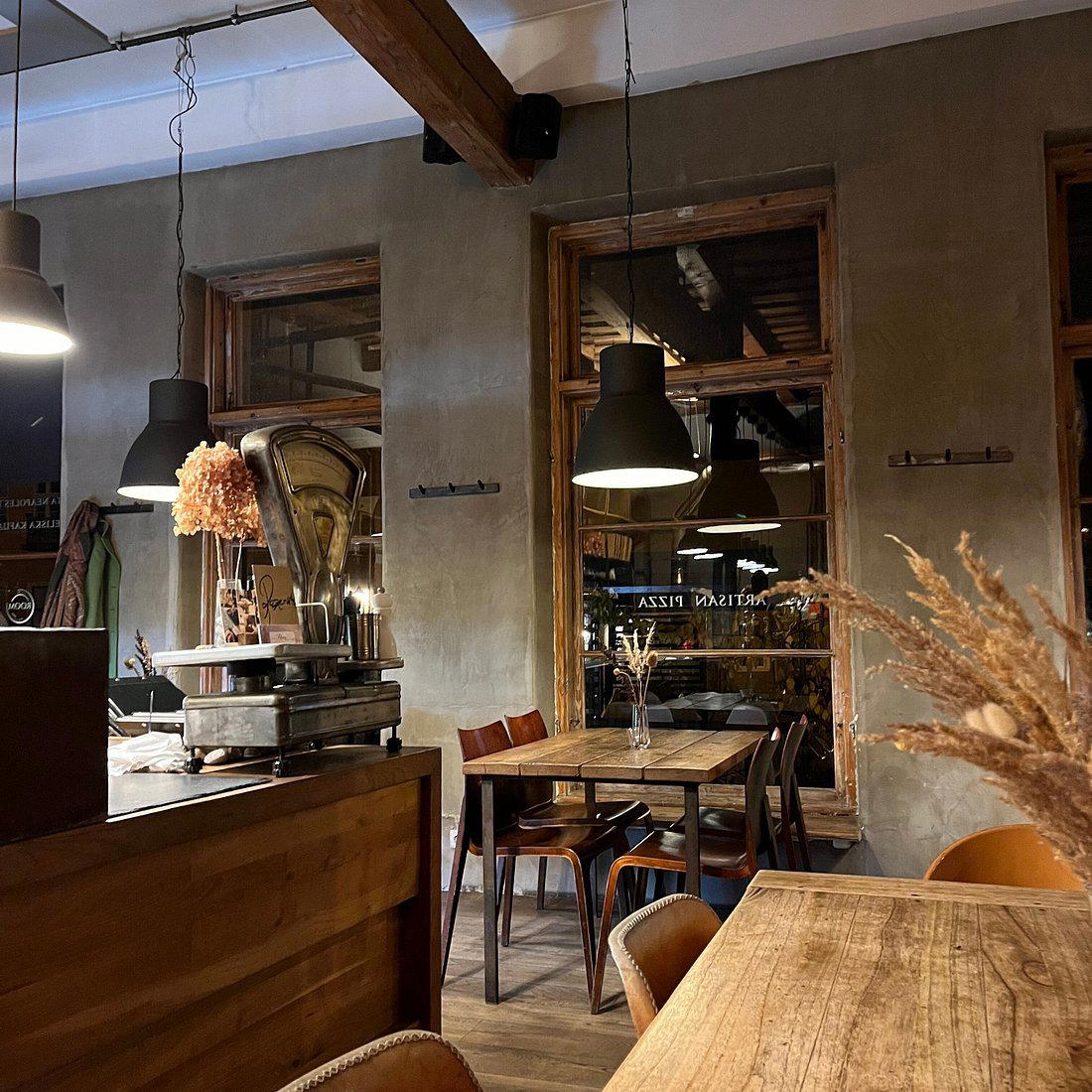
A Town That Earns Its Restaurant
Kuldīga occupies a position in Latvian travel that few small towns manage: genuinely visited for its own sake rather than as a waypoint. The UNESCO-listed waterfall, the intact baroque streetscape, the Venta river running below it all, these are the reasons people arrive, and they arrive with expectations that a certain kind of dinner will follow. Western Latvia's Courland region has its own culinary logic, built on cold-smoked fish, foraged greens, rye in several forms, and dairy produced at a scale that makes freshness the default rather than a talking point. Goldingen Room is a casual Italian, pizza and Mediterranean restaurant at Baznīcas iela 2 in Kuldīga, Latvia,876 reviews and an average price of about $15 per person. It operates inside that logic rather than in spite of it.
The address is not incidental. Baznīcas iela runs through the historic core, and arriving on foot from the main square takes minutes. The building sits in the company of Kuldīga's preserved merchant architecture, which sets a physical register before you have reached the door. In a town of this scale, a restaurant's physical placement says something about its ambitions, and this one announces itself as part of the fabric rather than a destination dropped in from elsewhere.
What Courland Puts on the Table
The ingredient argument for Courland cooking rests on geography. The region sits between the Baltic coast and the agricultural interior of western Latvia, which means access to both marine and land-based produce within distances that keep supply chains short. Baltic herring, pike, and eel have been processed and smoked in this corner of Latvia for centuries; the smoking traditions here predate any modern farm-to-table framing by generations. Alongside the fish culture, Courland's farming history produced a rye bread tradition that remains among the more distinctive in the Baltic states, dense and slightly sour, used as a base and a seasoning in equal measure.
For a restaurant positioned in Kuldīga's old town, working with these traditions is not a stylistic choice so much as a geographic condition. The same applies to foraged produce: the forests around the Venta valley yield mushrooms and berries through summer and autumn that appear in kitchens across the region, from village guesthouses to the more considered addresses. The difference between those tiers is what the kitchen does with the same raw material, and the Goldingen Room's placement in the town's dining hierarchy suggests it operates in the more deliberate half of that spectrum.
Latvia's wider fine-dining trajectory provides useful context. Riga has developed a cluster of serious kitchens over the past decade, including Max Cekot Kitchen in Rīga and Muusu in Riga, both operating at the €€€€ tier with menus that foreground Latvian and Baltic produce. Outside the capital, a smaller number of addresses have built comparable reputations in their own regions: H.E. Vanadziņš in Cēsis, Pavāru māja in Līgatne, and Akustika in Valmiera each demonstrate that serious cooking is not exclusively a Riga phenomenon. The Goldingen Room joins this geographic spread, extending it westward into Courland.
The Regional comparable set
Understanding where the restaurant sits requires a look at the broader Courland and western Latvian dining picture. Along the Baltic coast, addresses like MO in Liepaja and Albatross in Engure anchor a coastal cooking tradition that leans heavily on the sea. Inland, Nurmuiža Restaurant in Lauciene and ZOLTNERS in Tērvete frame the countryside manor-house and estate-kitchen model that has become a recognisable format in Latvian regional dining. Restorāns 1815 in Ligatne and Light House Jūrmala in Jurmala represent the resort-adjacent tier.
The restaurant in Kuldīga occupies a different position: an urban old-town address in a small historic city, rather than a coastal or countryside estate format. That placement creates a different kind of dining occasion, one where the architecture and street life of the town become part of the context. Internationally, the model of a small-city serious restaurant drawing on deep regional produce traditions has parallels in places as different as Atelier Moessmer Norbert Niederkofler in Brunico and Dal Pescatore in Runate, where the surrounding landscape functions as both supplier and reference point. The logic translates to Courland, even if the ingredients are entirely different.
Atmosphere and Format
Kuldīga's old town sets a particular register: stone and brick, a medieval street plan, the river close enough to feel rather than see. Restaurants in this kind of environment operate with a built-in seriousness that does not require theatrical interior design to reinforce it. The physical address on Baznīcas iela places the restaurant in the denser, more historical part of the town centre, which shapes the approach and pace appropriate to a visit. The format here rewards a slower, more deliberate engagement.
For an international comparison that captures the ingredient-sourcing discipline and small-city format, Le Bernardin in New York City and Lazy Bear in San Francisco show how seriously-considered sourcing functions as an editorial statement in its own right, regardless of geography. The principle applies equally in Kuldīga: when the surrounding region produces the ingredients on the plate, the menu becomes a document of place, not just a list of dishes. Atomix in New York City and Emeril's in New Orleans represent the other end of the scale spectrum, but the sourcing discipline connects across tiers.
Planning a Visit
Kuldīga is accessible by bus from Riga in roughly two and a half hours, and the town is compact enough to move entirely on foot once there. The restaurant's address on Baznīcas iela sits in the walkable historic centre, making it an obvious choice for an evening after time spent at the waterfall or along the Venta. Given that Kuldīga's tourism season concentrates in summer, when the town draws visitors for its festivals and landscape, dinner reservations at the more considered addresses are worth securing in advance during June through August. Shoulder season, particularly May and September, offers a quieter version of the town and typically easier access.
Quick Comparison
Comparable venues nearby, for context on price, style, and recognition.
| Venue | Cuisine | Price | Notes |
|---|---|---|---|
| Goldingen RoomThis venue — the venue you are viewing | Italian Pizza and Mediterranean | $$ | Not listed |
| Casa Nostra | Authentic Italian | $$ | Centrs |
| Piano | Latvian Seafood and European | $$ | Old Port |
| RIONE pizza&cocktails | Neapolitan Pizza & Cocktails | $$ | Centrs |
| Labietis | Latvian Craft Beer Taproom | $$ | Centrs |
| Tavs Banh-mi | Vietnamese Banh Mi & Pho | $ | Riga Center |
At a Glance
- Cozy
- Romantic
- Industrial
- Date Night
- Family
- Casual Hangout
- Terrace
- Open Kitchen
- Extensive Wine List
- Local Sourcing
- Street Scene
Current opening hours
- Monday
- 11 AM–8 PM
- Tuesday
- 11 AM–8 PM
- Wednesday
- 11 AM–8 PM
- Thursday
- 11 AM–8 PM
- Friday
- 11 AM–8 PM
- Saturday
- 11 AM–8 PM
- Sunday
- 11 AM–8 PM
Hours can change for holidays and private events. Last verified .
Industrial-romantic interior with atmospheric lighting, cozy atmosphere, and pleasant background music.