Goldie
.png)
Goldie occupies a long-standing hotel in the heart of Tábor's medieval centre, offering à la carte dining alongside four- and six-course tasting menus on Žižkov Square. The kitchen leans on Czech culinary tradition — kulajda mushroom soup, sturgeon, steak Rossini — while the summer terrace and bistro atmosphere make it one of the more considered dining options in South Bohemia. A wallet-friendly lunch menu broadens access without diluting the evening format.
 Discover on Pearl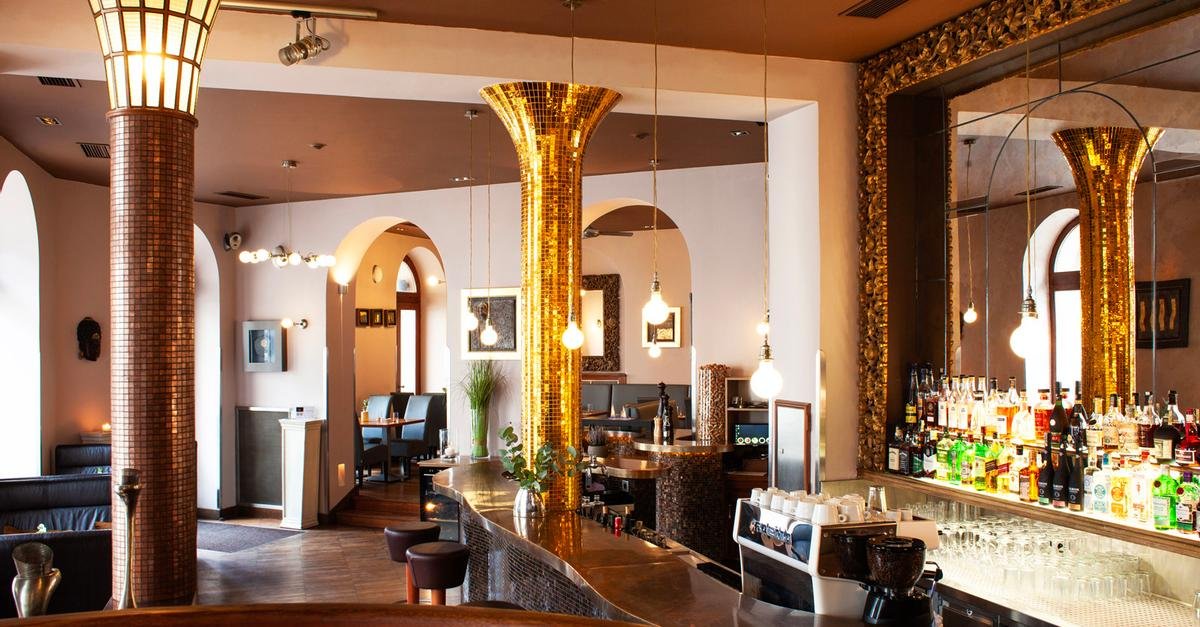
Dining on Žižkov Square: What Goldie Tells You About Tábor's Restaurant Scene
Tábor is not a city that announces itself through dining. South Bohemia's most historically charged town, built by Hussite radicals in the fifteenth century around a deliberate, labyrinthine street plan, has long been visited for its architecture and underground passages rather than its kitchens. That context matters when reading Goldie, the restaurant inside Hotel Nautilus on Žižkov Square, because it positions the venue correctly: this is not a restaurant that exists because Tábor has a dining scene. It exists, in part, to help create one.
The square itself sets the register. Žižkovo Náměstí is one of the more intact medieval market squares in the Czech Republic, framed by Gothic and Renaissance facades and anchored by the equestrian statue of Jan Žižka. Arriving at Goldie means arriving through that backdrop, and the room takes its cues accordingly. The atmosphere lands somewhere between historical weight and restrained modernity — described consistently as a sophisticated bistro that balances the charm of an older era with a degree of contemporary glamour. It is an atmosphere common to Central European hotel restaurants that have been thoughtfully preserved rather than renovated into generic neutrality.
The shortlist, unlocked.
Hard-to-book tables, cellar releases, and concierge-planned trips.
Get Exclusive Access →The Menu Architecture: Flexibility as a Signal of Ambition
Czech provincial dining has historically operated on fixed menus with limited variation, a legacy of both socialist-era catering culture and the practical realities of small-town supply chains. The more ambitious provincial restaurants of the past decade have pushed back against this with tasting menu formats borrowed from urban fine dining. Goldie sits in that intermediate space, offering a structure that gives diners genuine choice without abandoning the tasting menu format entirely.
The options run from à la carte through four- and six-course tasting menus, with a four-course vegetarian variant running alongside the main progression. That vegetarian option is worth noting as a signal of kitchen intent: in a regional Czech context, where meat-centred cooking remains the norm and vegetarian menus are still frequently an afterthought, building a dedicated vegetarian tasting route suggests a kitchen thinking about ingredient range rather than simply swapping proteins. A separate lunch menu, described as wallet-friendly, operates at a lower price point and widens access beyond the evening tasting format.
Ingredient Logic: Sturgeon, Kulajda, and the Sourcing Subtext
The kitchen's signature dishes point toward a sourcing philosophy that connects South Bohemia's agricultural identity to the plate. Sturgeon, listed as part of the "Sturgeon & Umami" dish, is not an arbitrary choice. Bohemia has a documented tradition of freshwater fish farming stretching back to the medieval period, with carp ponds across the South Bohemian region supplying both local kitchens and export markets for centuries. Sturgeon farming has expanded in Central Europe in recent decades as aquaculture operations seek alternatives to wild-caught fish, and a kitchen in this part of the country has logical access to domestically farmed product. Pairing sturgeon with umami signals an awareness of how Czech freshwater traditions can be reframed through contemporary technique without abandoning their regional foundation.
Kulajda, the traditional Czech mushroom soup with cream, dill, and egg, functions differently on the menu. It is not a reinterpretation or a technical exercise — it is a statement of regional continuity. Kulajda is one of the dishes most closely associated with South Bohemian cooking, a preparation that varies by household and by season depending on which mushrooms are available. Serving it in a tasting menu context, alongside a dish as technically named as "Sturgeon & Umami", indicates a kitchen that reads its Czech identity as an asset rather than a constraint. For comparison, La Degustation Bohême Bourgeoise in Prague has built a Michelin-starred format around a similar tension between Czech culinary heritage and fine dining ambition, though at a price point and formality that places it in a different category entirely. Goldie operates without that kind of institutional recognition but works from an analogous premise at smaller scale and lower register.
The fillet steak Rossini rounds out the signature trio. Rossini preparations, classically involving foie gras and truffle, belong to a French-inflected Central European tradition of luxury cooking that has never fully left the region's hotel restaurants. Its presence alongside kulajda is not a contradiction , it reflects the layered culinary inheritance of Czech fine dining, where French technique and local tradition have coexisted since the Austro-Hungarian period. Restaurants such as Chapelle in Písek and Bohém in Litomyšl represent similar provincial ambitions in the broader South and East Bohemian region, each working within the same tradition of locally grounded cooking with a European technical vocabulary.
Summer on the Square: The Terrace Equation
The terrace giving onto Žižkov Square is the room's seasonal trump card. Dining in a medieval square is a different proposition from dining inside one: the visual and atmospheric context changes the experience in ways that a well-designed interior cannot replicate. In summer, the terrace functions as the reason to time a visit specifically, rather than treating the restaurant as a year-round default. That seasonal specificity is a logistical consideration worth factoring into any planning. The indoor bistro atmosphere holds its own in cooler months, but the terrace converts a solid provincial dinner into something with a more distinct sense of place.
How Goldie Fits the Tábor Visit
Tábor's historical appeal is architectural and subterranean: the old town above ground and the network of medieval tunnels and passages beneath it. The restaurant's location on Žižkov Square means it sits inside the itinerary rather than requiring a detour. Dinner at Goldie connects naturally to an afternoon spent in the passages or climbing the tower of the Church of the Transfiguration of Our Lord , the city's labyrinth of alleys, underground routes, and historical buildings is one of the more absorbing half-days available in any Czech provincial town.
For a broader picture of where Goldie sits within Tábor's hospitality options, our full Tábor restaurants guide maps the dining scene in detail, while our Tábor hotels guide, bars guide, wineries guide, and experiences guide cover the full range of what the city offers. For those building a South Bohemia itinerary that extends beyond Tábor, the provincial dining circuit includes Chapelle in Písek and Babiččina zahrada in Průhonice, while further afield, Entrée in Olomouc, ATELIER bar & bistro in Brno, Cattaleya in Čeladná, ARRIGŌ in Děčín, Dvůr Perlová voda in Budyně nad Ohří, ESSENS in Hlohovec, and Grandrestaurant Pupp in Karlovy Vary represent the wider Czech provincial fine dining circuit. For international reference points in structured tasting menu formats, Atomix in New York City and Le Bernardin in New York City illustrate how the tasting menu format operates at its most developed end of the spectrum.
Goldie is located at Žižkovo Náměstí 20, on the main square of Tábor's old town, within Hotel Nautilus. The lunch menu provides an accessible entry point for visitors passing through on a day trip; the tasting menu formats are better suited to an evening when the square has quietened and the bistro atmosphere can be taken at full pace.
The shortlist, unlocked.
Hard-to-book tables, cellar releases, and concierge-planned trips.
Get Exclusive Access →Frequently Asked Questions
Side-by-Side Snapshot
These are the closest comparables we have in our database for quick context.
| Venue | Cuisine | Price | Awards | Notes |
|---|---|---|---|---|
| Goldie | This restaurant housed in the long-standing hotel Nautilus, right in the histori… | This venue | ||
| La Degustation Bohême Bourgeoise | French-Czech | €€€€ | Michelin 1 Star | French-Czech, €€€€ |
| Alcron | Modern European | Modern European | ||
| Benjamin | Modern Cuisine | €€€ | Modern Cuisine, €€€ | |
| Café Imperial | Traditional Cuisine | €€ | Traditional Cuisine, €€ | |
| Dejvická 34 by Tomáš Černý | Italian | €€ | Italian, €€ |
Need a table?
Our members enjoy priority alerts and concierge-led booking support for the world's most difficult tables.
Get Exclusive AccessThe shortlist, unlocked.
Hard-to-book tables, cellar releases, and concierge-planned trips.
Get Exclusive Access →