
Gaustablikk sits at the foot of Mount Gausta in Rjukan, a Norwegian valley town that sees no direct sunlight for five months of the year. Recognised by Star Wine List with a White Star award in 2023, the restaurant operates in a setting where the surrounding mountain terrain shapes both the menu and the wine program. For visitors making the journey to Telemark, it earns its place in the itinerary.
Pearl is the En Primeur Club membership app — saves, bookings, and concierge access live there. Same editors, same standards.
- Address
- Kvitåvatnvegen, 3660 Rjukan, Norway
- Phone
- +47 35 09 14 22
- Website
- gaustablikk.no
- Directions
- Get directions
 Saves & bookings on Pearl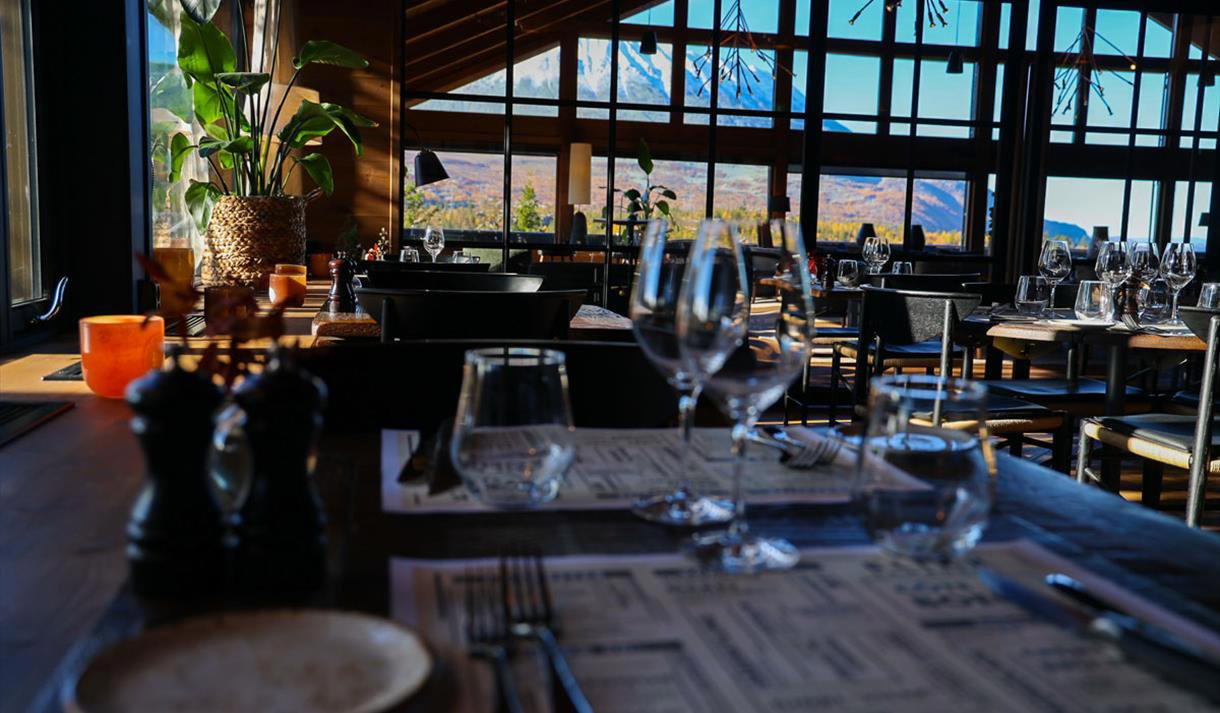
Where the Mountain Dictates the Menu
Rjukan sits in the Vestfjord valley floor, flanked by sheer cliffs that block direct sunlight from late September to mid-March. The town is so dramatically shaded that mirrors were installed on the surrounding hillsides in 2013 to redirect sunlight into the main square, a practical intervention that tells you everything about the relationship between this place and its geography. Gaustablikk, positioned along Kvitåvatnvegen with views toward Gaustatoppen (Norway's most-climbed mountain at 1,883 metres), operates squarely inside that relationship. The physical environment is not background here; it is the primary condition shaping what ends up on the plate and in the glass.
Norwegian mountain restaurants generally split into two categories: those that trade on scenery and deliver little else, and those that treat their remote position as a sourcing advantage. Gaustablikk belongs to the second group. The Telemark region surrounding Rjukan is one of Norway's more underexplored food territories, lamb and cattle graze at altitude, freshwater fish come from cold, clean lakes, and foraging terrain extends across protected highland that sees minimal agricultural pressure. These are conditions that, in other parts of Norway, have underpinned serious kitchen programs. The question for any mountain kitchen is how that geography shapes the menu.
The Wine Program and the White Star
In July 2023, Star Wine List published Gaustablikk as a White Star property, a recognition that places it within a relatively small cohort of Norwegian restaurants where the wine list warrants serious attention. Star Wine List's White Star designation signals a curated, quality-led program rather than a perfunctory selection, and in a country where import duties push wine prices well above European equivalents, a credible wine list in a remote mountain setting is a meaningful editorial commitment.
For context on what that positioning means: the Norwegian restaurants that regularly appear in the upper tier of the country's wine recognition include addresses in Oslo, Stavanger, and Bergen, cities with established fine dining infrastructure. Finding a White Star property in Rjukan, a town of fewer than 3,000 people that most international visitors know primarily as the base for UNESCO-listed industrial heritage and mountain hiking, is an anomaly worth noting. It suggests a kitchen and front-of-house operation with ambitions that exceed what the postcode might imply.
Norway's broader fine dining circuit operates at the €€€€ tier with New Nordic frameworks that emphasise hyper-local sourcing, fermentation, and minimal intervention. Gaustablikk does not operate at that price point or with that level of Michelin scrutiny, but the White Star credential positions its wine program alongside properties that take the broader table experience seriously. It is closer in spirit to Iris in Rosendal or Kvitnes Gård in Kvitnes, smaller, destination-specific properties where the setting does genuine work on the guest experience rather than simply serving as backdrop.
Sourcing in Telemark: Why Provenance Matters Here
The ingredient logic in this part of Norway is distinct from the coastal sourcing that drives kitchens in Bergen or Ålesund. Telemark's larder is a highland one: game, lamb, dairy from grazing animals, cold-water trout and char from mountain lakes, and a foraging calendar that runs from early spring fungi through late-autumn berries. These are not niche ingredients available only to well-connected chefs, they are the historical diet of the valley, and they remain genuinely local in a way that urban restaurants sourcing from across the country cannot replicate.
Mountain-sourced lamb in Norway, particularly from Telemark and the surrounding regions, carries a flavour profile shaped by heather and highland grass that differs measurably from lowland-raised animals. Cold freshwater fish from high-altitude lakes have a density and clean flavour that makes them behave differently in the kitchen than farmed equivalents. Any kitchen in this location that is paying attention to its supply chain has access to ingredients that city restaurants would pay a premium to obtain. The conditions for serious ingredient sourcing are present in a way that is worth noting for anyone planning the trip.
Getting to Rjukan, and Where Gaustablikk Sits in the Visit
Rjukan is roughly 180 kilometres west of Oslo, reachable by car in under three hours via the E134. There is no train service to the town; the journey requires either a private vehicle or a bus connection from Notodden or Kongsberg. That relative inaccessibility is part of what defines the visitor profile, people who come to Rjukan are there deliberately, either for the UNESCO Industrial Heritage Site (the Vemork hydroelectric plant and its connection to the Second World War heavy water sabotage), for skiing and hiking on Gaustatoppen, or increasingly for the kind of considered regional experience that requires effort to reach.
Gaustablikk's address on Kvitåvatnvegen places it toward the mountain rather than in the town centre, making it a natural anchor for visitors staying on that side of the valley.
Norway's remote dining circuit, which includes properties like Under in Lindesnes, Conservatory in Norangsfjorden, and Huset Restaurant in Longyearbyen, has established that remoteness itself can be a hospitality proposition rather than a drawback. Gaustablikk operates in that same logic: the effort required to reach Rjukan recalibrates what a good meal means. When the nearest comparable wine-listed property requires a multi-hour drive, the White Star carries weight.
A Quick Peer Check
Comparable venues nearby, for context on price, style, and recognition.
| Venue | Cuisine | Price | Notes |
|---|---|---|---|
| GaustablikkThis venue — the venue you are viewing | Modern Nordic Brasserie | $$$ | Not listed |
| Territoriet | Wine Bar with Light Fare | $$$ | Enerhaugen |
| Tolvte og Kranen | European Bistro with Norwegian Flair | $$$ | St. Hanshaugen |
| Brasserie Posten | Norwegian Brasserie | $$$ | Geiranger sentrum |
| Vianvang | Norwegian Mountain Gastronomy | $$$ | Vågå |
| Grand Café | Modern Nordic Brasserie | $$$$ | Vika |
Recognition history
Dated appearances from independent guides and award organizations, with the underlying list record or original source where available.
Star Wine List
Star Wine List
At a Glance
- Cozy
- Scenic
- Rustic
- Relaxed
- Special Occasion
- Family
- Group Dining
- Panoramic View
- Hotel Restaurant
- Extensive Wine List
- Sommelier Led
- Local Sourcing
- Mountain
Cozy and relaxed mountain atmosphere with warm wood interiors, fireside seating, and large windows framing spectacular mountain vistas.