Farmer Boys
Our verdict
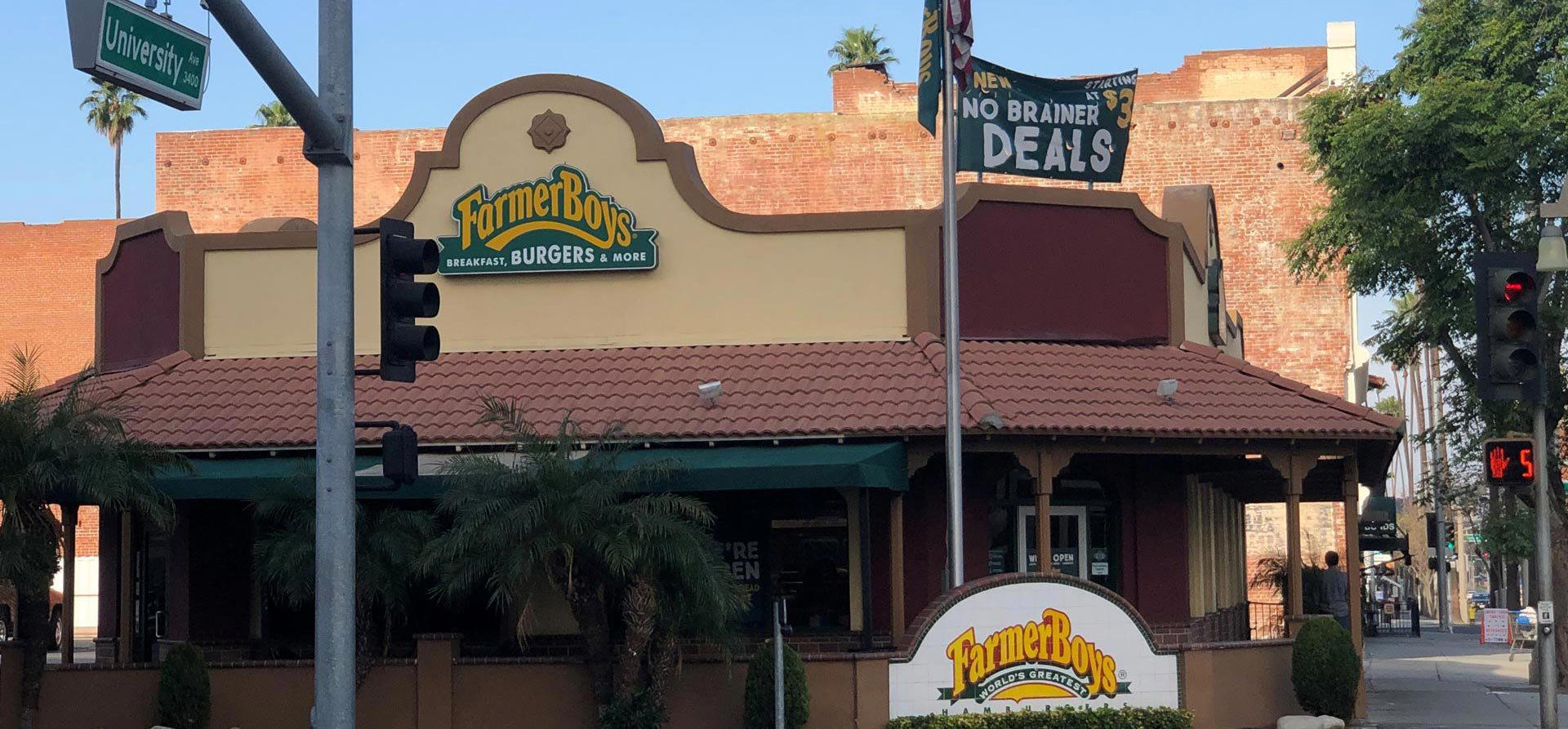
Farmer Boys at 3400 University Ave is a California-rooted burger and comfort-food chain with a strong Riverside presence, drawing students, commuters, and families along the University Avenue corridor. The menu centers on made-to-order burgers, breakfast staples, and farm-themed sides that position it firmly in the fast-casual tier. For a wider view of Riverside dining, see our full city guide.

Pearl is the En Primeur Club membership app — saves, bookings, and concierge access live there. Same editors, same standards.
The menu
What to order
- Farmer's Burger
- Farmer’s Chopped Cobb Salad
- Big Cheese
University Avenue and the Fast-Casual Tradition in the Inland Empire
University Avenue in Riverside functions as one of those corridor streets that tells you exactly where a city's everyday eating culture lives. Flanked by UC Riverside on one end and a dense mix of commuter traffic on the other, the strip has long supported a range of quick-service and fast-casual formats that serve students, hospital workers, and families rather than destination diners. Farmer Boys, at 3400 University Ave, fits that pattern precisely. It occupies a tier of California dining that rarely appears in editorial coverage but accounts for the majority of meals eaten in inland Southern California on any given weekday.
The Farmer Boys brand has operated across California and Nevada for decades, and its positioning has always leaned into an agricultural identity that differentiates it from generic burger chains. The name itself signals something: a claim to farm provenance, to freshness, to a connection with California's Central Valley agricultural heritage. Whether that claim holds up to scrutiny matters less than the fact that it shapes the menu philosophy, which runs to made-to-order burgers, all-day breakfast, and sides that sit closer to a diner's output than a fast-food assembly line. In the Inland Empire, where the distance between a meal and its agricultural source can feel abstract, that framing carries a certain local resonance.
Where Farmer Boys Sits in Riverside's Dining Spectrum
Riverside's restaurant scene spans a wider range than its size might suggest. On the higher end, Duane's Prime Steaks & Seafood and Le Chat Noir French Restaurant occupy a formal dining tier that serves the city's special-occasion market. The middle register includes spots like Monark Asian Bistro and The Chew Chew, which offer more casual environments with a distinct point of view. Further down the street, Angels Tijuana Tacos represents the taqueria tradition that runs deep through Southern California's fast-food culture.
Farmer Boys occupies its own band in this spectrum: the fast-casual segment that prices below sit-down restaurants but operates with a broader menu than a pure quick-service chain. That middle position is increasingly competitive in California, where regional chains with agricultural or farm-to-table framing have multiplied over the past two decades. The format works because it answers a specific demand: something faster than a full restaurant, more considered than a drive-through, and priced accessibly enough for repeat visits.
For context on how this compares to the upper tier of American dining, the gap is substantial. Restaurants like The French Laundry in Napa, Le Bernardin in New York City, or Providence in Los Angeles operate in a fundamentally different register, where tasting menus, sourcing transparency, and culinary credentials define the proposition. Regionally, Addison in San Diego represents what the Southern California fine-dining ceiling looks like. Farmer Boys makes no claim to compete in those categories, and that clarity of positioning is part of what makes it functional for its actual audience.
The Cultural Roots of California's Farm-Themed Burger Tradition
California's agricultural identity has long been co-opted by its food service industry, sometimes sincerely, sometimes superficially. The Central Valley produces a significant share of the country's fruits, vegetables, and dairy, and that proximity has influenced how chains operating in the state present themselves. The farm aesthetic, whether expressed through barn-wood interiors, imagery of produce, or menu language about freshness, taps into a real cultural current even when the supply chain behind it is largely conventional.
Farmer Boys sits within that tradition. The chain's origins in Perris, California, in the 1980s connect it geographically to the same Inland Empire region where this Riverside location operates, giving it a local-origin story that national burger chains cannot replicate. That regional rootedness matters to a segment of the Southern California customer base that applies some version of a buy-local preference even in the fast-casual tier. It is a different expression of the same impulse that drives farm-to-table rhetoric at the fine-dining level, scaled down and priced for daily use.
Comparable regional formats exist across the American West. In the Pacific Northwest, similar chains frame burgers through a Pacific agricultural lens. In Texas, ranch heritage plays a parallel role. What distinguishes California's version is the breadth of the agricultural claim: citrus, avocado, dairy, and grain all fall within the state's production scope, giving chains like Farmer Boys a wider pantry to reference, at least rhetorically. For a broader look at how farm-driven sourcing operates at the highest level, Blue Hill at Stone Barns in Tarrytown and Single Thread Farm in Healdsburg represent the category's apex, where sourcing is documented rather than implied.
Planning a Visit to Farmer Boys on University Avenue
The University Avenue location serves a high-traffic corridor that runs between UC Riverside and downtown. Visit timing depends on what you are trying to avoid: the lunch window draws students and nearby office workers, while the breakfast period tends to be quieter. Farmer Boys' all-day breakfast offering is one of its functional differentiators from comparable burger-focused chains, giving early visitors a full-menu option rather than a restricted morning slate. Because this is a fast-casual format with counter or drive-through service, reservations are not part of the format, and turnaround times are typically fast enough to make it a practical stop rather than a planned sit-down occasion.
For visitors building a broader Riverside itinerary, the University Ave location makes sense as a quick stop rather than an anchor. Those seeking a longer evening experience should look at the sit-down options covered in our full Riverside restaurants guide. Elsewhere on the EP Club platform, Lazy Bear in San Francisco, Smyth in Chicago, Emeril's in New Orleans, Atomix in New York City, The Inn at Little Washington, and Atelier Moessmer Norbert Niederkofler in Brunico represent the kinds of experiences that anchor a longer dining itinerary when the occasion demands it.
Frequently asked questions
Is Farmer Boys good for families?
The fast-casual format at 3400 University Ave suits families practically: ordering is straightforward at the counter, the menu covers enough ground to accommodate different preferences within the same visit, and the pace keeps things moving. It sits in a price tier accessible to most family budgets along the University Avenue corridor in Riverside.
What is the atmosphere like at Farmer Boys?
The University Avenue location operates in a high-traffic fast-casual environment consistent with the brand's Southern California footprint. The corridor runs between UC Riverside and downtown, so the dining room draws a mix of students, commuters, and local regulars depending on the time of day. Expect counter service and a functional dining room rather than table service.
How does Farmer Boys on University Avenue compare to other fast-casual options near UC Riverside?
Among fast-casual spots along the University Ave corridor in Riverside, Farmer Boys occupies a distinct position through its farm-themed California identity and made-to-order production format, which separates it from national chains operating on a pre-assembled model. The location at 3400 University Ave places it directly in the path of the UC Riverside student population as well as downtown-bound traffic, giving it a dual audience that most single-concept competitors along the strip do not share.
What should I eat at Farmer Boys?
The menu centers on made-to-order burgers and all-day breakfast, which are the format's primary draws relative to comparable quick-service options along University Ave. Both categories are produced to order rather than held under heat lamps, which puts Farmer Boys a step above standard drive-through chains in the same Riverside price tier.
Cost Snapshot
| Venue | Cuisine | Price | Notes |
|---|---|---|---|
| Farmer BoysThis venue (the venue you are viewing) | American Fast-Casual Farm-Fresh | $10–20 | Not listed |
| Angels Tijuana Tacos | Tijuana-style Tacos | $10–20 | Mexican Tijuana |
| Duane's Prime Steaks & Seafood | Prime Steaks & Seafood | $50–100 | Not listed |
| Le Chat Noir French Restaurant | Classic French Bistro | $50–100 | Not listed |
| Monark Asian Bistro | Chinese-Thai-Asian Fusion | $20–30 | Not listed |
| The Chew Chew | Contemporary American Grill | $30–50 | Not listed |
Continue exploring
More in Riverside
Restaurants in Riverside
All restaurants in Riverside →
Bars in Riverside
All bars in Riverside →
Hotels in Riverside
All hotels in Riverside →

Wineries in Riverside
Browse all →
Details
- Family
- Casual Hangout
- Brunch
- Local Sourcing
- A La Carte
- Vegetarian Friendly
Current opening hours
- Monday
- 6 AM–10 PM
- Tuesday
- 6 AM–10 PM
- Wednesday
- 6 AM–10 PM
- Thursday
- 6 AM–10 PM
- Friday
- 6 AM–10 PM
- Saturday
- 7 AM–10 PM
- Sunday
- 7 AM–10 PM
Hours can change for holidays and private events. Last verified .
Bright, casual fast-food atmosphere with focus on fresh, hearty meals.