村姑铁锅炖
Our verdict
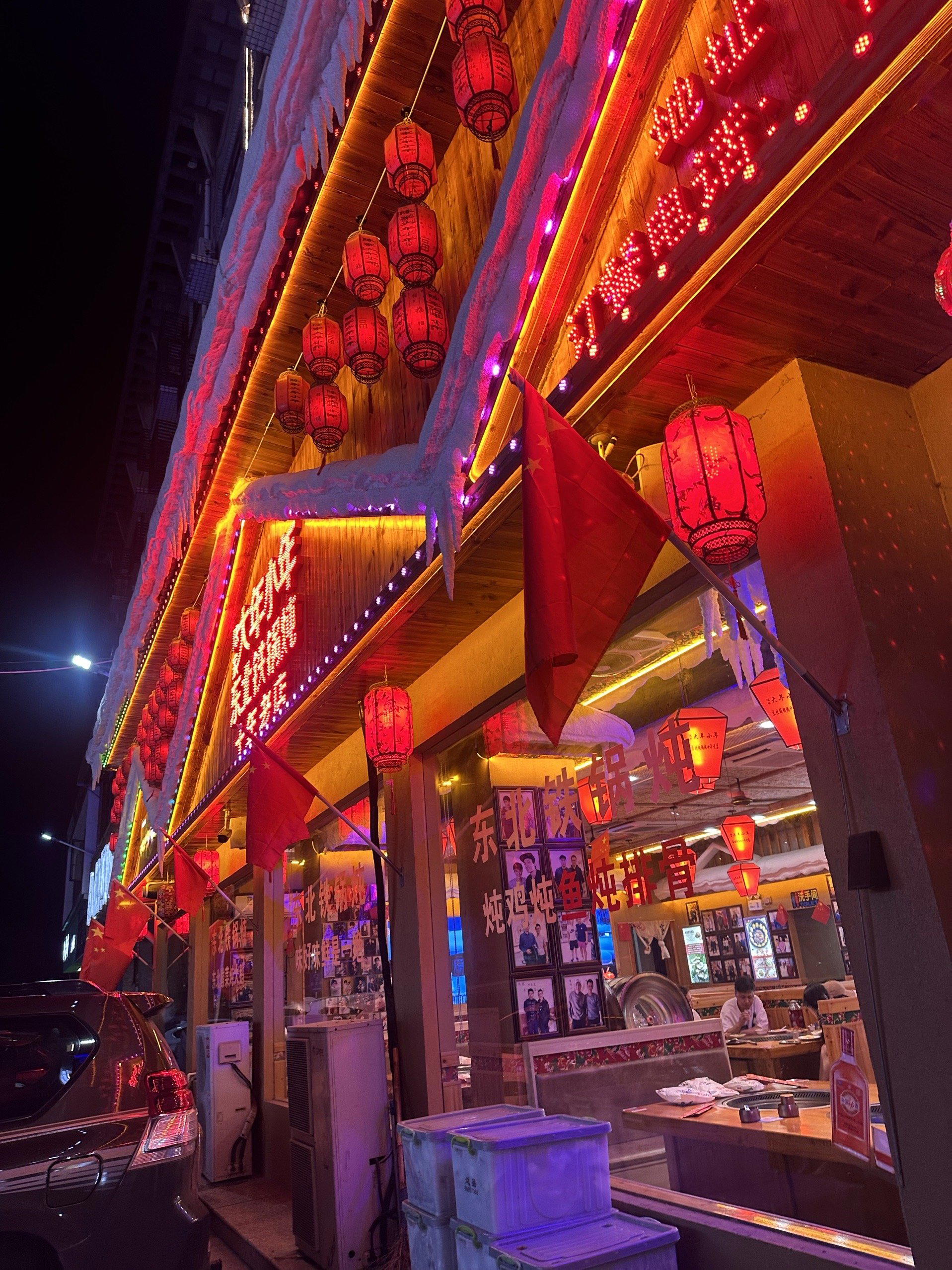
In Da Hinggan Ling, where winters push temperatures below -30°C and the Daxing'anling forests define what ends up on the plate, 村姑铁锅炖 represents the slow-braised, iron-pot cooking tradition that the region has practised for generations. The format centres on communal, long-cooked stews built from local produce, placing it squarely in northeastern China's hearty, ingredient-led cooking canon. For visitors coming through this remote corner of Heilongjiang, it is a reference point for understanding how extreme geography shapes a cuisine.

Pearl is the En Primeur Club membership app, where members save venues, book tables and use the concierge.
The menu
What to order
- 铁锅炖排骨 (iron pot stewed pork ribs)
- 铁锅炖鱼 (iron pot stewed fish)
- 小鸡炖蘑菇 (chicken with wild mushrooms)
- 杀猪烩菜 (braised pork with sauerkraut and blood sausage)
Where the Forest Meets the Fire: Iron-Pot Cooking in Daxing'anling
Arrive in Da Hinggan Ling by air or by train from Harbin and the landscape makes the food comprehensible before you have eaten a single bite. The Daxing'anling range, covering roughly 830,000 square kilometres of boreal forest, produces the conditions that define northeastern Chinese cooking: long, severe winters, short growing seasons, and a larder stocked with foraged mushrooms, wild game, river fish, and root vegetables preserved against the cold. This is not a cuisine that emerged from abundance in the conventional sense. It emerged from necessity, and the iron pot, or tieguodun, is its most honest expression.
Tieguodun, the slow-braised stew cooked and served in a cast-iron vessel over direct heat, is among the most deeply rooted formats in Dongbei (northeastern Chinese) cooking. The principle is simple and practical: tough cuts, foraged ingredients, and whatever the season offers are combined with minimal intervention and cooked low and slow until the braising liquid reduces into something dense and savoury.
Ingredient Sourcing in an Extreme Climate
The sourcing argument in Da Hinggan Ling is not one of artisanal curation in the way a farm-to-table programme in, say, Hangzhou or Suzhou might frame it. See how venues like Ru Yuan in Hangzhou and Dingshan·Jiangyan (Xiangcheng) in Suzhou operate in regions where produce supply is consistent and varied year-round. In Daxing'anling, sourcing is shaped by altitude, latitude, and season in ways those kitchens rarely confront. Wild mushrooms, including the prized matsutake-adjacent varieties found in northern Heilongjiang's pine forests, are available for a brief window in late summer and early autumn. River fish from the tributaries of the Amur basin, including species rarely seen on menus further south, carry a different texture and fat profile from farmed equivalents. Wild boar, pheasant, and other game animals remain part of the regional larder in ways that have largely disappeared from urban Dongbei cooking.
This is the material context for a restaurant like 村姑铁锅炖 on Tongjiang Street. The name itself, which translates loosely as Village Girl Iron Pot Stew, positions the cooking in the rural, homestyle register of the region rather than in the more polished bracket of city-facing Dongbei restaurants. That positioning is honest: the iron pot format is a farmhouse cooking tradition, and venues that execute it well in the places where it originated carry a different kind of authority from urban interpretations.
The Format and What It Signals
Tieguodun cooking as practised in Heilongjiang differs from the refined tasting formats that populate much of EP Club's China coverage. Contrast the single-ingredient focus and measured plating at venues like Xin Rong Ji (Xinyuan South Road) in Beijing or the Nikkei-inflected precision at 102 House in Shanghai with what tieguodun actually demands of a diner: patience, appetite, and willingness to eat from a shared vessel at the table. The iron pot arrives still bubbling, the steam carrying the smell of soy, star anise, dried chilli, and whatever protein or forage has gone in. There is no separation of courses in the conventional sense. Everything comes at once and is meant to be eaten over time as the flavours deepen.
For visitors comparing notes across China's broader dining scene, or those who have spent time with the coastal and southern cooking at venues like Jiangnan Wok·Rong in Fuzhou, Fleurs Et Festin in Xiamen, or Shang Palace in Yangzhou, tieguodun represents a structural break from the lightness and precision those regions prize. Dongbei cooking uses fat and salt as functional tools, not just flavour agents, because the winters demanded it. That is not a limitation. It is a logic.
Da Hinggan Ling's Dining Position
Da Hinggan Ling Prefecture sits at the northwestern edge of Heilongjiang, bordering Inner Mongolia and Russia. The city of Jagdaqi, the prefecture's administrative hub, has a small but coherent restaurant scene oriented around Dongbei comfort food, hotpot, and the lamb and mutton traditions that cross over from the Mongolian steppe to the west. Within that context, a tieguodun specialist sits in the mid-tier of local dining by price and format, operating alongside Heilongjiang staples like hand-pulled noodles. For comparison, 马木海兰州牛肉拉面馆 represents the city's noodle tradition, while 漠河北极村七掌柜齐市烤肉 covers the grilled meat format. Iron-pot stew occupies a distinct and seasonally weighted position: it is most coherent as a winter meal, which in this latitude means roughly October through April. For the broader Da Hinggan Ling dining picture, see our full Da Hinggan Ling restaurants guide.
This is not a cuisine that performs well against Michelin or 50 Best metrics, and it is not trying to. Its authority comes from geographical specificity and continuity of tradition, not from critical apparatus. For reference on what that critical apparatus looks like at the far other end of the spectrum, EP Club covers venues from Le Bernardin in New York City to Atomix in New York City, and the distance between those kitchens and a tieguodun pot in Heilongjiang is a useful measure of how wide the range of serious eating actually is.
Planning Your Visit
村姑铁锅炖 is located on Tongjiang Street in Da Hinggan Ling. Da Hinggan Ling is accessible via Jiagedaqi Airport, with connections from Harbin and Hailar; the prefecture is remote enough that most visitors are either in transit through the region or spending multiple days. Winter visits, when the tieguodun format is at its most contextually coherent, require appropriate preparation for temperatures that regularly reach -30°C or lower. The Tongjiang Street address places the restaurant in the city's accessible commercial zone, making it reachable on foot from the central hotel district.
Frequently asked questions
Where do I go for 村姑铁锅炖?
村姑铁锅炖 is located at Tongjiang Street, Da Hinggan Ling, 黑龙江, Da Hinggan Ling.
Is 村姑铁锅炖 a suitable stop for travellers passing through Da Hinggan Ling Prefecture?
Da Hinggan Ling's position at the northwestern edge of Heilongjiang, bordering Inner Mongolia and Russia, makes Tongjiang Street one of the few concentrated dining options in the prefecture's administrative centre. Tieguodun is an accessible format for travellers unfamiliar with Dongbei cuisine: the cooking is soy-braised and slow-built, without the strong fermented or offal notes that can challenge newcomers to northern Chinese food. For anyone moving through Jagdaqi by rail or air, the restaurant serves as a practical and regionally grounded meal stop.
What's the must-try dish at 村姑铁锅炖?
The restaurant's identity is built around tieguodun, the iron-pot braising tradition that defines winter eating across Heilongjiang. In this format, pork belly is typically slow-cooked with dried tofu, fermented vegetables, and soy-forward aromatics until the fat renders into the broth. The dish is a direct expression of Dongbei cold-climate cooking rather than a modernised interpretation of it.
Can I walk in to 村姑铁锅炖?
Da Hinggan Ling operates well outside the urban dining circuits where advance reservations are standard for mid-range restaurants. Venues on Tongjiang Street in this prefecture typically accommodate walk-ins, though arriving at peak meal times during colder months carries more risk given the region's limited dining options overall. Calling ahead is not possible through EP Club's confirmed database, so arriving early in the service window is the practical fallback.
What is 村姑铁锅炖 known for?
The restaurant is positioned within the tieguodun tradition that defines communal eating across Heilongjiang and the broader Dongbei region. The name itself signals the format: 村姑 (village girl) anchors the cooking in rural, unpretentious northeastern practice rather than urban refinement. Located on Tongjiang Street in Da Hinggan Ling, it represents one of the northernmost expressions of this stew tradition in China, shaped by an extreme sub-boreal climate and sourcing realities quite different from central Heilongjiang.
A Quick Peer Check
| Venue | Cuisine | Price | Awards | Notes |
|---|---|---|---|---|
| 村姑铁锅炖This venue (the venue you are viewing) | Northeast Chinese Iron Pot Stew | $10–20 | Not listed | Not listed |
| Fu He Hui | Modern Seasonal Vegetarian Fine Dining | $200–300 | 2 Michelin Stars · World's 50 Best #11 | Vegetarian |
| Aji | Asian Bistronomy (Nikkei Fusion) | $50–100 | 1 Michelin Star · Wine Spectator Best of Award of Excellence | Nikkei, Innovative |
| Five Foot Road | Modern Sichuan Fine Dining | Not listed | 1 Michelin Star · La Liste Top Restaurants | Sichuan |
| Jing | Modern French with Asian Influences | $300–500 | 1 Michelin Star · Black Pearl 1 Diamond | French Contemporary |
| Lai Heen | Michelin-Starred Cantonese | $50–100 | 1 Michelin Star · Forbes 5-Star | Cantonese |
Continue exploring
More in Da Hinggan Ling
Hotels in Da Hinggan Ling
All hotels in Da Hinggan Ling →
Details
- Rustic
- Cozy
- Lively
- Group Dining
- Casual Hangout
- Family
- Open Kitchen
- Local Sourcing
- Family Style
- Set Menu
- Local Beverages
Warm, family-style dining atmosphere with genuine Northeast Chinese hospitality; rustic and unpretentious setting focused on hearty, communal meals.