Our verdict
El Mictlan occupies a quietly significant address on Rue d'Aboukir in Paris's 2nd arrondissement, where the Sentier district's long history of creative reinvention provides the right backdrop for a Mexican dining concept operating well outside the French capital's dominant culinary tradition. The address alone places it at the intersection of two currents: the neighbourhood's appetite for the unconventional and Paris's slowly broadening interest in non-European cuisines with serious technical foundations.

Pearl is the En Primeur Club membership app, where members save venues, book tables and use the concierge.
The menu
What to order
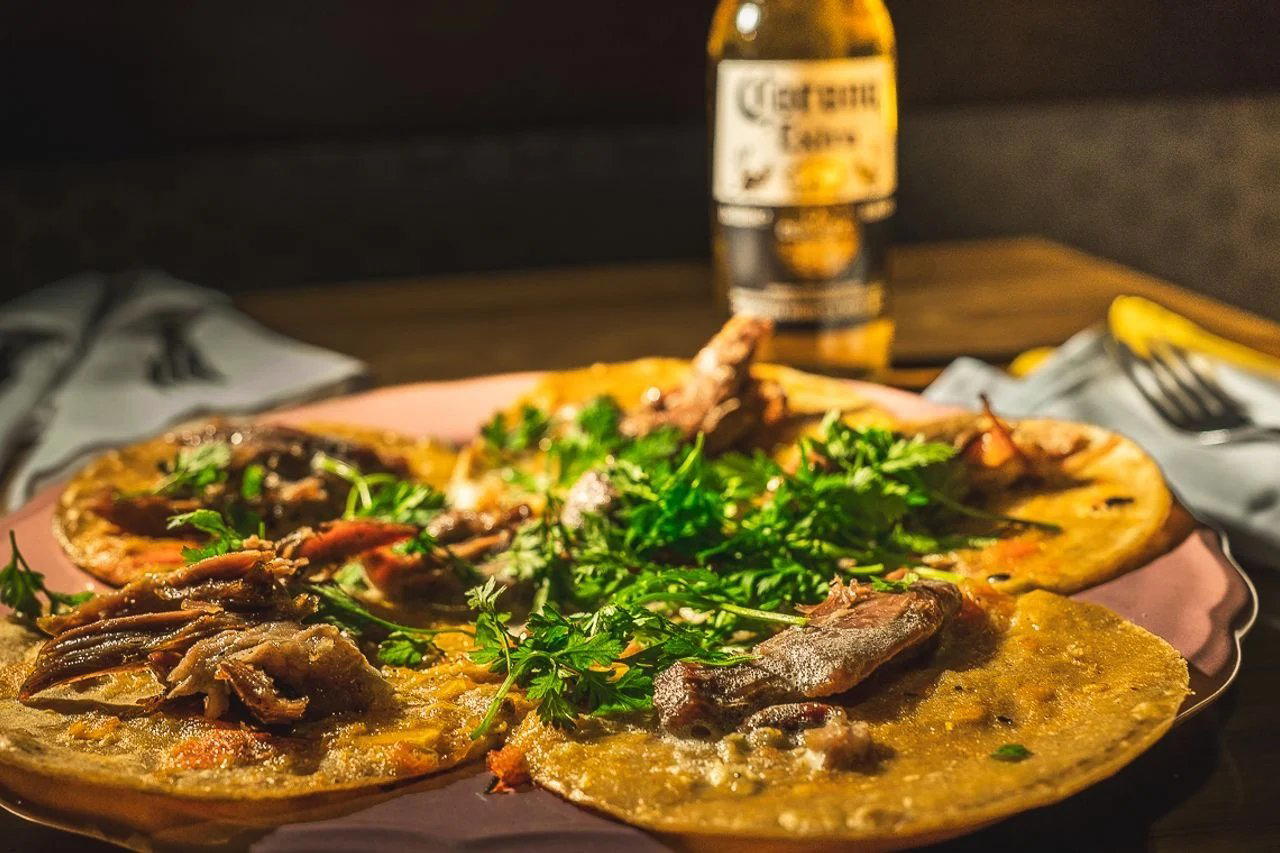
- Carnitas de Canard Confit
- Fondue Mexicaine
The 2nd Arrondissement and the Case for Mexican Dining in Paris
For most of its modern history, Paris has treated non-European cuisines as either tourist accommodation or ethnic-enclave dining, with very little space in between for something that takes its source tradition seriously. That has been changing, slowly but measurably, over the past decade. Japanese restaurants pushed the first significant crack in that wall, with counters like Kei showing how a foreign culinary vocabulary could earn Michelin recognition inside a city still largely defined by L'Ambroisie-style classicism and the high-concept modernism of Alléno Paris au Pavillon Ledoyen. Mexican cuisine has arrived later and with less institutional support, but the appetite for it among Parisian diners who have traveled widely or followed the global conversation around places like Mirazur and Le Bernardin is real and growing.
El Mictlan, addressed at 15 Rue d'Aboukir in the 2nd arrondissement, sits inside that emerging conversation. The Sentier neighbourhood has spent years repositioning from its textile-trade origins into a district defined by independent restaurants, creative studios, and the kind of foot traffic that comes from people actively looking for something different. It is not the obvious postcode for a destination dining address, that remains the 8th, where Le Cinq and Arpège anchor a more traditional fine-dining corridor, but it is precisely the kind of neighbourhood where a concept with roots outside the French canon can find an audience without the weight of institutional expectation pressing down on every decision.
What Keeps the Regulars Coming Back
Mexican cuisine carries a dual reputation in European cities: broadly loved as street food and poorly understood as a serious culinary tradition. The regulars at El Mictlan are not, by and large, people who stumbled in looking for tacos on a Tuesday. The clientele that builds loyalty at an address like this tends to be self-selecting, diners who have encountered Mexican cooking at a level beyond Tex-Mex shorthand, who know that the regional cuisines of Oaxaca, Yucatán, and Veracruz operate with a complexity of technique and ingredient sourcing that rivals anything produced in the more formally celebrated kitchens of Bras or Troisgros.
The unwritten menu at a restaurant like this is made up of the dishes regulars request without consulting a printed list, the timing knowledge that gets you a better table, and the accumulated sense of what the kitchen is proudest of on any given service. In Paris's Mexican dining tier, that kind of institutional memory tends to build around moles, the long-cooked sauce traditions that can involve thirty or more ingredients and days of preparation, and around the sourcing of ingredients that simply do not exist in standard French wholesale supply chains. Dried chilies, heirloom corn for handmade tortillas, epazote and hoja santa: these are not commodities available at Rungis. The restaurants that take them seriously either import with discipline or cultivate relationships with specialist suppliers, and the regulars know which approach is being taken.
The name El Mictlan references the Aztec underworld, a nine-level realm of the dead in Nahua cosmology, which signals an intent to operate with some cultural specificity rather than generic pan-Latin framing. Names carry weight in the way a restaurant positions itself to its earliest and most loyal guests, and this one belongs to a tradition of Mexican restaurants in European capitals that want to be understood on their own terms.
Rue d'Aboukir in Context
Address puts El Mictlan within reasonable reach of several transit options and in a part of the 2nd that has seen consistent restaurant openings over the past several years. Sentier rewards the visitor who arrives on foot from the Grands Boulevards or by Metro to Sentier or Bonne Nouvelle; the streets are narrow enough that discovering a restaurant here still carries the quality of a find rather than a pilgrimage to a known monument. That pedestrian intimacy is part of what allows a newer concept to build a loyal following before it enters the broader critical conversation.
For context on what the broader French dining tradition looks like at its most established, the regional anchors, Paul Bocuse, Auberge de l'Ill, Les Prés d'Eugénie, Georges Blanc, Flocons de Sel, Auberge du Vieux Puits, and La Table du Castellet, represent a culinary infrastructure built over generations. El Mictlan is doing something structurally different: importing a tradition rather than inheriting one. That is a harder position to hold in a city this attached to its own gastronomic identity, and it is part of what makes the project worth watching. For a broader survey of where Paris dining is moving, the EP Club Paris restaurants guide maps the full range. You can also see how the American independent dining model handles similar ambitions at Lazy Bear in San Francisco, where the format itself became a statement of intent.
Planning a Visit
El Mictlan is located at 15 Rue d'Aboukir, 75002 Paris, in the Sentier district of the 2nd arrondissement. Current booking details, hours, and pricing are best confirmed directly with the restaurant, as this information was not available at time of writing. The neighbourhood is well-served by public transit, with Metro lines placing it within a short walk of several stations along the Grands Boulevards axis. Given the size typical of independent restaurant addresses in this part of the 2nd, advance reservation is advisable, particularly for weekend services where the regulars tend to cluster.
Frequently asked questions
What part of town is El Mictlan in?
El Mictlan is located at 15 Rue d'Aboukir, 75002 Paris, France, Paris.
Is El Mictlan in Paris a good option for someone looking to understand Mexican cuisine beyond street food?
El Mictlan's placement in the 2nd arrondissement, a district where the dining conversation has shifted toward more considered independent restaurants, signals intent beyond casual Mexican fare. Paris has historically offered very limited serious treatment of Mexican culinary tradition outside of tourist-facing or enclave contexts, making an address like this one on Rue d'Aboukir worth attention for anyone looking beyond tacos and nachos.
What should I order at El Mictlan?
Specific menu details for El Mictlan are not published in advance, which is common for restaurants in the Sentier district that rotate offerings based on seasonal and sourced ingredients. The kitchen's focus, as reflected in the venue's positioning within the 2nd arrondissement's more considered dining scene, points toward preparations that treat Mexican culinary tradition seriously rather than as a simplified European approximation. Visiting without fixed expectations tends to serve guests better here than arriving with a particular dish in mind.
How hard is it to get a table at El Mictlan?
The Sentier area of the 2nd arrondissement has seen consistent restaurant demand in recent years, and smaller independent addresses in this part of Paris tend to fill midweek as well as on weekends. Checking in early in the week for later slots is a reasonable approach for first-time visitors.
Reputation First
Comparable venues nearby, for context on price, style, and recognition.
| Venue | Cuisine | Price | Notes |
|---|---|---|---|
| El MictlanThis venue (the venue you are viewing) | Mexican-French Fusion | Not listed | Not listed |
| Le Georges | Modern French Fusion with Rooftop Views | Not listed | 4th arrondissement |
| Monsieur George | Modern French Fine Dining | $150–200 | 8th Arr. |
| Nuna (Le Commandant Charcot) | Contemporary French Fine Dining by Alain Ducasse | Not listed | onboard Le Commandant Charcot |
| Sphère | Modern French Gastronomy with Japanese Influences | $100–150 | 8ème arrondissement |
| Écume | Modern French Seafood Counter | $50–100 | Batignolles |