
Star Wine List
Caves Legrand has operated as one of Paris's most serious wine institutions since the late 19th century, occupying a address inside the Galerie Vivienne in the 2nd arrondissement. Equal parts merchant, bar, and tasting destination, it draws collectors, sommeliers, and curious visitors who arrive for the cellar depth and stay for the atmosphere of the passage itself.

Pearl is the En Primeur Club membership app, where members save venues, book tables and use the concierge.
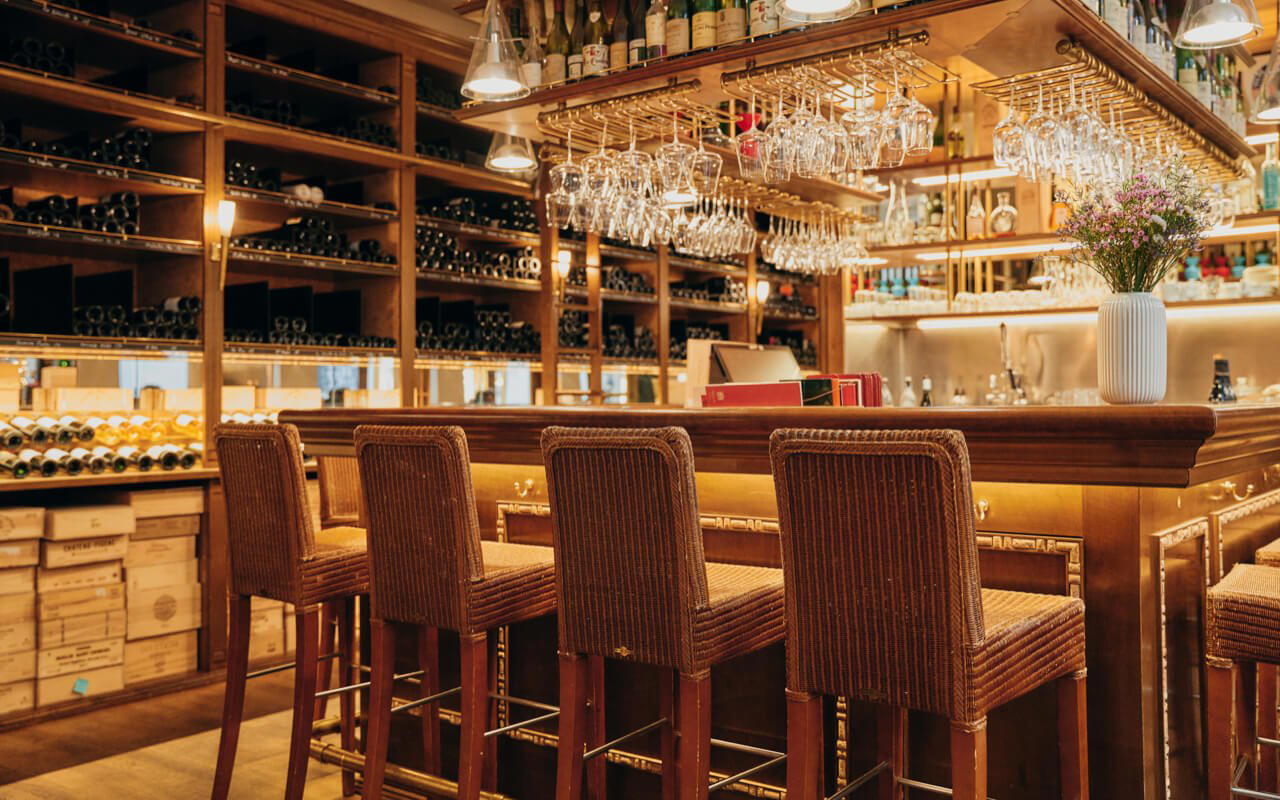
A Passage That Sets the Tone
Before you reach the bottles, the architecture does its work. Galerie Vivienne, one of the last surviving covered passages of 19th-century Paris, opens from Rue de la Banque in the 2nd arrondissement with mosaic floors, glass-vaulted ceilings, and a quality of diffused afternoon light that most purpose-built wine destinations would struggle to engineer. Caves Legrand occupies a position inside this passage that feels less like a retail address and more like a logical endpoint for anyone who has spent time walking the arcade's length. The setting is not incidental to the experience; it shapes what kind of place this is and what kind of visitor tends to arrive.
Paris has no shortage of wine merchants, and the 2nd arrondissement alone holds bars and cave à manger concepts competing for the same educated drinking public. What separates Caves Legrand from that category is the weight of its institutional history, which begins in the late 19th century, and its continued operation as a multi-format destination: merchant, tasting bar, and gathering point for trade professionals and serious collectors, all under one address.
The Cellar Logic
Wine institutions of this age in Paris tend to follow one of two trajectories. Some calcify around a prestige-driven back catalogue, treating the cellar as a museum and pricing accordingly. Others modernise the selection while keeping the historical frame as a calling card. Caves Legrand, under Arnaud Tronche, sits closer to the latter position, maintaining depth across French regions while extending the range in directions that reflect how the Paris wine trade has shifted over the past two decades.
The curation logic at places like this is worth understanding before you visit. At the serious end of the Paris cave à vin spectrum, a selection is less about volume and more about coherence: the ability to move from entry-level natural producers through to benchmark classified Bordeaux or aged Burgundy within a single merchant, and to do so with enough stock depth that the interesting bottles are actually available. Caves Legrand has historically operated in that register, which is why it draws both the trade professional sourcing for a restaurant list and the private collector building a cellar.
If you are visiting without a specific purchase in mind, the bar format matters as much as the merchant side. Paris wine bars have matured considerably since the early natural wine wave of the 2000s, and the more interesting operators now offer pours that function as a working demonstration of the merchant's selection philosophy. Arriving at Caves Legrand for a glass rather than a purchase is a legitimate way to orient yourself within what the cellar offers.
Where It Sits in the Paris Wine Scene
Paris wine drinking has fragmented across formats in recent years. The cocktail bar tier, represented by addresses like Danico, Candelaria, and Bar Nouveau, operates on a different axis entirely, as does the high-volume nightlife end represented by Buddha Bar. Caves Legrand belongs to a separate tradition: the wine merchant with an in-house tasting function, a format that predates the modern bar concept in France by several generations and that carries a different set of expectations around pacing, interaction, and purpose.
That tradition remains meaningful in Paris precisely because the city still supports a professional wine trade at scale. Sommeliers sourcing for major restaurants, collectors building cellars, and buyers working across export markets all move through the same small number of serious merchant addresses. Caves Legrand's position inside Galerie Vivienne gives it a geographical and atmospheric specificity that distinguishes it from the more contemporary cave à manger formats that have opened across the Marais and the 11th over the past decade.
For visitors arriving from wine regions elsewhere in France, the contrast is instructive. Bar Casa in Bordeaux, Coté Vin in Toulouse, and La Maison M. in Lyon each operate wine bar concepts shaped by their regional production context. Paris merchants like Caves Legrand operate differently: without a dominant local production to anchor the range, the selection is necessarily comparative, drawing across appellations and producers in a way that reflects how the capital functions as a market rather than a source.
Practical Considerations
The Galerie Vivienne address places Caves Legrand within walking distance of the Palais Royal and the Bibliothèque Nationale site on Rue de Richelieu, making it a natural stop within a 2nd arrondissement itinerary that also covers the passage architecture of the area. The passage itself closes in the evening, which affects timing for anyone planning a later visit; arriving in the afternoon, when the light through the glass vault is at its most characteristic, is generally the more considered approach.
For those building a broader Paris drinking itinerary, the full picture is worth consulting: see our full Paris restaurants and bars guide for context across arrondissements. Comparisons further afield include Papa Doble in Montpellier, Au Brasseur in Strasbourg, Le Café de la Fontaine in La Turbie, and, further afield, Bar Leather Apron in Honolulu, each representing a different model for how serious drinking destinations are structured outside major French cities.
Know Before You Go
- Address: 1 Rue de la Banque, 75002 Paris
- Location: Inside Galerie Vivienne, one of the preserved 19th-century covered passages in central Paris
- Getting there: Bourse (line 3) is the nearest Metro station, a short walk from the passage entrance on Rue de la Banque
- Format: Wine merchant with in-house tasting bar; suitable for both purchasing and drinking by the glass
- Timing note: The Galerie Vivienne operates on passage hours and is not accessible late at night; afternoon visits align leading with both the light and the commercial trading hours of the merchant
- Who it suits: Trade professionals, collectors, visitors with a specific interest in French wine, and anyone whose 2nd arrondissement itinerary benefits from a serious drinking anchor
Cost and Credentials
Comparable venues nearby, for context on price, style, and recognition.
| Venue | Price | Awards | Notes |
|---|---|---|---|
| Caves LegrandThis venue (the venue you are viewing) | $30–50 | Star Wine List | Not listed |
| Bistrot du Passage | $30–50 | Star Wine List | 7th Arrondissement, wine_bar |
| Le Baron Rouge | $20–30 | Star Wine List | Bastille, wine_bar |
| 36 Corneil | Not listed | Not listed | South Pigalle, wine_bar |
| ROJO | Not listed | Not listed | Paris, cocktail_bar |
| Point Éphémère | $20–30 | Not listed | Canal Saint-Martin, 10th arrondissement, lounge |
Recognition history
Dated appearances from independent guides and award organizations, with the underlying list record or original source where available.
Star Wine List
Star Wine List
Continue exploring
More in Paris
Bars in Paris
All bars in Paris →
Restaurants in Paris
All restaurants in Paris →
Details
- Classic
- Cozy
- Rustic
- Elegant
- Intimate
- Date Night
- Casual Hangout
- After Work
- Historic Building
- Seated Bar
- Lounge Seating
- Outdoor Terrace
- Conventional Wine
Current opening hours
- Monday
- 10 AM–7:30 PM
- Tuesday
- 10 AM–7:30 PM
- Wednesday
- 10 AM–7:30 PM
- Thursday
- 10 AM–7:30 PM
- Friday
- 10 AM–7:30 PM
- Saturday
- 10 AM–7:30 PM
- Sunday
- Closed
Hours can change for holidays and private events. Hours as of .
Warm rustic atmosphere with wooden shelves of rare bottles, soft lighting, and gentle hum of conversation.