


2 Michelin Stars · La Liste Top Restaurants · Falstaff Restaurant - 94 Falstaff Points
Our verdict
A two-Michelin-star address on Münster's Alter Fischmarkt, Coeur D'Artichaut holds 79 points in La Liste 2026 and offers monthly-changing six- or eight-course tasting menus rooted in French technique and Northern German produce. Chef Frédéric Morel's approach to sauces and stocks draws on Breton training; the courtyard terrace and pendant-lit dining room make the setting one of the more considered in Westphalia.

Pearl is the En Primeur Club membership app — saves, bookings, and concierge access live there. Same editors, same standards.
- Address
- Alter Fischmarkt 11a, 48143 Münster, Germany
- Phone
- +49 251 39582823
- Hours
- Mon–Tue ClosedWed–Sat 6:30–11:30 PMSun 12–4 PM
- Website
- coeur-dartichaut.de
- Directions
- Get directions
- Booking
- Book on the venue's website
The menu
What to order
- Morel's Tasting Menu
- Signature Dessert with Eucalyptus
A Courtyard Off the Cathedral Quarter
Münster's restaurant scene has long operated in the shadow of more celebrated German gastronomic cities, yet the city's compact Altstadt contains a concentration of serious cooking that rewards attention. At the top of that concentration sits Coeur D'Artichaut, which occupies a courtyard position just off Alter Fischmarkt, a short walk from the Westfälischer Dom. The approach — through an enclosed passage rather than a street-facing entrance — places the restaurant in a category that German fine dining has made something of a speciality: the deliberately understated address that reveals itself only to those who know to look.
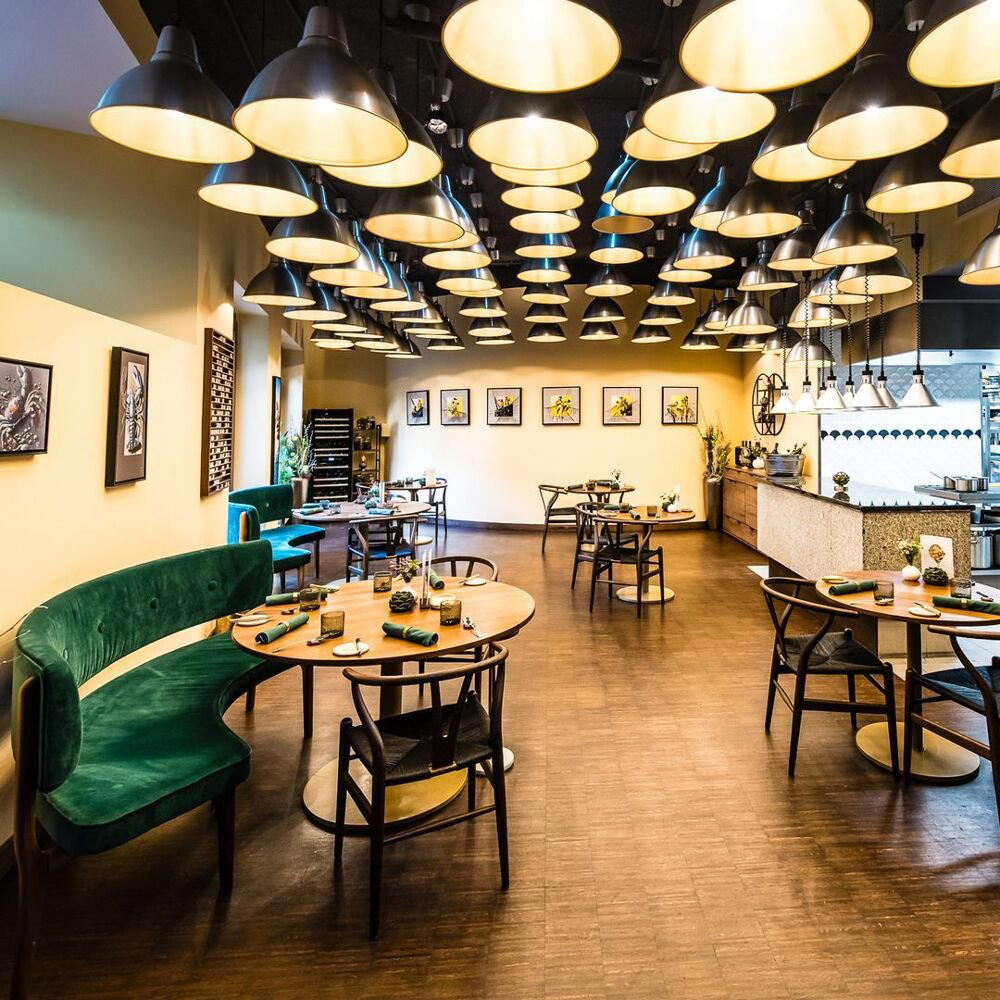
The dining room itself does not continue that understatement. A ceiling dense with pendant lights gives the space a theatrical quality that the Michelin inspectors describe as reminiscent of a stage set, and the open kitchen reinforces that sense of performance. This is a room designed to be noticed once you are inside it, which is a different design philosophy from the street-facing grandeur of older fine dining formats. It aligns Coeur D'Artichaut with a generation of European restaurants that have chosen interiority over visibility, places where the architectural statement is made to the guest already seated, not to the passer-by.
Where the Bistro Tradition Meets Tasting-Menu Discipline
The phrase the restaurant uses, casual fine dining, carries more weight than it might appear. The French bistro tradition that underpins it has a long and precise history: the bistro was never simply a cheaper restaurant. It was a specific register of hospitality in which quality of ingredient and quality of technique were maintained while formality was relaxed. The great Parisian bistros of the twentieth century, and the Lyon bouchons that preceded them, demonstrated that serious cooking and convivial atmosphere were not in tension. What changed in the past two decades is that this tradition has been absorbed into the tasting-menu format, producing a hybrid form that Coeur D'Artichaut represents clearly: technically rigorous, seasonally driven, but without the ceremonial distance of classical haute cuisine.
Frédéric Morel's Breton background matters here as context rather than biography. Brittany has produced a cooking culture built on exceptional primary produce, particularly seafood and dairy, and a habit of restraint that lets ingredients carry dishes rather than elaborate construction. When that sensibility is applied in Northern Germany, with its own tradition of direct, produce-led cooking, the result is a kitchen that operates in two complementary registers at once. The sauces and stocks, which have drawn specific notice from Michelin, are precisely where French classical technique becomes most visible: they are the element that separates a well-sourced dinner from a properly cooked one.
Germany's two-star tier is a smaller and more selective group than the country's single-star cohort. Among comparable addresses in the broader German fine dining circuit, Coeur D'Artichaut belongs to a set that includes Aqua in Wolfsburg, JAN in Munich, Schwarzwaldstube in Baiersbronn, Vendôme in Bergisch Gladbach, ES:SENZ in Grassau, Restaurant Haerlin in Hamburg, Schanz in Piesport, and CODA Dessert Dining in Berlin, all operating at the level where Michelin recognition is paired with a distinct culinary identity. Within that peer group, Coeur D'Artichaut's position in a mid-sized university city rather than a major metropolitan centre gives it a particular character: it functions as the kind of destination restaurant that a city of Münster's scale rarely sustains at this level.
For Modern French cooking at two-star level in other European contexts, Sketch, The Lecture Room and Library in London and Alex Dilling at Hotel Café Royal in London represent the broader category at comparable recognition levels, and the comparison clarifies what distinguishes the Münster address: a regional specificity that neither London counterpart needs to carry.
The Menu Structure and What It Signals
Morel's Tasting menu changes monthly, which is a meaningful structural commitment. Monthly rotation sits between the seasonal-only updates of more conservative kitchens and the weekly or daily changes of the most market-driven operations. It signals a kitchen confident enough in its own output to commit to a full menu cycle while remaining genuinely responsive to ingredient availability. The six- and eight-course formats offer a choice of depth rather than a single prescriptive path, which is consistent with the casual fine dining register: the guest has agency over the length of the evening.
The Sunday four-course option is a practical accommodation that also says something about the restaurant's relationship with its local audience. Sunday lunch formats in France have historically been a different meal from the weekday tasting menu, more family-oriented, slightly less formal, but still serious. Coeur D'Artichaut's Sunday structure (available excluding public holidays and Sundays in December) maps onto that tradition and extends the restaurant's accessibility without diluting its technical ambitions.
The house-made alcohol-free pairings are worth noting as a signal of current fine dining thinking. Non-alcoholic pairing programs have moved from novelty to expectation at this level over the past several years, and the quality of those pairings has become a secondary measure of a kitchen's creativity. A restaurant that builds its own alcohol-free accompaniments rather than defaulting to commercial alternatives is making a statement about the completeness of its hospitality offer.
One further detail: the chefs personally serve and present the dishes. This is a deliberate practice rather than a logistical convenience. It maintains a direct connection between the kitchen and the table, eliminates the interpretive layer of service staff who did not cook the food, and reinforces the theatre that the dining room's design already establishes.
Coeur D'Artichaut in Münster's Broader Dining Picture
Münster's restaurant circuit extends well beyond this address. At the one-star level, Spitzner operates in the same Modern French register at a lower price point, making it a useful reference for how the city's French-leaning fine dining has developed across tiers. BOK Restaurant Brust oder Keule covers the farm-to-table end of the market at the €€€ level, and Villa Medici provides Mediterranean cooking at a more accessible price range. For a full account of what the city offers across categories, the [Münster restaurants guide](), [bars guide](), [hotels guide](), [wineries guide](), and experiences guide cover the full picture.
The La Liste methodology aggregates critical and public opinion across sources, and a two-year upward trajectory at those scores is a meaningful indicator of sustained output rather than a single strong performance. It positions the restaurant solidly within the upper tier of German fine dining without yet reaching the 80-point threshold that typically marks a different tier of international recognition.
Planning a Visit
The restaurant is located at Alter Fischmarkt 11a in Münster's Altstadt, set back from the street in a courtyard that opens onto a terrace during summer months. At the €€€€ price range, the tasting menu format, and the two-star designation, this sits at the top of Münster's dining spend and requires advance planning. The Monday-through-Saturday format with a distinct Sunday menu means the booking approach differs by day. Given the monthly menu rotation, timing a visit around a specific seasonal window, late spring through early autumn for terrace access, winter for the enclosed dining room at its most atmospheric, is worth considering when booking.
FAQ
What's the must-try dish at Coeur D'Artichaut?
The monthly rotation of Morel's Tasting means no individual dish is permanently on the menu. What the awards record and Michelin commentary consistently flag is the quality of the sauces and stocks, which are the most technically demanding element of French classical cooking and the hardest to execute at a consistent level. Whatever the current menu composition, those preparations are the most reliable indicator of what the kitchen does at its highest level. The alcohol-free pairing program is worth opting for if you want to assess the full range of the kitchen's creative output beyond the food itself.
Frequently asked questions
Who's behind the kitchen at Coeur D'Artichaut?
The chef associated with Coeur D'Artichaut is Frédéric Morel.
What's the must-try dish at Coeur D'Artichaut?
Because the Morel's Tasting menu changes every month, no single dish is a fixture on the menu. What remains consistent across all iterations is the kitchen's reputation for its sauces and stocks, which Michelin's own notes single out as outstanding. The six- or eight-course format is where those fundamentals get the most space to develop, so booking that over the four-course Sunday option gives the fuller picture of what Frédéric Morel's cooking is about.
What price level is Coeur D'Artichaut?
Pricing at Coeur D'Artichaut is listed as €€€€.
What's the address for Coeur D'Artichaut?
Coeur D'Artichaut is located at Alter Fischmarkt 11a, 48143 Münster, Germany, Münster.
What's Coeur D'Artichaut known for in terms of accolades?
Coeur D'Artichaut has received recognition including: La Liste Top Restaurants (2026): 79pts; La Liste Top Restaurants (2025): 77.5pts; Michelin 2 Stars (2025); Somewhat tucked away in a courtyard (where there is a fabulous terrace in summer) and just a stone's throw from the cathedral, this a….
Budget Reality Check
| Venue | Cuisine | Price | Awards | Notes |
|---|---|---|---|---|
| Coeur D'ArtichautThis venue — the venue you are viewing | Modern French with Breton Influences | $200–300 | 2 Michelin Stars · La Liste Top Restaurants | Not listed |
| BOK Restaurant Brust oder Keule | Modern European Fine Dining | $150–200 | 1 Michelin Star | Farm to table |
| Spitzner | Modern French Fine Dining | Not listed | 1 Michelin Star | Modern French |
| Villa Medici | Mediterranean-Italian Fine Dining | $50–100 | Michelin Plate | Not listed |
Recognition history
Dated appearances from independent guides and award organizations, with the underlying list record or original source where available.
Michelin 2 Stars
Michelin
La Liste Top Restaurants
La Liste
Falstaff Restaurant - 94 Falstaff Points
Falstaff
Full recognition history (6 entries)
La Liste Top Restaurants
La Liste
Michelin 2 Stars
Michelin
Michelin 2 Stars
Michelin
Continue exploring
More in Münster
Restaurants in Münster
Browse all →
Bars in Münster
Browse all →
Hotels in Münster
Browse all →
Wineries in Münster
Browse all →
Details
- Elegant
- Sophisticated
- Modern
- Intimate
- Celebration
- Special Occasion
- Date Night
- Open Kitchen
- Courtyard
- Terrace
- Chefs Counter
- Sommelier Led
- Zero Proof
- Local Sourcing
- Tasting Menu
- Set Menu
- Wine Pairings
- Alcohol Free Pairings
- Vegetarian Friendly
- Allergy Accommodating
Current opening hours
- Monday
- Closed
- Tuesday
- Closed
- Wednesday
- 6:30–11:30 PM
- Thursday
- 6:30–11:30 PM
- Friday
- 6:30–11:30 PM
- Saturday
- 6:30–11:30 PM
- Sunday
- 12–4 PM
Hours can change for holidays and private events. Last verified .
Stylish dining area reminiscent of a theater stage, featuring striking ceiling with densely packed pendant lights, eye-catching open kitchen, and a fabulous summer terrace in a tucked-away courtyard near the cathedral.