Our verdict
In the hill villages above Ajloun, أكلة وفتلة operates from Orjan as part of a growing network of community kitchens that treat locally sourced, home-style Jordanian cooking as their core proposition. The food here draws from the agricultural traditions of northern Jordan, where proximity to olive groves, herb gardens, and smallholder farms shapes what ends up on the table. For travellers passing through or hiking the Ajloun Forest Reserve, it represents one of the more grounded eating options in the area.

Pearl is the En Primeur Club membership app, where members save venues, book tables and use the concierge.
The menu
What to order
- فطور فلاحي
- خبز الطابون
- قلية بندورة
- مفتول
Where the Ingredients Come From First
The villages of northern Jordan's Ajloun governorate occupy a green, terraced landscape that most visitors associate with the castle on the ridge rather than with what grows on the hillsides below it. Olive cultivation here dates back centuries, and smallholder farming remains active in communities like Orjan, where أكلة وفتلة is located. That geographic and agricultural context is not incidental to the food served here, it is the food's foundation. In communities where the supply chain between garden and kitchen is measured in walking distance rather than trucking hours, the ingredient question answers itself. What appears on the table is determined largely by what the surrounding land produces in a given season.
This pattern of hyperlocal sourcing is not a marketing position in Orjan the way it might be framed at a restaurant in a capital city. In villages across Ajloun, it is simply the default mode of food production. Home cooks and community kitchens alike work with what is available locally, wild herbs gathered from the hillsides, olive oil pressed from local groves, dried legumes stored from the previous harvest. The result is a cuisine that reflects the agricultural calendar with a directness that more elaborately conceived restaurants in Amman or Petra rarely achieve, regardless of their sourcing intentions. For context on how Jordan's broader dining scene situates itself relative to this tradition, our full Ajloun restaurants guide maps the range from community kitchens to more formal establishments.
The Setting in Orjan
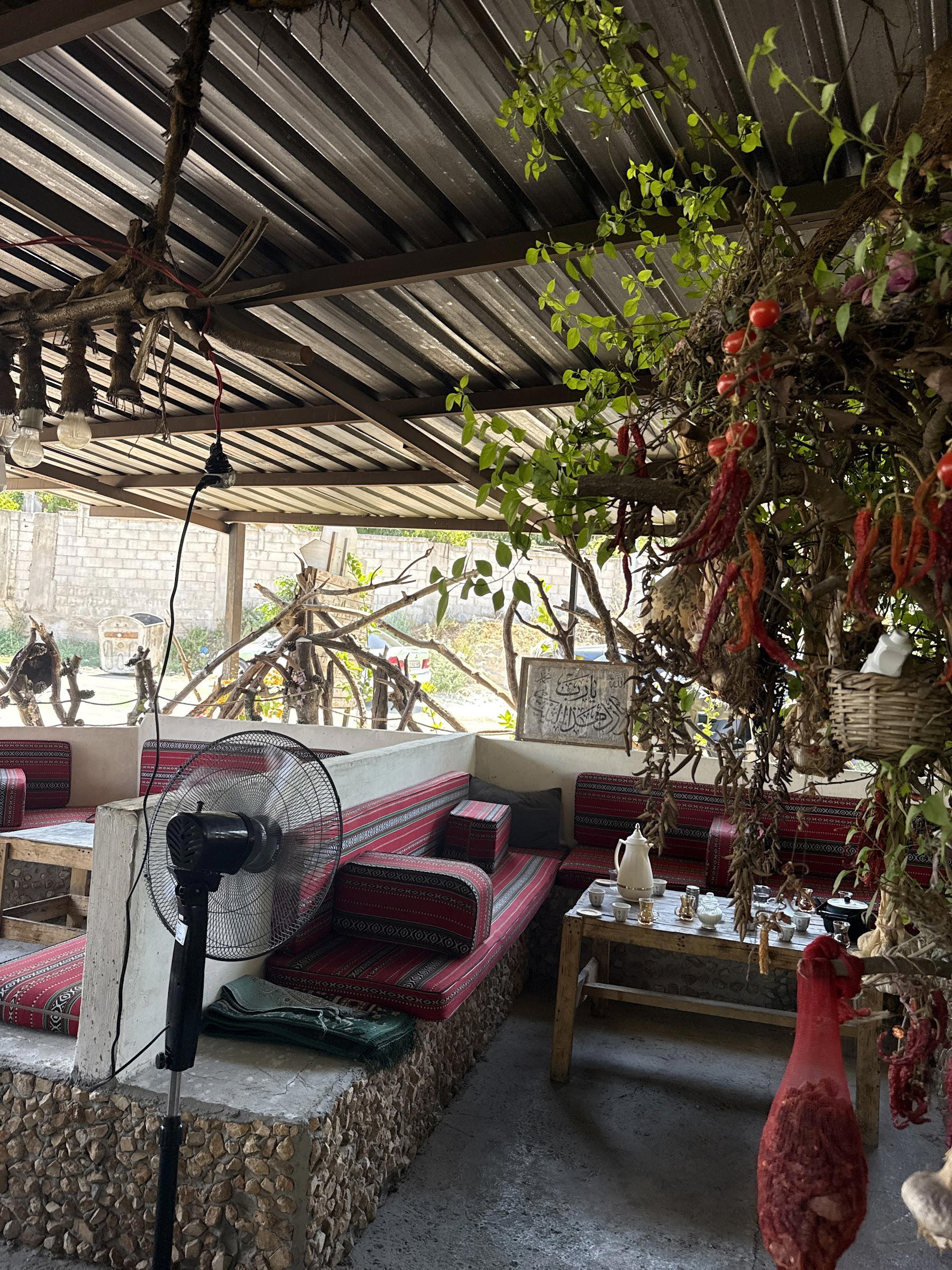
Orjan sits within the Ajloun Forest Reserve's broader ecological zone, a highland area where the Royal Society for the Conservation of Nature has been active in promoting community-based tourism since the early 2000s. Restaurants and kitchens that operate here do so in proximity to hiking trails, nature lodges, and a visitor economy built around low-impact, experience-oriented travel. The physical environment approaching أكلة وفتلة is therefore one shaped by pine and oak forest, stone-built village architecture, and the kind of quietness that distinguishes Ajloun from Jordan's more heavily trafficked sites. Arriving here is a different register from arriving at a restaurant in downtown Amman, where the surrounding urban noise sets a particular tone before you enter the door.
Community kitchens operating in this environment tend toward informal room arrangements, shared tables, and the visual presence of food preparation rather than a separation between kitchen and dining space. The social character of meals in this tradition is part of the format, not a stylistic flourish. Groups eat together; portions are sized for sharing; the pace is determined by the kitchen's rhythm rather than table-turn targets. This contrasts sharply with the tightly sequenced tasting formats at restaurants like Atomix in New York City or the theatrical pacing of Alinea in Chicago, where the dining experience is engineered to the minute. In Orjan, the tempo is agricultural.
The Food Tradition Behind the Name
The name أكلة وفتلة translates roughly to a meal and a twist, a colloquial phrasing that signals something handmade, practical, and rooted in domestic cooking rather than restaurant convention. The cooking traditions of northern Jordan draw heavily on the musakhan and mansaf lineage, as well as on the broader Levantine pantry of preserved lemons, sumac, za'atar, and slow-cooked legumes. In Ajloun specifically, the proximity to olive production gives olive oil a different role than it plays in cities: it is not a finishing ingredient or a premium addition, it is the primary cooking fat, present in quantity and quality that reflects local abundance rather than imported cost.
Village cooking in this region also relies on techniques that extend the usefulness of seasonal ingredients, drying, fermenting, and preserving in ways that reflect a food culture built around agricultural cycles rather than year-round supply chain availability. This positions the food at أكلة وفتلة within a broader tradition of Jordanian home cooking that urban restaurants like Deretna My Mom Recipe in Petra have sought to reference and formalise for a visitor audience. The Orjan version operates closer to the source, without the mediation of a restaurant concept framing the same dishes.
Across Jordan, there is a growing recognition that this category of community-based, women-operated kitchen represents a distinct and serious tier of the country's food culture, not a rustic footnote to the fine dining happening at establishments in Amman. The comparison is instructive: where a restaurant like 13C Bar in the Back in Amman operates within an urban hospitality framework with all its attendant signals, community kitchens in Ajloun are answerable only to the land and the recipes passed through generations of local households.
Planning Your Visit
Orjan is accessible from Ajloun town, itself reached from Amman via a drive of roughly 75 to 80 kilometres through the northern highlands. The village sits within the nature reserve zone, making it a logical stop for visitors combining the Ajloun Castle with forest hiking or an overnight at one of the reserve's eco-lodges. Timing matters: the area is at its most active from spring through early autumn, when hiking traffic is highest and the local produce supply is most varied. Phone and website details for أكلة وفتلة are not publicly listed in current directories, so the most reliable approach for visitors is to enquire directly through the RSCN visitor centre in Ajloun or through tour operators running community tourism programmes in the area. Prices, as is typical for community kitchens in this tier across Jordan, are substantially lower than urban restaurant equivalents, this is not a fine dining category in any sense that applies to, say, Arpège in Paris or Alain Ducasse at Louis XV in Monte Carlo. It is a community meal, priced accordingly, and the value proposition sits entirely in the food's directness and the setting's authenticity rather than in service theatrics or curated atmosphere.
Frequently asked questions
Is أكلة وفتلة a family-friendly restaurant?
The venue sits in Orjan, a rural village in Ajloun governorate where food traditions are rooted in domestic, communal cooking, a context that tends to be naturally oriented toward family dining. The name itself, translating roughly to 'a meal and a twist,' signals a handmade, practical approach rather than a formal or adult-focused dining format.
How would you describe the vibe at أكلة وفتلة?
Orjan is a highland village within the ecological zone of the Ajloun Forest Reserve, and the setting shapes the atmosphere accordingly, unhurried, grounded in the immediate landscape, and closer to a farmhouse table than a city restaurant. This is the kind of place where the surroundings and the food are in direct conversation with each other.
What makes أكلة وفتلة different from restaurants in Ajloun town?
While Ajloun town serves as the main hub for visitors heading to the castle, أكلة وفتلة operates from Orjan, a village embedded within the Ajloun Forest Reserve's broader ecological zone, roughly a further drive into the northern highlands. That location puts it closer to the agricultural source of northern Jordanian ingredients and further from the tourist circuit, which shapes both what is cooked and who is eating there.
What should I order at أكلة وفتلة?
The name أكلة وفتلة points toward handmade, traditional preparations, 'a twist' in the colloquial Arabic sense implies something worked by hand, likely dough or a pastry-adjacent element. The villages of Ajloun governorate are known for produce grown on terraced northern highland farms, so expect ingredient-forward cooking tied to what is locally grown and seasonal.
Where exactly is أكلة وفتلة?
أكلة وفتلة is located at CP2R+J8C, Orjan, Jordan, Ajloun.
Do I need a reservation for أكلة وفتلة?
No phone number or website is publicly listed for أكلة وفتلة, which means advance booking through conventional channels is not straightforward. For a rural venue in Orjan, arriving during midday hours, when village kitchens are most likely to be operating, is a reasonable approach, though confirming locally before the trip is advisable.
Side-by-Side Snapshot
Comparable venues nearby, for context on price, style, and recognition.
| Venue | Cuisine | Price | Notes |
|---|---|---|---|
| أكلة وفتلةThis venue (the venue you are viewing) | Traditional Jordanian Rural Cuisine | Not listed | Not listed |
| Hashem Restaurant | Authentic Levantine Breakfast | $1–10 | Downtown Amman |
| Adam's Secrets Restaurant & Cafe | Jordanian & International Cafe | $10–20 | Abdoun |
| Alibaba Restaurant | Seafood & Middle Eastern | $10–20 | Town Center |
| Deretna My Mom Recipe | Jordanian Traditional | $20–30 | Petra - Wadi Musa |
| Levant | Modern Armenian-Lebanese Levantine | $30–50 | 3rd Circle |
Continue exploring
More in Ajloun
Restaurants in Ajloun
All restaurants in Ajloun →

Bars in Ajloun
Browse all →



Hotels in Ajloun
Browse all →

Wineries in Ajloun
Browse all →
Details
- Rustic
- Cozy
- Classic
- Family
- Casual Hangout
- Open Kitchen
- Local Sourcing
- Farm To Table
- Mountain
- A La Carte
- Halal
Current opening hours
- Monday
- 10 AM–10 PM
- Tuesday
- 10 AM–10 PM
- Wednesday
- 10 AM–10 PM
- Thursday
- 10 AM–10 PM
- Friday
- 10 AM–10 PM
- Saturday
- 10 AM–10 PM
- Sunday
- 10 AM–10 PM
Hours can change for holidays and private events. Hours as of .
Warm, nostalgic rural atmosphere with the scent of firewood, heat from the oven, and traditional countryside charm.