







Born occupies Jinricksha Station, a 1903 rickshaw depot on Neil Road, where a nine-course tasting menu fuses French technique with Chinese cooking tradition. Holding a Michelin star (2024), Black Pearl 1 Diamond (2025), and ranked #54 on Asia's 50 Best Restaurants 2025, it sits in Singapore's upper tier of creative tasting-menu restaurants. Sommelier Leslie Loo oversees a wine list of 3,450 selections weighted toward France.
 Discover on Pearl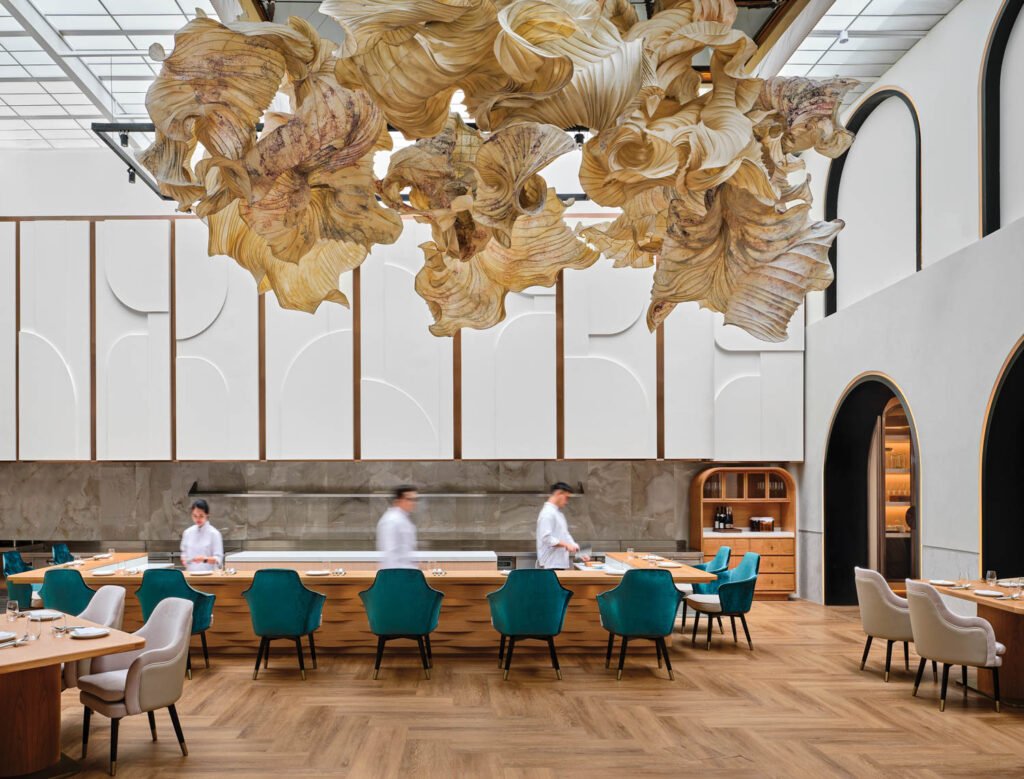
A Victorian Depot, a Nine-Course Arc, and a Room That Earns Repeat Visits
The building announces itself before the food does. Jinricksha Station on Neil Road was built in 1903 as a licensing depot for rickshaw pullers, and its arched facade carries that century-old weight into the present. Inside, double arches glow with warm light, a high glass ceiling draws the eye upward, and an ethereal paper sculpture anchors the room without dominating it. The architecture alone explains something about the kind of dining that happens here: structured, considered, and built around contrast rather than noise. For anyone who has eaten at Singapore's upper tier of tasting-menu restaurants, the physical setting at Born reads less like decoration and more like an argument.
Singapore's creative dining scene has consolidated around a recognisable cohort. Odette commands the French Contemporary bracket at the leading of the price tier. Zén represents European Contemporary at equivalent pricing. Nouri works a crossroads-cooking philosophy with sustained critical recognition. Born sits in this peer set, not as an outlier but as a distinct voice: a kitchen where French gastronomy and Chinese culinary tradition are not placed side by side but genuinely fused, course by course across a nine-course format.
The shortlist, unlocked.
Hard-to-book tables, cellar releases, and concierge-planned trips.
Get Exclusive Access →What the Nine Courses Are Actually Doing
The menu at Born draws on two culinary systems that share more structural DNA than their geographic distance suggests. French gastronomy provides the scaffolding: classical sauce logic, precision in temperature and texture, an emphasis on ingredient sourcing that leans global. The Chinese influence is not cosmetic. It enters through flavour memory, specific cooking techniques, and a sensibility around balance that differs from the European tradition. The result is a menu that requires attention rather than passive consumption, which is precisely what brings the room's regulars back.
Among the dishes that have established a following is the aged wagyu tartare served with an oyster inside a fried bao. The construction is instructive: the tartare registers as European in technique, the bao as Chinese in form, and the oyster as something that belongs to both traditions simultaneously. That kind of layered reference is consistent across the nine courses rather than reserved for a single showpiece moment. Chef Zor Tan, who trained under André Chiang, operates within the Singaporean tradition of chefs who absorbed French rigour and then interrogated it through their own biographical lens. The tasting menu format, running through the full evening service, reflects that ambition.
Regulars at Born return not simply for the menu but for the way the menu changes. A tasting-format kitchen at this price point and recognition level does not stay static. The 2025 ranking at #54 on Asia's 50 Best Restaurants (up from #92 in 2024 and #94 in 2023) reflects consistent upward momentum over three years, which suggests that the kitchen is refining rather than repeating. For guests who have been twice or more, that trajectory is part of the appeal. The creative arc the menu follows across a given season is a reason to book again, not just once.
The Wine Program and Its Logic
A tasting menu built on French technique pairs naturally with France-weighted wine, and the list at Born reflects that alignment. Sommelier Leslie Loo oversees a selection of 3,450 bottles with declared strengths in Burgundy, Bordeaux, and Champagne. The pricing sits at the $$$ tier based on the list's general markup structure, with a significant number of bottles above the $100 mark. The corkage fee, for guests who bring their own, is $89.
Wine programs of this depth at Singapore's fine dining tier are not uncommon. Les Amis operates one of the deepest cellars in the city. What distinguishes Born's list is that its France-first orientation mirrors the kitchen's primary technical tradition, which creates a coherence between food and wine that pairing-focused guests appreciate. For the regulars who eat here frequently, the cellar's depth means the sommelier can suggest different bottles across repeat visits without reaching for the same two or three references.
The Regulars and What They Know
The guests who return to Born repeatedly tend to share a few characteristics. They are attentive to craft, familiar with the French-Chinese format from exposure to comparable kitchens in Hong Kong, Shanghai, and Bangkok, and they book with enough lead time to secure preferred seating. In the broader Asian creative dining circuit, Born occupies a comparable register to Bo Innovation in Hong Kong or Gaggan Anand in Bangkok: a kitchen that places cultural identity at the centre of the tasting format rather than treating it as a secondary flavour note.
What the regulars understand that first-time visitors sometimes miss is that the pacing of the nine courses rewards attention to sequence. The menu builds. Flavour intensity, textural register, and the interplay between the two culinary traditions shift across the arc in a way that only becomes apparent by the fifth or sixth course. This is not a menu designed for guests who want to photograph each dish and move on. It is designed for the table that is paying attention throughout.
For comparison within Singapore's broader tasting-menu scene, Jaan by Kirk Westaway takes a British Contemporary approach at a slightly lower price tier. Labyrinth operates in the Innovative category at $$$. Born's position at $$$$ aligns it with Odette and Zén at the leading of the local bracket. Internationally, the format and creative ambition place it in conversation with restaurants like Atomix in New York, where cultural identity frames a tasting menu that operates at the technical level of its European counterparts.
Planning a Visit
Born is located at 1 Neil Rd, #01-01, in the Tanjong Pagar district, within the Jinricksha Station building that dates to 1903. The neighbourhood sits on the edge of the CBD and is accessible from Outram Park MRT. Dinner service runs Tuesday through Saturday from 6 PM to 11 PM, with an additional Friday lunch from 12 PM to 3 PM. The restaurant is closed on Sundays and Mondays. The Michelin star (2024), Black Pearl 1 Diamond (2025), and Asia's 50 Best ranking at #54 (2025) place it clearly in the city's upper tier, where bookings are made well in advance. Given the upward ranking trajectory and the nine-course format's reputation for evolution, guests familiar with Singapore's fine dining rhythm tend to book multiple visits per year rather than treating it as a single occasion. The $$$$ price tier at dinner reflects the tasting menu format; the full wine experience with sommelier guidance adds meaningfully to the total.
For a complete map of Singapore's dining scene across formats and price points, see our full Singapore restaurants guide. Visitors planning the broader trip can also reference our Singapore hotels guide, our Singapore bars guide, and our Singapore experiences guide for the full picture.
Frequently Asked Questions
- What should I expect atmosphere-wise at Born?
- Born occupies the ground floor of Jinricksha Station, a heritage building from 1903. The dining room combines the structure's original arched architecture with a contemporary interior: glowing double arches, a high glass ceiling, and a large paper sculpture. The effect is formal without being austere. At the $$$$ price tier, with a Michelin star and a #54 ranking on Asia's 50 Best (2025), the room draws guests who treat fine dining as an occasion. Expect a measured pace across the nine courses and a room that is engaged rather than theatrical.
- What's the leading thing to order at Born?
- The format is a nine-course tasting menu, so ordering is not a question of selection in the conventional sense. The aged wagyu tartare with oyster in a fried bao is among the signatures that have attracted attention across publications covering Singapore's innovative dining scene. More broadly, the menu's interest lies in how French technique and Chinese culinary tradition are integrated across the full sequence rather than in any single dish. Chef Zor Tan, who carries André Chiang's training in his background, has built a menu where the arc matters as much as the individual courses. First-time visitors benefit from arriving with that frame in mind. For comparable creative tasting experiences in the wider Asian circuit, Mosu in Hong Kong and Ultraviolet by Paul Pairet in Shanghai operate in an adjacent register.
Price Lens
A quick peer snapshot; use it as orientation, not a full ranking.
| Venue | Price | Awards | Notes |
|---|---|---|---|
| Born | $$$$ | Michelin 1 Star, Black Pearl 1 Diamond (2025) | This venue |
| Zén | $$$$ | Michelin 3 Star | European Contemporary, $$$$ |
| Jaan by Kirk Westaway | $$$ | Michelin 2 Star | British Contemporary, $$$ |
| Burnt Ends | $$$ | Michelin 1 Star | Australian Barbecue, Barbecue, $$$ |
| Summer Pavilion | $$ | Michelin 1 Star | Cantonese, $$ |
| Labyrinth | $$$ | Michelin 1 Star | Innovative, $$$ |
Need a table?
Our members enjoy priority alerts and concierge-led booking support for the world's most difficult tables.
Get Exclusive AccessThe shortlist, unlocked.
Hard-to-book tables, cellar releases, and concierge-planned trips.
Get Exclusive Access →