Anker
Anker sits on Kornhausplatz, one of Berne's most architecturally layered squares, placing it at the intersection of the city's civic and social life. The address alone signals a certain seriousness about place — a quality that runs through Swiss dining at its more considered end. For visitors working through the capital's restaurant scene, Anker is a reference point worth understanding in context.
Pearl is the En Primeur Club membership app — saves, bookings, and concierge access live there. Same editors, same standards.
- Address
- Kornhauspl. 16, 3011 Bern, Switzerland
- Phone
- +41 31 311 11 13
- Website
- roeschti.ch
- Directions
- Get directions
 Saves & bookings on Pearl
Kornhausplatz and the Logic of Where Berne Eats
Berne's dining geography is more structured than it first appears. The Altstadt, a UNESCO-listed medieval core of sandstone arcades and covered walkways, funnels foot traffic and local loyalty into a relatively compact set of addresses. Kornhausplatz sits at the northern edge of that zone, a square defined by the monumental Kornhaus itself — an eighteenth-century granary converted into a cultural venue — and by the tram lines that make it one of the city's most functional transit nodes. Restaurants here are not incidental; they occupy a position that the city's residents pass through daily, which means they are tested by local repeat custom rather than tourist novelty alone.
Anker, at Kornhauspl. 16, occupies that kind of address. The square's character is civic rather than decorative: broad, open, functional. A restaurant operating here draws from office workers at lunch, families in the early evening, and a more deliberate dinner crowd after dark. That range shapes what a kitchen must be capable of delivering consistently, which is a more demanding brief than it sounds.
Swiss Sourcing and the Regional Kitchen
Switzerland's culinary identity is partly a sourcing story. The country's fragmented topography, alpine pasture, pre-alpine farmland, lake systems, and valley-floor agriculture, produces ingredients with strong regional character: cheeses from Gruyère and Appenzell, lake fish from Geneva and Constance, beef and veal from highland graziers, root vegetables and pulses from the Mittelland plateau that runs through the canton of Bern. For a kitchen in Berne, the supply radius is unusually rich. The Emmental valley begins less than twenty kilometres east. Bernese farmsteads have supplied city markets for centuries through the covered market at Bundesplatz and the smaller weekly markets across the Altstadt.
The broader Swiss fine-dining conversation has moved consistently toward tighter sourcing and regional articulation. Properties like Schloss Schauenstein in Fürstenau built part of their reputation on integrating estate-grown produce with a technical kitchen. Memories in Bad Ragaz and focus ATELIER in Vitznau operate in the modern Swiss register that foregrounds seasonal rhythm and regional provenance. Even at the vegetarian end of the spectrum, Magdalena in Schwyz has made alpine-sourced plant produce the structural logic of its menu. The direction across the country's serious kitchens is consistent: the further the ingredient has travelled, the harder it is to defend its presence on a Swiss menu at any meaningful price point.
Where Anker sits within that conversation, in terms of sourcing philosophy or menu structure, is not fully documented in available data. What the address implies is a kitchen that serves a broad Bernese constituency, which historically in Switzerland has meant engagement with the regional larder as a practical and cultural baseline, not an optional positioning choice.
The Berne Context: What a Capital Dining Room Must Do
Berne is a federal capital with a population of around 130,000. The dining scene reflects that: concentrated, locally oriented, resistant to the tourist-driven volatility that inflates and deflates restaurant quality in more visited cities. Michelin coverage of Berne has historically been thinner than Zurich or Geneva, partly because the city's restaurant culture runs toward craft and consistency over technical spectacle. For a city that houses the Swiss parliament, the Federal Council, and a significant diplomatic corps, there is genuine demand for serious hospitality that does not announce itself with excessive ceremony.
That institutional culture shapes what diners expect from a well-positioned Kornhausplatz address. The comparison set for Anker is local and practical: not the three-Michelin-star register of Hotel de Ville Crissier or Cheval Blanc by Peter Knogl in Basel, nor the destination-driven model of Da Vittorio in St. Moritz, but rather the category of reliable, address-anchored Swiss restaurants that hold a neighbourhood together over years. That is a different kind of achievement, and in Berne it is arguably more culturally significant.
For visitors working through the Swiss dining circuit, a Berne stop sits naturally between the Jura sensibility of Maison Wenger in Le Noirmont and the eastern Swiss register of Einstein Gourmet in Sankt Gallen. The capital's kitchens occupy their own middle ground: less alpine-austere than the Graubünden properties, less cosmopolitan than Zurich, more politically inflected than the resort dining of La Brezza in Ascona or La Table du Valrose in Rougemont.
Planning a Visit: What the Address Tells You
Kornhausplatz is accessible by tram from Berne Hauptbahnhof in under five minutes, and on foot from the main station through the Altstadt in around ten. The square is open and easy to orient around; number 16 sits on the east side. Because specific booking methods, hours, and pricing for Anker are not in the available record, prospective visitors should confirm current details directly before planning. For a square this central in a city this administratively busy, lunch service on weekdays tends to be in demand; an early reservation or an off-peak arrival is a reasonable working assumption for any well-trafficked Kornhausplatz address.
Those assembling a broader Berne itinerary can use our full Berne restaurants guide for context on how the city's dining options map across neighbourhoods and price points. For Swiss dining at the technically ambitious end, addresses like Mammertsberg in Freidorf, Skin's in Lenzburg, and Taverne zum Schäfli in Wigoltingen show the range of what the country's mid-sized and smaller towns are producing. For international reference points in the broader editorial context, Le Bernardin in New York City and Lazy Bear in San Francisco represent the kind of sourcing-led, format-conscious cooking that has influenced European kitchens including Switzerland's over the past decade. The Japanese Restaurant in Andermatt is a useful reminder of how far Swiss resort dining has diversified beyond the alpine-European template.
How Anker Berne compares with similar nearby venues.
| Venue | Cuisine | Price |
|---|---|---|
| Casino Restaurant | Modern French | €€€ |
| Wein & Sein | Modern Cuisine | €€€€ |
Continue exploring
More in Berne
Restaurants in Berne
Browse all →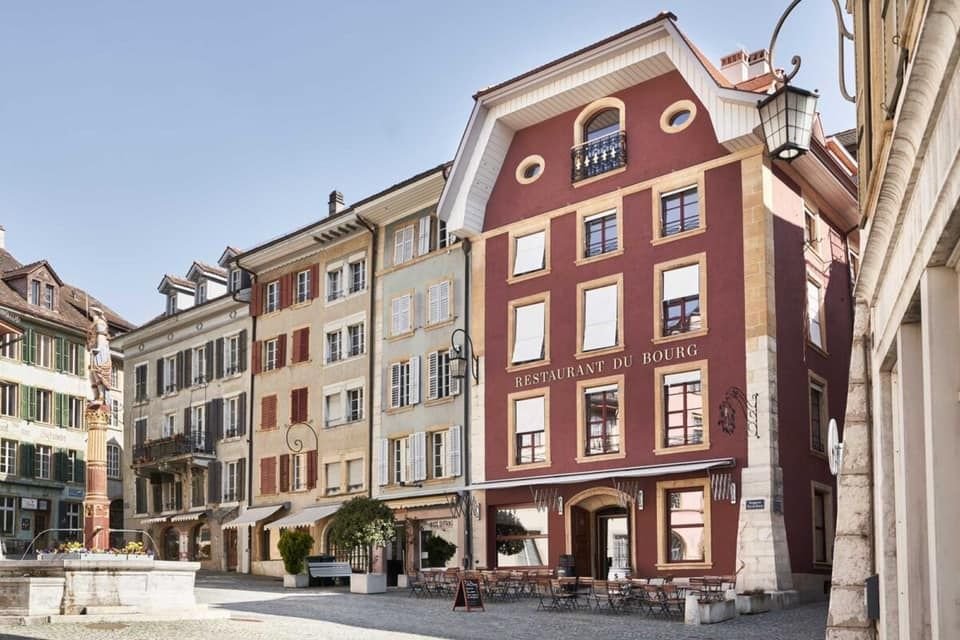
Bars in Berne
Browse all →
Hotels in Berne
Browse all →

At a Glance
- Rustic
- Cozy
- Family
- Casual Hangout
- Standalone
Current opening hours
- Monday
- 9 AM–11:30 PM
- Tuesday
- 9 AM–11:30 PM
- Wednesday
- 9 AM–11:30 PM
- Thursday
- 9 AM–11:30 PM
- Friday
- 9 AM–11:30 PM
- Saturday
- 9 AM–11:30 PM
- Sunday
- Closed
Hours can change for holidays and private events. Last verified .
Rustic pub atmosphere with clinker flooring, wooden chairs, chequered tablecloths, and lampshades evoking traditional Swiss events.
Know Before You Go
- Getting there
- Kornhauspl. 16, 3011 Bern, Switzerland