Acme Smoked Fish
Acme Smoked Fish has anchored Brooklyn's smoked fish trade from its Greenpoint facility for over a century, supplying the city's most demanding appetizing counters and delis before opening its wholesale operation to retail customers on select Fridays. The address at 30 Gem Street places it squarely in a working industrial neighborhood, where the product does the talking and the sourcing chain runs deeper than almost any comparable operation in the Northeast.
Pearl is the En Primeur Club membership app — saves, bookings, and concierge access live there. Same editors, same standards.
- Address
- 30 Gem St, Brooklyn, NY 11222
- Phone
- +1 718 383 8585
- Website
- acmesmokedfish.com
- Directions
- Get directions
 Saves & bookings on Pearl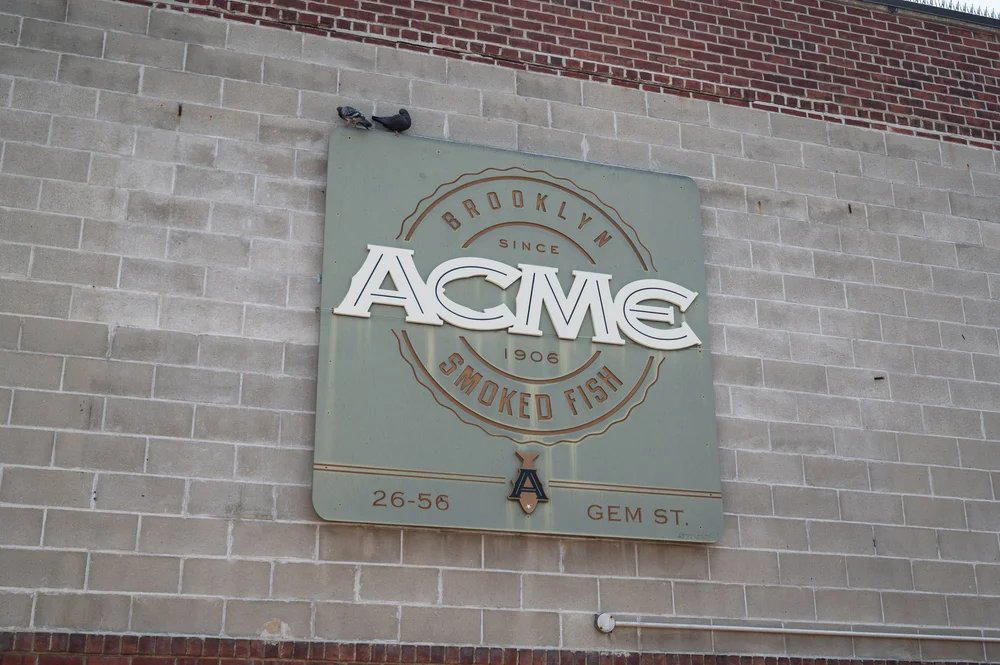
The Smell Reaches You Before the Sign Does
Arriving on Gem Street in Greenpoint, Brooklyn, the curing and smoking operation announces itself through the air before any signage comes into view. This is not a restaurant neighborhood in the conventional sense. The block sits inside a working industrial corridor where food production, not food service, defines the character. Acme Smoked Fish occupies that industrial register fully, and that is precisely what gives it weight in a city whose appetizing tradition runs back to the late nineteenth century.
New York's relationship with smoked and cured fish predates almost every fine-dining category the city now exports to the world. The appetizing store, a distinctly Ashkenazi-American institution built around smoked salmon, whitefish, sable, and pickled herring, was once the anchor of Jewish commercial life on the Lower East Side and in Brooklyn. That tradition has thinned considerably, with a small number of retail survivors carrying the institutional memory. Acme is the production layer beneath much of what survives, supplying wholesale to the counters and kitchen operations that still depend on cured fish as a central category. For operations like Le Bernardin and others working at the highest tier of New York seafood, sourcing transparency and supply-chain depth matter enormously; Acme represents the kind of producer relationship that serious kitchens actively pursue.
A Century of Smoke: How the Sourcing Chain Works
The facility at 30 Gem Street operates as a large-scale smoked fish producer with roots going back to 1905, making it one of the oldest continuous food production operations in New York City. The longevity is not incidental. Building a curing and smoking operation that maintains consistency over multiple generations requires command of sourcing at the raw fish level, control of brining and preparation protocols, and sustained relationships with distributors and retail accounts.
Smoked fish production at this scale draws from a supply chain that spans wild-caught Atlantic and Pacific salmon, whitefish from the Great Lakes, sable sourced from Alaskan waters, and herring from the North Atlantic. Each fish species moves through different preparation protocols: cold-smoking preserves moisture and produces the silky, translucent texture that serious appetizing customers require in a Nova-style salmon; hot-smoking renders whitefish and chubs with a drier, flakier result suited to spreads and salads. The distinction matters because the end product's quality depends entirely on the raw fish grade and the precision of temperature and timing at the smoke stage. There is no correcting a poor-quality fish at the smoking stage, which is why sourcing decisions at the front end of the production chain define the final product.
This is the operational logic that separates a facility like Acme from commodity smoked fish production. Restaurants across New York's serious dining tier, from neighborhood institutions to the kind of tasting-menu programs found at Eleven Madison Park and Per Se, increasingly trace ingredient provenance to the production level. Smoked fish sits inside that conversation as much as any farm-to-table produce supplier. The same sourcing rigor that drives programs at Blue Hill at Stone Barns in Tarrytown or Single Thread Farm in Healdsburg applies, in principle, to every link in the food production chain.
The Friday Retail Window
Acme's public-facing operation runs on a narrow schedule: the facility opens for retail sales on Friday mornings, drawing a regular crowd of consumers, caterers, and chefs who want direct access to production-fresh product at wholesale-adjacent pricing. The format is functional, not experiential. Buyers arrive early, select from available product, and leave. There is no tasting menu, no counter service, no hospitality infrastructure. The draw is purely the product and the price advantage of purchasing directly from the source.
Friday timing is not arbitrary. The retail window aligns with weekend entertaining demand, which for smoked fish peaks sharply around Saturday and Sunday morning tables. A Saturday bagel-and-lox spread built on product purchased directly from the producer the previous morning reflects a sourcing logic that most retail buyers cannot access through conventional grocery channels. Planning around the Friday window requires knowing it exists, which is why the operation has developed a loyal following that spreads largely through word of mouth rather than formal marketing.
For visitors to New York whose interests extend beyond the tasting-menu tier, the Acme Friday retail window offers a different kind of access to the city's food culture. It sits alongside, rather than in competition with, the experiences available at Masa or Atomix. The sourcing-focused traveler who has already absorbed the higher end of New York's dining scene, detailed in our full New York City restaurants guide, will find this a worthwhile detour into the production infrastructure that underlies the city's food identity.
Where Acme Sits in the Broader Sourcing Conversation
Ingredient provenance has become a structuring principle across American fine dining, from Smyth in Chicago to Providence in Los Angeles, Lazy Bear in San Francisco, and Addison in San Diego. The conversation tends to center on produce, meat, and dairy, but it applies with equal force to seafood processing. Operations like Emeril's in New Orleans and The Inn at Little Washington have long made regional seafood sourcing central to their identities. In Europe, producers anchored to place and method, such as Atelier Moessmer Norbert Niederkofler in Brunico and Dal Pescatore in Runate, demonstrate that deep sourcing relationships are a defining characteristic of serious food programs rather than a marketing overlay.
Acme fits that frame at the production level. It is not positioned as a dining destination, and evaluating it against restaurants would be a category error. It is better understood as infrastructure: the kind of operation that makes New York's appetizing tradition functional rather than merely nostalgic. The city has very few production facilities with this combination of scale, longevity, and connection to a specific culinary tradition. That combination is what gives the address on Gem Street its relevance for anyone interested in food at the production end, not only the service end. Places like The French Laundry in Napa and Frasca Food & Wine in Boulder represent the finished, plated expression of sourcing philosophy; Acme represents one of the earlier chapters in that same story.
Planning Your Visit
The retail operation at 30 Gem Street, Brooklyn, runs on Friday mornings and draws steady early traffic, so arriving before mid-morning gives the widest product selection. Greenpoint is accessible from Manhattan via the G train, with the Nassau Avenue stop placing visitors a short walk from the facility. The operation is wholesale-first, so the environment is production-floor rather than retail-polished: bring a cooler or insulated bag if purchasing significant quantities, and plan the visit as the first stop of the morning rather than a destination in itself. No formal booking is required for the retail window.
How Acme Smoked Fish compares with similar nearby venues.
| Venue | Cuisine | Price |
|---|---|---|
| Rule Of Thirds | Japanese | Not listed |
| Chez Ma Tante | French Bistro, American Contemporary | $$$ |
| Cecily | American | $$ |
Continue exploring
More in New York City
Restaurants in New York City
Browse all →
Bars in New York City
Browse all →
Hotels in New York City
Browse all →





At a Glance
- Well Known
- Classic
- Casual Hangout
- Solo
- Open Kitchen
- Sustainable Seafood
Current opening hours
- Monday
- 8 AM–5 PM
- Tuesday
- 8 AM–5 PM
- Wednesday
- 8 AM–5 PM
- Thursday
- 8 AM–5 PM
- Friday
- 8 AM–5 PM
- Saturday
- Closed
- Sunday
- Closed
Hours can change for holidays and private events. Last verified .
Industrial factory setting with a no-frills, authentic neighborhood atmosphere; retail counter service on Fish Fridays with a working production facility.
Know Before You Go
- Getting there
- 30 Gem St, Brooklyn, NY 11222