Google: 4.8 · 506 reviews
Waterfall Resort Alaska
Waterfall Resort Alaska sits at the edge of Southeast Alaska's coastal wilderness, where the built environment steps back to let the terrain take precedence. The resort occupies a former cannery site near Ketchikan, positioning it within a tradition of adaptive reuse that defines much of the region's premium hospitality. Access is seaplane or boat, which frames the arrival as a deliberate act of separation from the mainland.
 Discover on Pearl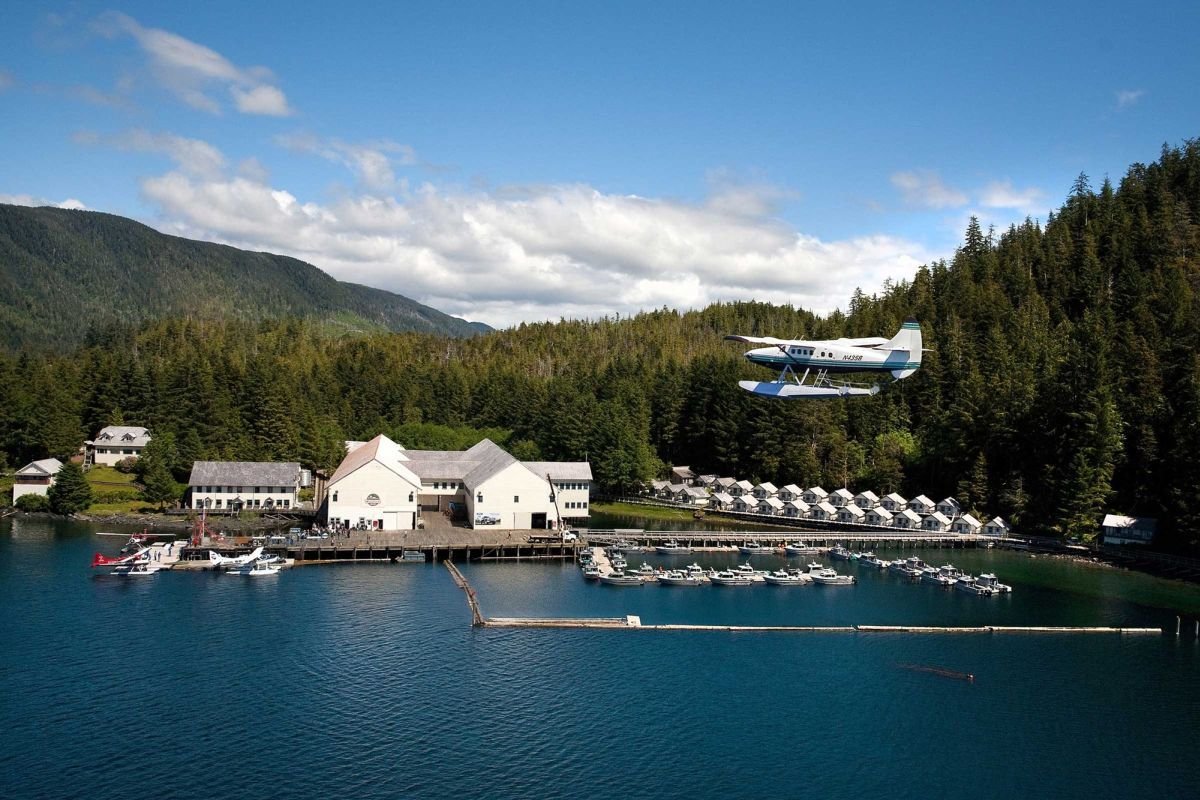
Where the Built Environment Meets the Alaskan Coast
Southeast Alaska has produced a particular category of resort architecture: structures that don't impose on the terrain so much as acknowledge it. The model emerged from the region's cannery and fishing lodge heritage, where buildings were placed for operational necessity rather than aesthetic ambition, and where the landscape consistently outranks whatever human intervention arrives beside it. Waterfall Resort Alaska fits within that lineage, occupying a former salmon cannery site that gives it both a physical footprint and a historical context most purpose-built wilderness lodges lack. The address on Dock Street in Ketchikan serves as the mainland coordination point, but the property itself is accessible only by seaplane or boat — a logistical structure that functions, intentionally or not, as an architectural threshold between the connected world and something considerably older.
The Cannery Skeleton as Design Premise
Adaptive reuse in remote Alaska carries different stakes than the warehouse conversions that populate urban hospitality. There are no nearby supply chains, no easy replacements, and no street-level foot traffic to forgive a misread renovation. What survives of the original cannery infrastructure at Waterfall Resort sets the tonal register for the whole property: weathered wood, functional geometries, structures oriented toward the water because that's where the work always came from. This is not a design language chosen for its photogenic qualities, though it photographs well. It's the residue of an industry that shaped the economic character of Southeast Alaska for over a century, and the resort's decision to work within that residue rather than erase it puts it in a different category from properties that parachute a contemporary aesthetic into wilderness settings.
The contrast with resort models built from scratch is instructive. Properties like Amangiri in Canyon Point or Ambiente in Sedona use architecture as a primary editorial statement, their buildings conceived to produce a specific visual relationship with the surrounding geology. The Waterfall approach is less authored in that sense: the history of the site does much of the design work, and the resort's task is curation rather than conception. That's a narrower brief, but it produces a different kind of authenticity — one grounded in place rather than in a designer's interpretation of place.
Arrival as Part of the Experience
The seaplane or boat approach to Waterfall Resort is not a logistical inconvenience to be managed. It's the entry sequence, and it functions architecturally in the same way a long approach road or a deliberate gate sequence functions at other high-end properties. The flight over the Alexander Archipelago, with its fjords and old-growth Sitka spruce, recalibrates expectations before a guest sets foot on the dock. By the time the floatplane touches down, the resort's physical setting has already done considerable psychological work. This is a structural advantage that no amount of interior design can replicate, and it places Waterfall in the company of access-constrained properties like Little Palm Island Resort in Little Torch Key and Kona Village in Kailua Kona, where the journey to arrival is inseparable from the overall experience.
Southeast Alaska's Hospitality Tier
Ketchikan occupies a particular position in Alaskan tourism: it's the first major port of call on the Inside Passage cruise circuit, which means it receives enormous visitor volume, most of it concentrated in the summer months between May and September. The cruise infrastructure and the wilderness lodge sector operate in almost entirely separate registers, drawing different travelers with different expectations and different budget thresholds. Waterfall Resort sits firmly in the lodge tier, which in Southeast Alaska competes less against other Ketchikan options and more against comparable access-controlled properties across the broader Pacific Northwest and Rocky Mountain wilderness corridor. That peer set includes places like Sage Lodge in Pray, Montana and Blackberry Farm in Walland, Tennessee , properties where remoteness is a feature that structures the entire offer rather than a marketing afterthought. For a broader sense of what Ketchikan's hospitality offers beyond the lodge circuit, our full Ketchikan restaurants and venues guide maps the range.
Sport Fishing as Architectural Program
In the wilderness lodge category, the primary activity frequently determines the physical layout of the property to a degree that would be unusual in conventional hospitality. At fishing-oriented lodges along the Southeast Alaska coast, the dock, the boat storage, the fish-cleaning facilities, and the cold storage infrastructure are not back-of-house considerations , they're the operational core, and the guest accommodation is arranged around them. This is a fundamentally different architectural logic from, say, Amangani in Jackson Hole, where the view is the central organizing principle, or The Fifth Avenue Hotel in New York City, where the building itself carries the primary cultural weight. At a working fishing lodge, the program drives the plan, and the aesthetic emerges from the program rather than the reverse. That functional honesty is either the appeal or the limitation, depending on what a guest is looking for.
Planning Your Stay
The operating season at Southeast Alaska lodges of this type is compressed by the region's weather and the salmon and halibut runs that anchor the fishing program, with peak access concentrated in the summer months. Ketchikan is served by Alaska Airlines with connections through Seattle, and the mainland coordination address on Dock Street handles transfers to the property itself by seaplane or boat. Given the access-controlled nature of the resort and the limited capacity typical of the cannery-conversion lodge model, advance planning matters considerably more here than at properties with easier logistics. The broader comparison set for travelers weighing this category against other access-constrained American properties includes Post Ranch Inn in Big Sur and SingleThread Farm Inn in Healdsburg , both places where the setting enforces a particular pace and where the physical environment is the primary program. Travelers whose priorities align more with urban luxury should consider Raffles Boston, Aman New York, or Chicago Athletic Association before committing to the logistical and experiential demands of a remote Alaskan lodge. For those whose interest extends to spa-anchored wilderness retreats, Canyon Ranch Tucson and Bernardus Lodge in Carmel Valley offer relevant comparison points. The Alpine Falls Ranch in Superior and Troutbeck in Amenia represent the working-landscape lodge category at different price and access points, useful context for calibrating expectations across the sector.
Fast Comparison
These are the closest comparables we have in our database for quick context.
| Venue | Cuisine | Price | Awards | Notes |
|---|---|---|---|---|
| Waterfall Resort Alaska | This venue | |||
| Aman New York | Michelin 3 Key | |||
| Amangiri | Michelin 3 Key | |||
| Hotel Bel-Air | Michelin 3 Key | |||
| The Beverly Hills Hotel | Michelin 3 Key | |||
| The Carlyle, A Rosewood Hotel | Michelin 2 Key |
At a Glance
- Rustic
- Scenic
- Cozy
- Family Vacation
- Group Retreat
- Waterfront
- Panoramic View
- Wifi
- Concierge
- Room Service
- Restaurant
- Water Sports
- Waterfront
- Mountain
- Garden
Rugged yet comfortable historic cabins and lodge rooms with stunning waterfront views, evoking a cozy reconnection with Alaskan wilderness nature.