Tortuga Lodge & Gardens
Tortuga Lodge & Gardens sits along the canals of Tortuguero, one of Costa Rica's most ecologically dense regions, where access is by boat only and the surrounding national park shapes every dimension of the stay. The property operates within a conservation-forward tradition common to Caribbean-slope lodges, where architecture defers to the forest and programming centers on wildlife observation rather than resort amenity.
Pearl is the En Primeur Club membership app — saves, bookings, and concierge access live there. Same editors, same standards.
- Address
- 2.2 km norte de La Baula Lodge, Tortuguero
- Directions
- Get directions
 Saves & bookings on Pearl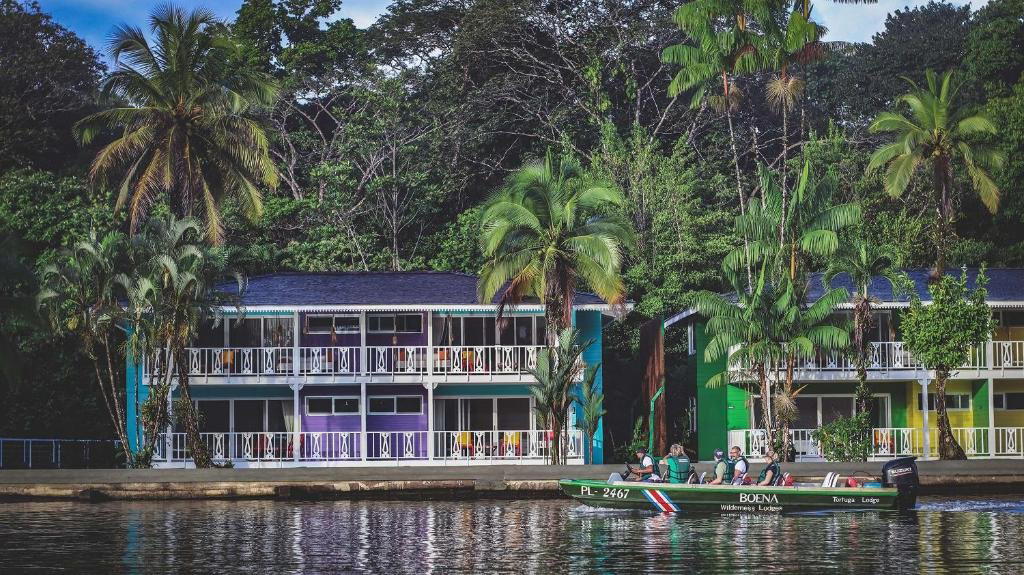
Where the Canal Dictates the Architecture
Tortuguero is not a destination you drive to. The only way in is by small plane to a grass airstrip or by river launch through a canal system that threads between the Caribbean coast and the interior rainforest. That logistical fact, more than any design decision, shapes what a lodge here can be. Properties on this stretch of the Caribbean slope of Costa Rica cannot rely on road access, delivery infrastructure, or the kind of staffing depth available in San José or Guanacaste. What they can offer, and what the better ones have organized themselves around, is proximity to one of the most ecologically dense protected zones in Central America: Tortuguero National Park, home to nesting green sea turtles, river otters, four species of monkey, and a canal network that functions as the primary transport corridor.
Tortuga Lodge & Gardens sits approximately 2.2 km north of La Baula Lodge along that canal, which is as precise a location as the geography allows. The address itself signals how the region works: distance is measured in canal kilometers, not street grids. For a first-time visitor arriving by boat, the approach through overhanging vegetation with the sound of howler monkeys in the canopy above is the arrival experience, not a lobby or a porte-cochère.
A Construction Logic Shaped by Isolation
Building in Tortuguero requires solving problems that don't arise in road-connected destinations. Every material, every piece of furniture, every kitchen delivery arrives by boat. That constraint has historically pushed Caribbean-slope lodges toward two responses: either lean into rustic minimalism, or invest heavily in on-site production and self-sufficiency. The more considered properties in this category — across Costa Rica's Atlantic zone — tend to use local hardwoods and open-air construction that reduces the need for mechanical cooling, blurring the boundary between interior and the rainforest canopy outside. Screened pavilions, refined walkways, and deep verandas are not aesthetic choices so much as practical adaptations to humidity, insect pressure, and the ambient sound environment.
In that context, gardens at a lodge like Tortuga serve a function beyond ornament. A maintained garden in a rainforest setting creates a negotiated perimeter between managed space and wild vegetation, giving guests a graduated experience: familiar planting in the foreground, primary forest at the edge. Costa Rica's Caribbean lodges that have invested in botanical programs create a layered wildlife corridor that draws species closer to the property, making passive observation possible without organized excursions. That combination of managed garden and forest proximity is a specific design strategy, and it defines how the better lodges in this region justify their category.
Positioning Within Costa Rica's Lodge Spectrum
Costa Rica's premium lodge market has evolved into a fairly legible set of tiers. At the leading sit properties with international branding or collection membership, such as Hacienda AltaGracia, Auberge Resorts Collection in Pérez Zeledón and the Andaz Costa Rica Resort at Peninsula Papagayo in Guanacaste, which compete on spa programming, F&B; investment, and service staffing ratios. Below that tier sits a category of independent or small-group lodges that compete on location specificity and ecological access rather than amenity breadth. Tortuga Lodge operates in this second category, where the asset is the surrounding national park and canal system, not the room count or the resort infrastructure.
That positioning is meaningful for the traveler choosing between, say, a Pacific coast resort property like JW Marriott Guanacaste Resort & Spa in Santa Cruz and a Caribbean-slope lodge. The Pacific properties offer beach access, consistent dry-season weather, and a higher ceiling on resort amenity. The Caribbean lodges offer something the Pacific coast cannot replicate: the canal ecosystem, the Atlantic forest, and turtle nesting season (July through October for green turtles, with peak activity in August and September). Those two products serve different travel intentions, and conflating them misreads the category.
Among Caribbean-slope lodges specifically, the differentiation comes down to canal proximity, guide quality, and the degree to which the property has integrated conservation programming. Drake Bay Getaway Resort in Drake Bay occupies a comparable niche on the Osa Peninsula, where access is similarly restricted and the surrounding protected area defines the experience. The comparison is instructive: both properties ask guests to accept logistical complexity in exchange for ecological access that is genuinely unavailable in more connected parts of the country.
The Seasonal and Practical Framework
Tortuguero's Caribbean climate does not follow the Pacific dry season that structures most Costa Rica travel planning. Rain falls year-round on the Atlantic slope, with the heaviest months typically running from June through July and again in November and December. That pattern means there is no true off-season for wildlife, the canals remain navigable, the forest active, and the park accessible regardless of month. What changes is turtle nesting activity, which draws the highest concentration of visitors between July and October.
Getting to Tortuguero requires a commitment. Small charter flights from San José's Tobías Bolaños International Airport reach the local airstrip in under an hour. Alternatively, a combination of shuttle and river launch from the Moín terminal near Limón takes two to three hours. Neither option is demanding by wilderness lodge standards, but both require advance coordination, which is the norm for properties in this access category. Visitors arriving from elsewhere in Costa Rica who have been staying at properties like El Silencio Lodge & Spa in Bajos del Toro or Hotel Belmar in Monteverde will find the logistical model familiar: remote access is part of what the property is selling.
For broader Costa Rica planning that includes other regions, properties such as Arenas Del Mar Beachfront & Rainforest Resort in Aguirre, Lapa Rios in Puerto Jimenez, Kura Boutique Hotel in Uvita, Hotel Nantipa in Santa Teresa de Cobano, and Casa Chameleon at Las Catalinas in Potrero represent different ecological zones and access profiles across the country. Our full Tortuguero restaurants and lodging guide covers the broader options in the canal zone.
Side-by-Side Snapshot
| Venue | Cuisine |
|---|---|
| Tortuga Lodge & GardensThis venue — the venue you are viewing | This venue |
At a Glance
- Quiet
- Scenic
- Rustic
- Cozy
- Romantic Getaway
- Family Vacation
- Wellness Retreat
- Weekend Escape
- Waterfront
- Garden
- Panoramic View
- Wi Fi
- Pool
- Room Service
- Concierge
- Waterfront
- Garden
- Wi Fi
- Pool
- Room Service
- Concierge
Tranquil and relaxing with sweeping river views, lush tropical surroundings, and a serene natural atmosphere.
Know Before You Go
- Getting there
- 2.2 km norte de La Baula Lodge, Tortuguero