Popa Mountain Resort occupies one of Myanmar's most geographically charged settings, perched on the slopes of Mount Popa above the Bagan plains. The property sits within a tradition of landscape-integrated retreat architecture that has defined the region's premium accommodation tier. For travellers moving between Bagan and Mandalay, it represents a considered stop in a part of the country where altitude and volcanic topography shape everything from the climate to the views.
 Discover on Pearl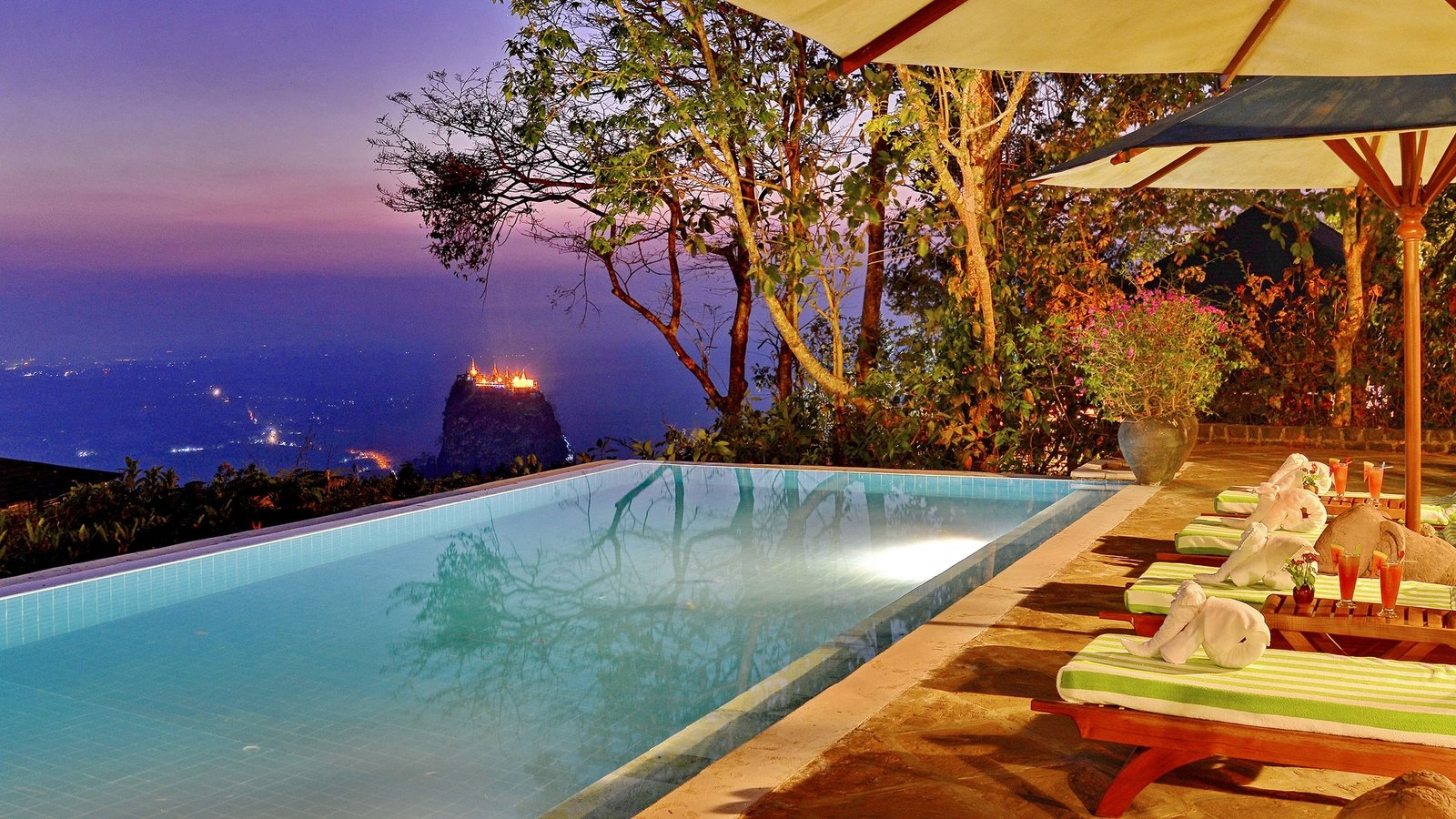
A Mountain Stage That Precedes the Architecture
Some resort settings do the heavy lifting before a single design decision is made. Mount Popa, an extinct volcano rising roughly 1,500 metres above the central Myanmar plains, belongs to that category. The peak carries deep significance in Burmese animist tradition — it is considered the home of the nats, the 37 spirit figures that predate Buddhism in the region and remain woven into everyday ritual life across Myanmar. A resort built against this backdrop enters a conversation that goes well beyond hospitality. Popa Mountain Resort positions itself inside that conversation, using the mountain's topography and cultural weight as the primary architectural context rather than working against it.
The broader pattern here is familiar across Southeast Asia's premium mountain properties: terrain as the first design layer, with built structures acting as a frame rather than a focal point. Properties like Amangiri in Canyon Point operate on the same logic in a desert context, where geology sets the aesthetic agenda and architecture responds with restraint. In Myanmar's mountain tier, that restraint tends to express itself through open-sided pavilions, refined walkways, and sightlines kept clear of the surrounding landscape.
The shortlist, unlocked.
Hard-to-book tables, cellar releases, and concierge-planned trips.
Get Exclusive Access →Design Embedded in Elevation
The resort's position on the slopes of Mount Popa means that elevation differentials are a primary design consideration rather than a secondary one. Multi-level properties built into hillside terrain typically use that gradient to create staggered accommodation, where each room tier gains a height advantage over the one below it. This approach, common across the better-constructed mountain lodges in Southeast Asia, produces a hierarchy of views that directly shapes room category strategy for guests. The upper tiers tend to look out across the Bagan plains toward the Irrawaddy basin; on clear mornings, that vista extends well beyond what any flat-site property can offer.
Architectural vocabulary appropriate to this setting draws from local tradition without replicating it wholesale. Teak, bamboo, and laterite stone appear throughout the best-considered properties in central Myanmar, materials chosen not only for aesthetic continuity with the surroundings but for their thermal performance at altitude, where temperatures drop noticeably after dark even during the dry season. Open circulation spaces — corridors that are more loggia than corridor , address the climate while keeping guests oriented toward the landscape rather than insulated from it.
For context on how a different strain of design-led mountain hospitality operates in Southeast Asia, Novotel Inle Lake in Inle Lake represents the branded-hotel tier operating in a similarly atmospheric setting, while Wa Ale Resort in the Myeik Archipelago illustrates what the low-key, design-sensitive end of Myanmar's premium accommodation spectrum looks like in a coastal context. Popa Mountain Resort occupies a different geographic and cultural register from both, defined by volcanic altitude rather than water.
The Cultural Geography of Mount Popa
The mountain itself demands context that few resort experiences in Myanmar can match for density. The Taung Kalat shrine , a monastery built atop a volcanic plug adjacent to the main crater , draws Burmese pilgrims throughout the year, particularly around full moon festivals. The presence of active religious life immediately adjacent to a resort property creates a dynamic uncommon in the international luxury market: guests are not visiting a preserved or curated piece of local culture but are arriving at a site that continues to function as a centre of living practice. That distinction matters for how the setting is experienced, and it places Popa Mountain Resort in a peer group closer to properties adjacent to active temple complexes in Kyoto or Luang Prabang than to conventional nature retreats.
Seasonality at this altitude runs differently from Bagan below. The cooler months, broadly from November through February, bring clear mornings with long-range views across the plains. The monsoon season, roughly June through September, wraps the mountain in cloud cover that dramatically alters the character of the setting , reducing visibility but intensifying the green of the surrounding forest. Both versions of the mountain have their advocates; the dry season draws the majority of international visitors, while the wet months see predominantly local and regional travel.
Placing Popa in Myanmar's Premium Accommodation Picture
Myanmar's hotel sector has faced significant disruption since 2021, and the country's tourism infrastructure sits in a different position than it did during the high-growth period of the mid-2010s. For travellers considering the country, the Bagan-Mandalay axis remains the most-visited corridor, and Mount Popa sits geographically between those two anchors, roughly 50 kilometres southeast of Bagan. That position makes the resort a logical overnight stop for itinerary builders working that route rather than a standalone destination requiring a dedicated trip.
Within that corridor, the choice between different property tiers reflects a broader split visible across Myanmar's accommodation market: internationally branded hotels offering standardised infrastructure against smaller, locally oriented properties that offer more direct access to the geographic and cultural specificity of their setting. LOTTE HOTEL YANGON in Yangon represents the full-service international tier in the country's commercial capital; Popa Mountain Resort sits at the opposite end of that spectrum in terms of setting remoteness and landscape immersion, operating in a register closer to properties that use geographical rarity as their primary value proposition.
The broader global comparison is instructive. Properties built around singular landscape features , volcanic formations, geological anomalies, sacred peaks , occupy a consistent tier in the premium travel market, from Castello di Reschio in Lisciano Niccone (terrain as historical palimpsest) to One&Only; Mandarina in Riviera Nayarit (dramatic coastal topography). What distinguishes Popa Mountain Resort's context is the overlay of active religious significance onto the landscape drama , a combination that is genuinely rare in the global resort market.
For readers building a broader Myanmar itinerary, our full တောင်ကလပ် restaurants guide covers the regional food and hospitality picture in more depth.
Planning a Stay
Access to Mount Popa typically runs via road from Bagan, a journey of approximately one hour depending on road conditions and the specific route taken. The dry season window from November through early April represents the most predictable weather for travel on these roads and the clearest viewing conditions from the mountain. Booking patterns in Myanmar's premium accommodation sector have shifted considerably in recent years, and direct contact with the property is advisable rather than relying on third-party availability, particularly for stays during the peak November-to-February window when both international visitors and the domestic travel market are most active. Given the limited altitude accommodation options in this specific part of Myanmar, the resort operates without the pressure of dense local competition, which tends to mean booking lead times matter more than they might in markets with more alternatives.
Frequently Asked Questions
- Is Popa Mountain Resort more low-key or high-energy?
- The setting dictates the pace. Mount Popa draws pilgrims and nature-oriented travellers rather than nightlife or event crowds, and the resort's position on an active religious mountain means the prevailing atmosphere leans contemplative rather than social. It occupies a different register from, say, Mandarin Oriental Bangkok or LOTTE HOTEL YANGON in terms of energy level. Guests looking for activity tend to be those drawn by the hiking, the nat shrines, and the views across the Bagan plains rather than by resort amenities in isolation.
- Which room category should I book at Popa Mountain Resort?
- At a hillside property built across elevation differentials, the upper room tiers typically command meaningfully better sightlines across the plains below. Given that the view of the Bagan plain and the volcanic landscape is the primary reason to be at this altitude at all, the case for the higher room categories is stronger here than it would be at a flat-site property. For context on how room tier decisions work across premium properties with strong landscape orientations, Hotel Esencia in Tulum and Aman Venice both illustrate the principle that orientation and position within a property often matter as much as room size or category label.
- What is Popa Mountain Resort leading at?
- The property's primary strength is its address: there is no other resort accommodation at this elevation on Mount Popa, and the combination of volcanic landscape, long-range plain views, and proximity to the Taung Kalat nat shrine creates a context that the wider Myanmar hotel market does not replicate. For travellers whose priority is geographical and cultural specificity over amenity depth, that positioning is the argument. Compare it against the amenity-led approach of a property like Badrutt's Palace Hotel in St. Moritz to understand the difference in value proposition.
- How does the religious significance of Mount Popa affect the experience of staying at the resort?
- The Taung Kalat shrine and the broader nat mythology attached to Mount Popa mean that the mountain functions as an active pilgrimage site throughout the year, with activity intensifying around full moon festivals in the Burmese calendar. Guests staying at Popa Mountain Resort are in proximity to that activity rather than separate from it, which distinguishes the experience from conventional nature retreats where local culture is observed at a distance. The presence of monastery life and pilgrim traffic on the adjacent volcanic plug is audible and visible from the resort grounds, particularly during festival periods , a texture that travellers seeking pure seclusion should weigh against those who find that kind of living context adds rather than subtracts from a stay.
Quick Comparison
These are the closest comparables we have in our database for quick context.
| Venue | Cuisine | Price | Awards | Notes |
|---|---|---|---|---|
| Popa Mountain Resort | This venue | |||
| LOTTE HOTEL YANGON | ||||
| Wa Ale Resort | ||||
| Novotel Inle Lake |
Preferential Rates?
Our members enjoy concierge-led booking support and priority upgrades at the world's finest hotels.
Get Exclusive AccessThe shortlist, unlocked.
Hard-to-book tables, cellar releases, and concierge-planned trips.
Get Exclusive Access →