Palazzo Radomiri Hotel

Michelin Selected
A Michelin Selected hotel occupying a restored 18th-century Baroque palazzo on Montenegro's Bay of Kotor, Palazzo Radomiri sits outside the old town walls in Dobrota, where the water comes close enough to the stone terrace to feel like an extension of the bay itself. The property belongs to a small category of Adriatic heritage hotels that trade scale for architectural specificity.

Pearl is the En Primeur Club membership app — saves, bookings, and concierge access live there. Same editors, same standards.
- Address
- bb Kriva, Dobrota 85331, Montenegro
- Phone
- +382 67 884 930
- Website
- palazzoradomiri.com
- Directions
- Get directions
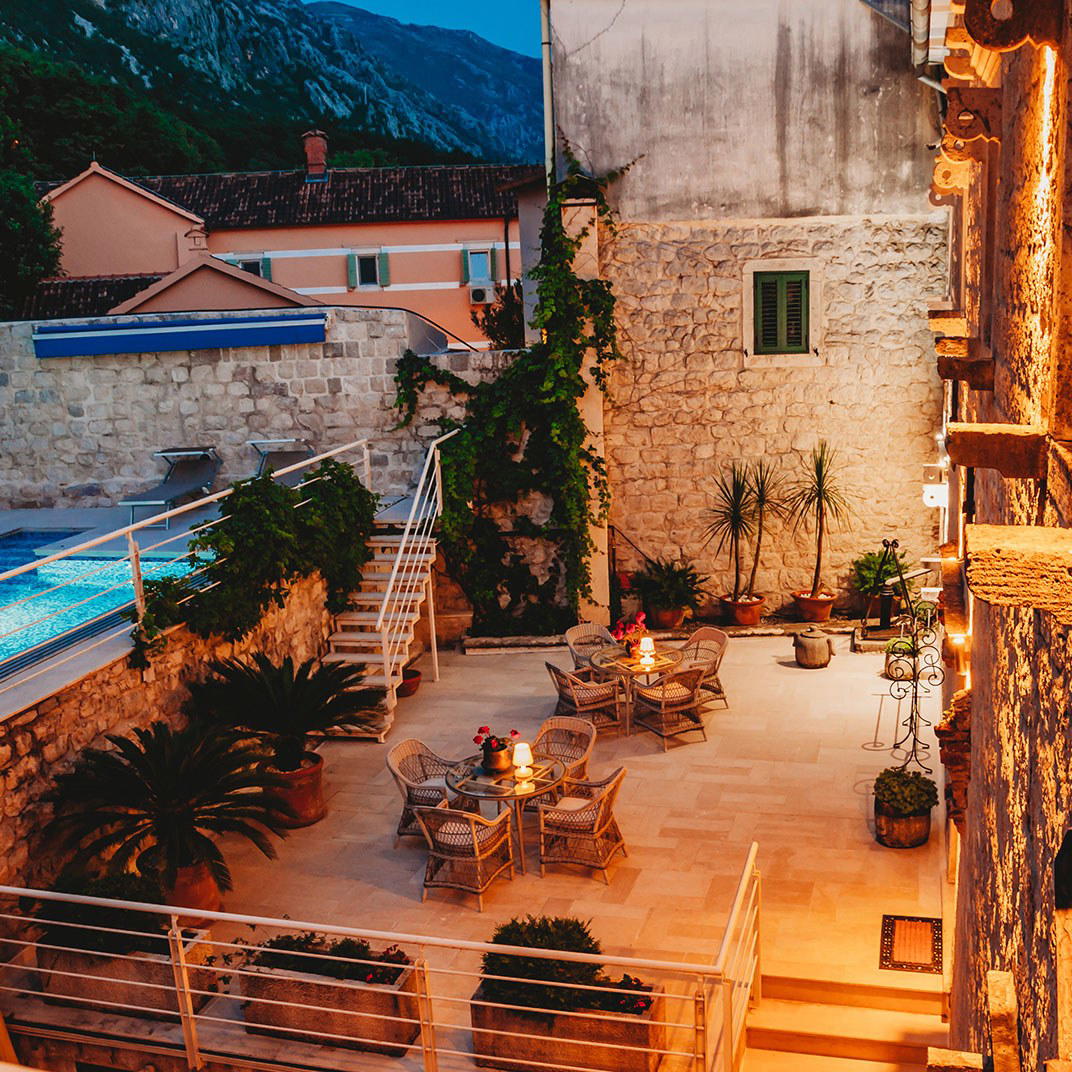
Stone, Water, and the Architecture of Restraint
The Bay of Kotor has a way of reframing what luxury means. Enclosed by karst mountains that drop almost vertically into the water, the bay operates at a scale that makes large resort footprints look out of proportion. The hotels that tend to read most convincingly here are the ones that work with the existing grain of the place: walled courtyards, thick stone construction, water access at the level of a terrace rather than a beach. Palazzo Radomiri Hotel, positioned in the village of Dobrota just north of Kotor's old town walls, fits precisely that template.
The building is an 18th-century Baroque palazzo, and the architectural logic of that era is still legible throughout the property. Baroque residential construction along the Kotor riviera was a function of Venetian commercial wealth: merchants who prospered under the Republic built substantial stone houses with formal facades facing the water, interior courtyards for private use, and rooms arranged around a central axis. Palazzo Radomiri preserves that spatial hierarchy. The relationship between the public face of the building and the bay is not incidental — it was the organizing principle of the original design, and it remains the defining experience of staying here.
That kind of architectural continuity is rarer than it sounds along the Montenegrin coast. Much of the new luxury development in the region, including large-scale projects at Luštica Bay and Herceg Novi, has been built from scratch on previously undeveloped land. The Chedi Luštica Bay in Tivat and One&Only; Portonovi in Herceg Novi operate at resort scale with contemporary construction. Palazzo Radomiri does not compete in that register. It belongs instead to a smaller, older cohort of Adriatic heritage properties where the building itself carries most of the editorial weight.
Michelin Selection and What It Signals
Palazzo Radomiri carries a MICHELIN Selected designation from the Michelin Hotels & Stays 2025 guide. Michelin's hotel selection sits outside its restaurant star system but follows a comparable curatorial logic: properties are assessed on quality, character, and consistency rather than scale or marketing spend. For comparison, properties like Mamula Island by Banyan Tree in Mamula and Ananti Resort Residences & Beach Club in Reževići represent the newer investment tier along this coastline, while Palazzo Radomiri's selection is grounded in the historic fabric of the building rather than amenity volume.
This distinction matters when calibrating expectations. Michelin's hotel guide consistently recognizes properties where a strong sense of place compensates for a limited room count or the absence of full resort infrastructure. Heritage palazzo hotels in the Adriatic, whether on the Dalmatian coast or here in the Bay of Kotor, tend to deliver on atmosphere and architectural specificity rather than spa square footage. Guests who have stayed at comparable properties, such as converted palazzi in Venice like Aman Venice or Cipriani, A Belmond Hotel, Venice, will recognize the trade-off: the building gives you something a purpose-built hotel cannot, but the operational envelope is correspondingly tighter.
Dobrota: The Village as Context
The address on Kriva in Dobrota places the hotel in a ribbon settlement that stretches along the waterfront north of Kotor's UNESCO-listed old town. Dobrota was historically home to the captains and merchant families who served the Venetian fleet, and the architecture along its waterfront reflects that concentrated wealth: a sequence of 17th- and 18th-century palazzi, chapels, and walled gardens, most of them privately held and seldom open to visitors. Staying at Palazzo Radomiri puts you inside that fabric rather than across from it.
The practical geography matters too. Kotor's old town is walkable from Dobrota, which means access to the walled city's restaurants, shops, and the weekly market without being inside the walls, where summer foot traffic at peak season compresses significantly. The bay itself is navigable by water taxi, connecting Dobrota to Perast, Our Lady of the Rocks, and the western shore of the bay. For guests arriving by car, the Kotor approach from the south via the Adriatic Highway is among the more memorable coastal drives in the region. Our full Kotor restaurants guide covers where to eat once you're based here.
How It Sits in the Regional Tier
Montenegro's hotel market has stratified quickly over the past decade. At the top of the new-build category sit properties with international brand affiliations and resort-level infrastructure: Dukley Hotel & Resort in Budva represents the domestic luxury developer model, while the international brand approach shows up at properties like Villa Geba in Sveti Stefan. Neither model is what Palazzo Radomiri is doing. Its competitive set is smaller and more European in reference: small heritage hotels in walled Adriatic cities, properties where the building's age is a credential rather than a complication.
The design logic connecting a restored 18th-century Venetian-inflected palazzo on the Bay of Kotor to a converted historic property like Castello di Reschio in Lisciano Niccone in Umbria, or to the adaptive reuse philosophy behind properties like Hotel Sacher Wien in Vienna, is the same underlying proposition: architecture as the primary amenity, and history as a framework for contemporary hospitality rather than an obstacle to it.
Planning Your Stay
The Bay of Kotor operates on a compressed summer season. July and August bring the highest visitor density to Kotor's old town and the surrounding villages, with water temperatures warm enough for swimming from late June through September. Spring, particularly May and early June, and early autumn in September and October tend to offer more manageable conditions for exploring the bay and the mountain roads above it. The Lovćen massif above Kotor, accessible by the famous serpentine road with 25 hairpin bends, is leading driven outside of peak summer heat. Flights to Tivat airport connect to a range of European hubs seasonally; Podgorica's airport operates year-round with fewer direct routes. From Tivat, Dobrota is approximately 30 kilometres by road around the bay.
Palazzo Radomiri is not a property where the amenity list is the story. The case for staying here rests on the building, the waterfront position, and the specific quality of light that the enclosed bay produces in the morning hours. Those are things the Michelin selection is implicitly endorsing, and they are reasons enough for the right traveller to look past properties with more extensive programming elsewhere along the coast.
How It Stacks Up
Comparable venues nearby, for context on price, style, and recognition.
| Venue | Cuisine | Price | Awards | Notes |
|---|---|---|---|---|
| Palazzo Radomiri HotelThis venue — the venue you are viewing | Restored 18th-century sea captain's palazzo blending historical charm with modern comforts. | $100–200 | Michelin Selected | Not listed |
| One&Only Portonovi | Luxury resort blending modern architecture with local village-inspired rustic elements | $750–1,000 | 2 Michelin Keys · La Liste Top Hotels | Herceg Novi |
| Mamula Island | Restored 19th-century fortress blending heritage with contemporary luxury | $750–1,000 | Michelin Selected · Tablet Hotels Best New Hotel Designs (Europe) | Mamula Island |
| Lazure Hotel & Marina | Heritage-meets-modern luxury boutique resort blending 18th-century Venetian architecture with contemporary design and minimalist aesthetics. | $200–300 | Michelin Selected | Meljine, Herceg Novi |
| Dukley Hotel & Resort | luxury beachfront resort | $200–300 | Michelin Selected | Zavala Peninsula |
| Ananti Resort Residences & Beach Club | Contemporary luxury beachside resort with suites and independent villas | Not listed | Leading Hotels of World Member | Reževići |
Recognition history
Dated appearances from independent guides and award organizations, with the underlying list record or original source where available.
Michelin Selected
Michelin
Continue exploring
More in Kotor
Hotels in Kotor
Browse all →
Bars in Kotor
Browse all →
Restaurants in Kotor
Browse all →
Wineries in Kotor
Browse all →
Details
- Romantic
- Quiet
- Elegant
- Scenic
- Intimate
- Sophisticated
- Honeymoon
- Romantic Getaway
- Anniversary
- Weekend Escape
- Beachfront
- Panoramic View
- Historic Building
- Terrace
- Wi Fi
- Pool
- Spa
- Fitness Center
- Room Service
- Concierge
- Airport Transfer
- Private Beach
- Bar
- Waterfront
- Mountain
Sublimely peaceful antique-filled interiors with exposed stone walls, overlooking the serene bay, fostering a romantic and relaxing atmosphere.