Matterhorn FOCUS

A 30-room design hotel in Zermatt awarded Michelin 2 Keys in 2024, Matterhorn FOCUS is defined by designer Heinz Julen's signature glass, steel, and wood aesthetic. Nearly every room opens onto a private balcony with direct views of Zermatt village or the Matterhorn itself. A dedicated lift connects guests to the Matterhorn Express cable car system.
 Discover on Pearl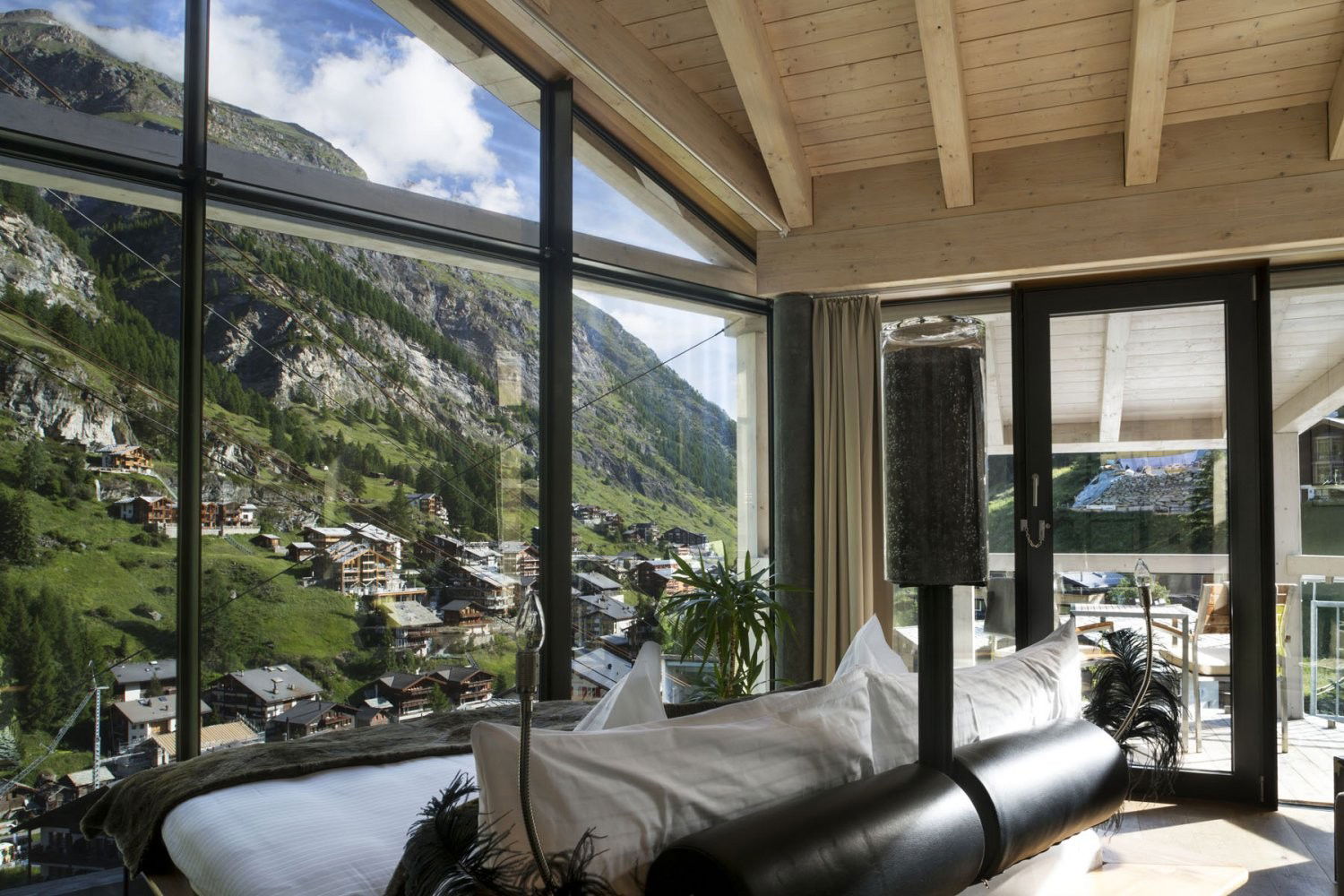
Glass, Steel, and Mountain: Design-Led Lodging in Zermatt
Zermatt's hotel market has never been more stratified. At one end sit the grand Belle Époque institutions like the Grand Hotel Zermatterhof and Mont Cervin Palace, offering the kind of formal Swiss grandeur that has defined Alpine hospitality for over a century. At the other end, a newer cohort of smaller, design-forward properties has established itself by treating material honesty and architectural specificity as the primary luxury signal. Matterhorn FOCUS belongs firmly to that second group. Designer Heinz Julen, one of the more consequential figures in Zermatt's contemporary architecture scene, conceived the property around a material palette of glass, steel, and wood — a language that reads simultaneously as industrial and Alpine, resisting the decorative pastiche that dominates much of the resort's accommodation offer.
The result is a 30-room hotel that earns Michelin's 2 Keys recognition (awarded 2024) not through scale or amenity breadth, but through the clarity and consistency of its design proposition. That Michelin 2 Keys designation places it alongside CERVO Mountain Resort in Zermatt's design-led tier, a peer set that prioritises architectural intent over room count. For context on how the full Zermatt accommodation market maps out, our full Zermatt hotels guide covers the range from budget chalets to the village's most awarded properties.
The View as Structural Feature
In most Alpine resorts, a Matterhorn view is a marketing claim attached to a select number of premium rooms. At Matterhorn FOCUS, the view is closer to a design principle. Almost all of the property's 30 rooms are fitted with private balconies oriented toward either Zermatt village or the Matterhorn, meaning the mountain is not an upgrade — it is the default condition of the stay. This orientation is architectural rather than incidental: Julen's glass-forward aesthetic is explicitly designed to dissolve the boundary between interior and exterior, so the mountain reads as part of the room rather than something glimpsed through a window.
This approach to view-framing has become more common in premium Alpine lodging , properties like 22 SUMMITS Boutique Hotel and Backstage Hotel Vernissage both foreground the visual relationship with the surrounding peaks , but the consistency of the balcony provision across nearly the entire room inventory at Matterhorn FOCUS is a meaningful distinction within that peer group.
Responsible Luxury in the Alpine Context
The Michelin 2 Keys framework, introduced to evaluate hotels with the same rigour applied to restaurants, assesses properties on criteria that include architecture, service consistency, and increasingly, environmental responsibility. In the Swiss Alps, where the tension between tourism infrastructure and ecological fragility is particularly acute, responsible luxury is not a marketing overlay , it is a condition of operating at altitude in a protected landscape. Zermatt itself is a car-free village, accessible only by train from Täsch, which structures the entire resort's relationship with low-impact mobility. Every property in Zermatt inherits this baseline sustainability credential by virtue of the village's transport policy.
Within that context, design-led properties like Matterhorn FOCUS carry an additional implicit argument: that materiality and scale are themselves sustainability choices. A 30-room hotel with a considered material palette , wood sourced from regional traditions, glass that reduces the need for artificial lighting by maximising daylight, steel that foregrounds longevity over ornament , represents a different footprint model than a 200-room resort with a full spa infrastructure. The compact scale means energy demand is proportionally lower, and the design coherence reduces the churn of renovation cycles that affect larger properties. This is not a claim the property makes explicitly in available data, but it is a structural reality of the format that aligns with the direction European luxury hospitality is moving, as Michelin's own Keys criteria reflect.
Switzerland's broader hotel sector is navigating similar questions. Properties like the The Alpina Gstaad and the Bürgenstock Resort have made sustainability infrastructure central to their positioning, while city hotels such as Baur au Lac in Zurich and Beau-Rivage Palace in Lausanne approach responsible practices through heritage preservation and community longevity. Matterhorn FOCUS operates at a smaller scale than all of these, but its Michelin recognition places it in the same conversation about what constitutes accountable luxury in the Swiss context.
Access and Practical Positioning
One of the property's logistical advantages is direct lift access to the Matterhorn Express cable car, the primary route up toward Trockener Steg and onward connections to the Klein Matterhorn. This removes one of the more friction-heavy aspects of skiing or hiking in Zermatt , the morning trek through the village to the lifts , and positions the hotel as genuinely ski-in, ski-out in functional terms, not merely by proximity. For a 30-room property at this price positioning, that access adds meaningful practical value that larger hotels at equivalent rates cannot always offer.
Getting to Zermatt requires arrival by train: the Matterhorn Gotthard Bahn from Täsch (itself reached by rail from Geneva, Zurich, or Visp) is the standard route, and the car-free village means all luggage transfer is handled by electric taxi or hotel transport. Booking should be treated as essential well ahead of peak winter season (December through February) and summer hiking months (July through August), when the village operates at near-capacity. The property's 30 rooms limit availability further, so advance planning is the standard operating assumption for this tier of Zermatt lodging.
For dining options around the property, our full Zermatt restaurants guide maps the village's range from casual rosti-and-fondue spots to Michelin-recognised tables. For bars and après-ski, our full Zermatt bars guide covers the scene. And if cultural programming or mountain experiences are a priority, our full Zermatt experiences guide outlines what the valley offers beyond skiing.
Where It Sits in the Zermatt Market
Matterhorn FOCUS occupies a specific niche: design-led, architecturally coherent, Michelin-recognised, and compact enough to feel closer to a private residence than a resort. It does not offer the lobby grandeur of the BEAUSiTE Zermatt or the full-service breadth of Boutique Hotel Matthiol. What it offers instead is architectural specificity and a view proposition that is structurally embedded rather than optionally available.
For guests whose priority is a considered physical environment and direct mountain access rather than F&B; programming or spa facilities, this is the relevant peer set. Within that set, the Heinz Julen design credential and the 2024 Michelin 2 Keys award provide verifiable positioning signals that place it at the upper end of the boutique tier in Zermatt. Travellers comparing it against Swiss luxury benchmarks elsewhere in the country , the Badrutt's Palace Hotel in St. Moritz or the Hotel Les Trois Rois in Basel , will find a different kind of offer: smaller, quieter, architecturally precise, with the mountain doing most of the heavy work that those properties assign to service scale.
Frequently Asked Questions
- Which room category should I book at Matterhorn FOCUS?
- Almost all of the property's 30 rooms include a private balcony oriented toward either Zermatt village or the Matterhorn, so the baseline room offer already reflects what the hotel's Michelin 2 Keys (2024) recognition and Heinz Julen design concept are built around. The primary decision is whether you prioritise village views or direct Matterhorn sight lines, rather than a significant step-up in room type. Given the 30-room inventory and demand during peak seasons, confirming a Matterhorn-facing balcony at the time of booking rather than on arrival is the sensible approach.
- Why do people go to Matterhorn FOCUS?
- Matterhorn FOCUS attracts guests looking for a design-led alternative to Zermatt's larger, more traditional hotels. The Michelin 2 Keys recognition (2024), Heinz Julen's glass-steel-wood architecture, near-universal balcony provision with mountain or village views, and direct lift access to the Matterhorn Express are the primary draws. It sits in a specific niche within the Zermatt market: architecturally coherent, compact at 30 rooms, and positioned above mid-market boutique options without the formal service structure of the village's grand hotel tier.
- Do they take walk-ins at Matterhorn FOCUS?
- Walk-in availability at a 30-room property in Zermatt is not a reliable planning assumption, particularly during peak ski season (December to February) and peak summer hiking months (July and August), when the village operates at high occupancy across all tiers. Matterhorn FOCUS's Michelin 2 Keys status (2024) and limited room count mean demand is consistent. Advance booking is the standard approach; no walk-in policy is confirmed in available data, but the inventory constraints make pre-arrival reservation the only dependable option.
- What's Matterhorn FOCUS a strong choice for?
- Matterhorn FOCUS is a strong choice for travellers who place architectural environment and mountain access above F&B; programming or resort-scale amenities. The direct lift connection to the Matterhorn Express is a functional ski-in, ski-out advantage, the Heinz Julen design creates a coherent visual experience across the property, and the 2024 Michelin 2 Keys recognition provides an independent quality signal. Guests comparing it to properties like CERVO Mountain Resort will find a similarly boutique scale with a different material aesthetic.
- How does the Heinz Julen design at Matterhorn FOCUS compare to other Zermatt hotels?
- Heinz Julen is among the most recognised designers working in Zermatt, with a body of work that spans hospitality, residential, and public projects in the village. The glass, steel, and wood palette at Matterhorn FOCUS is a signature rather than a generic Alpine vernacular, distinguishing it from the timber-chalet styling common across the resort's mid-tier and from the formal grandeur of the village's historic properties. The 2024 Michelin 2 Keys award, which evaluates design coherence as part of its hotel assessment criteria, effectively validates that the execution reaches a recognised standard within European luxury lodging.
Cost and Credentials
A quick peer reference to anchor this venue in its category.
| Venue | Price | Awards | Notes |
|---|---|---|---|
| Matterhorn FOCUS | Michelin 2 Keys | This venue | |
| CERVO Mountain Resort | Michelin 2 Key | Michelin 2 Keys | |
| Chalet Hotel Schönegg | |||
| THE OMNIA Mountain Lodge | |||
| 22 SUMMITS Boutique Hotel | |||
| Backstage Hotel Vernissage |
Preferential Rates?
Our members enjoy concierge-led booking support and priority upgrades at the world's finest hotels.
Get Exclusive Access