
Built almost entirely from salt blocks harvested from the Salar de Uyuni, Hotel de Sal Luna Salada sits on the edge of the world's largest salt flat at 3,656 metres above sea level. Recognised by the Michelin Selected Hotels 2025 guide, it is one of the few properties anywhere that uses its geological setting as its primary construction material. The result is a hotel that reads as architecture before it reads as hospitality.
Pearl is the En Primeur Club membership app — saves, bookings, and concierge access live there. Same editors, same standards.
- Address
- A 25 km de Uyuni, Uyuni, Bolivia
- Phone
- +591 71212007
- Website
- lunasaladahotel.com.bo
- Directions
- Get directions
 Saves & bookings on Pearl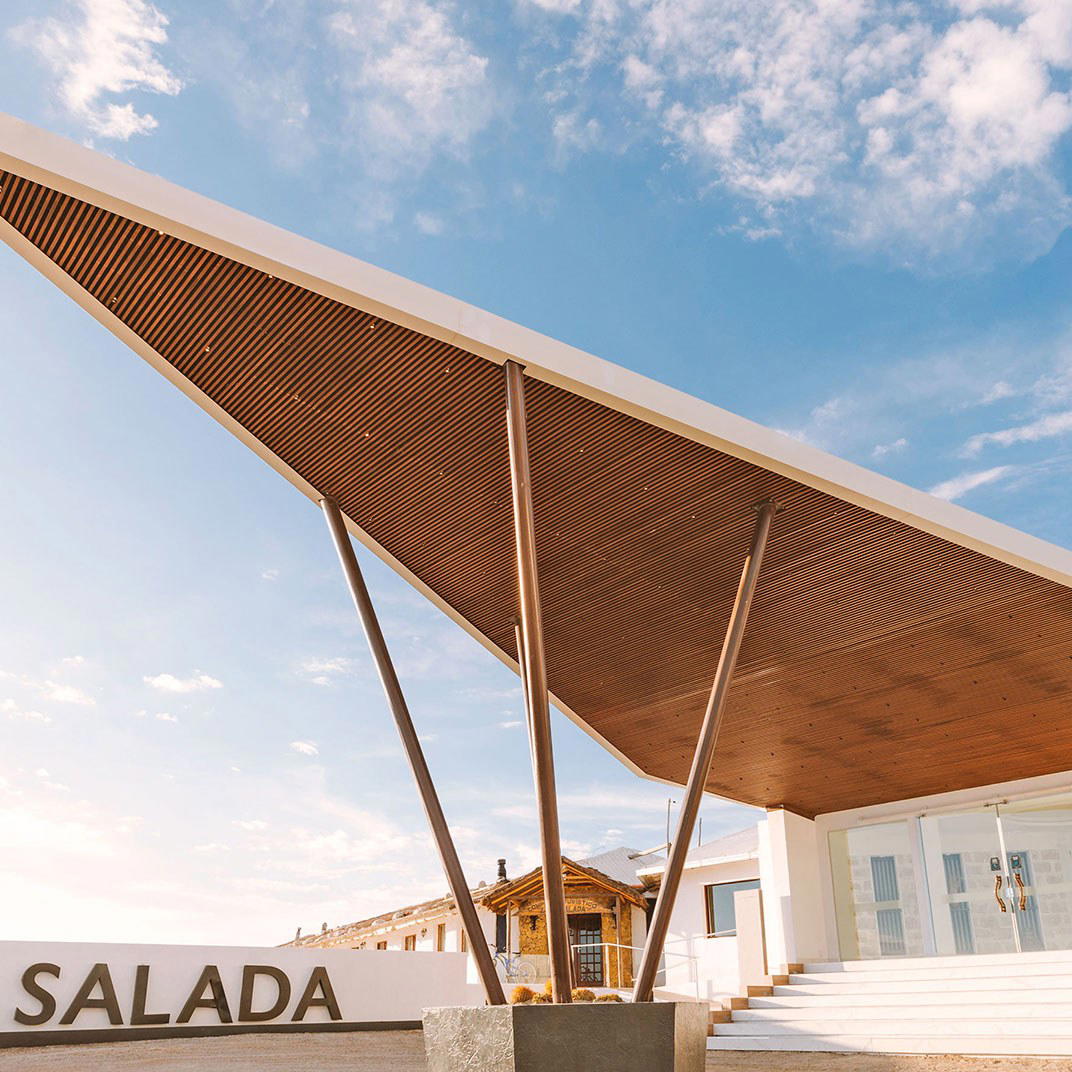
When the Building Material Is the Landscape
There is a narrow category of hotels where the physical environment so completely determines the structure that the two become inseparable. Most properties in dramatic locations borrow their setting as backdrop. Hotel de Sal Luna Salada does something categorically different: the Salar de Uyuni, the world's largest salt flat stretching across roughly 10,000 square kilometres of the Bolivian altiplano at over 3,600 metres altitude, is not the view from the window. It is the wall, the floor, the ceiling, and the furniture. Walls are laid from salt blocks. Floors are packed salt. The beds, tables, and chairs are carved or constructed from salt extracted directly from the flat. The architecture is less a design statement than a geological fact.
This places Luna Salada in a small international cohort of properties whose construction logic is entirely site-specific. You might draw a loose parallel to cave hotels in Cappadocia or the desert-poured concrete of Amangiri in Canyon Point, where the building material and the terrain share an obvious kinship. But neither of those uses the same material underfoot as overhead. The salt hotel format is almost entirely limited to Bolivia, and within Bolivia, the cluster of properties near Uyuni represents the only serious iteration of the concept at any scale.
Michelin Recognition and What It Signals Here
Luna Salada carries a Michelin Selected designation in the 2025 Michelin Hotels guide, which positions it within a comparable set defined by quality of experience rather than luxury spend. Michelin Selected does not imply the trophy architecture of a Badrutt's Palace Hotel in St. Moritz or the multi-Michelin-starred dining programs of Le Bristol Paris. What it does signal, in a remote altiplano location with genuine logistical constraints, is that the hospitality standard holds up against a global editorial filter. For Uyuni specifically, where the accommodation options have historically ranged from budget backpacker hostels to mid-tier lodges, a Michelin selection represents a meaningful positioning step.
The nearest comparison within Uyuni's own competitive set is Explora Uyuni, which approaches the destination through guided expedition programming. Luna Salada's angle is architectural and atmospheric rather than activity-led, which makes the two properties complementary in offer rather than direct substitutes. Travellers choosing between them are essentially choosing between immersive design and structured exploration.
The Architecture as Experience
Salt as a building material carries specific atmospheric consequences. The interior temperature regulation differs from stone or concrete because salt has low thermal conductivity, which moderates the dramatic swing between the altiplano's cold nights and intense daytime solar radiation. The surfaces have a particular texture, somewhere between rough plaster and compressed mineral, and the light behaviour across white salt walls changes significantly depending on time of day and sky conditions. At altitude, under the high-contrast light of the Bolivian altiplano, the interior spaces can appear almost luminous in certain conditions.
The design philosophy at properties like this tends to sit in tension between the material's raw quality and the demands of guest comfort. Too much refinement erases the point; too little tips into novelty gimmick. The properties that resolve that tension most convincingly, like Castello di Reschio in Lisciano Niccone with its restored Umbrian stone, or Hotel Esencia in Tulum with its hacienda bones, treat the original material as structural constraint rather than decorative motif. Luna Salada operates in a similar register: the salt is not an accent, it is the architecture.
Getting There and Planning the Visit
Uyuni is reached by domestic flight from La Paz or Santa Cruz, or by overnight bus from La Paz, a journey of around 10 to 11 hours depending on road conditions. The altitude sits above 3,600 metres, which requires standard acclimatisation protocols: most travellers spend at least one night in La Paz (where Atix Hotel in La Paz provides a strong base at 3,640 metres) before continuing south. The dry season, running from May through October, delivers the clearest skies and the easiest road access across the flat. The wet season, November through April, floods the salar's surface to a shallow film of water that produces the famous mirror reflection effect, a genuinely different visual experience that draws photographers specifically for that condition.
Luna Salada sits directly on the edge of the salar, meaning the flat is accessible on foot from the property rather than requiring a vehicle transfer. For a destination where the journey to the salt flat is often treated as a separate excursion, this is a logistical advantage worth weighing. Advance booking is advisable, particularly for the dry season peak window of June through August, when Uyuni receives its highest concentration of international visitors.
Bolivia's Hospitality Positioning in a Global Context
Bolivia sits outside the primary luxury hotel circuits that run through Europe, Southeast Asia, and the Middle East. Properties in La Paz and Uyuni do not compete in the same tier as Aman Venice, Mandarin Oriental Bangkok, or Hôtel de Paris Monte-Carlo on price or facility scale. What Bolivia does offer, and Luna Salada delivers more directly than most, is an encounter with a physical environment that has no equivalent elsewhere. The Salar de Uyuni is not a landscape that translates into other formats. A hotel built from its material, sitting on its edge, with Michelin editorial recognition, occupies a position that no amount of investment in a conventional luxury hotel could replicate in a more accessible destination.
That specificity is the editorial case for the property. Travellers who have moved through the recognised luxury canon, from Cheval Blanc Paris to Bvlgari Hotel Tokyo, will find nothing here that competes on conventional luxury terms. What they will find is a building that cannot exist anywhere else, in a place that rewards the effort of getting there. The property reads as the architectural anchor of a destination with a specific draw and few peers.
Comparison Snapshot
Comparable venues nearby, for context on price, style, and recognition.
| Venue | Cuisine | Price | Awards | Notes |
|---|---|---|---|---|
| Hotel de Sal Luna SaladaThis venue — the venue you are viewing | Rustic Andean lodge with contemporary comfort, blending traditional Bolivian design elements with modern amenities in a remote salt flat setting. | $$$ | Not listed | Not listed |
| Explora Uyuni | Sustainable minimalist lodge designed for minimal environmental impact with low-profile architecture. | $$$$ | Not listed | Tunupa volcano slopes |
| Atix Hotel | Contemporary boutique in upscale residential area with local Bolivian materials and art integration. | $$$$ | 4-Star | Zona Sur |
| Met Hotel La Paz | Contemporary luxury boutique hotel with Nordic-inspired spa design and Andean cultural elements | $$$$ | 5-Star | Alto Obrajes |
Recognition history
Dated appearances from independent guides and award organizations, with the underlying list record or original source where available.
Michelin Selected
Michelin
Continue exploring
More in Uyuni
Hotels in Uyuni
Browse all →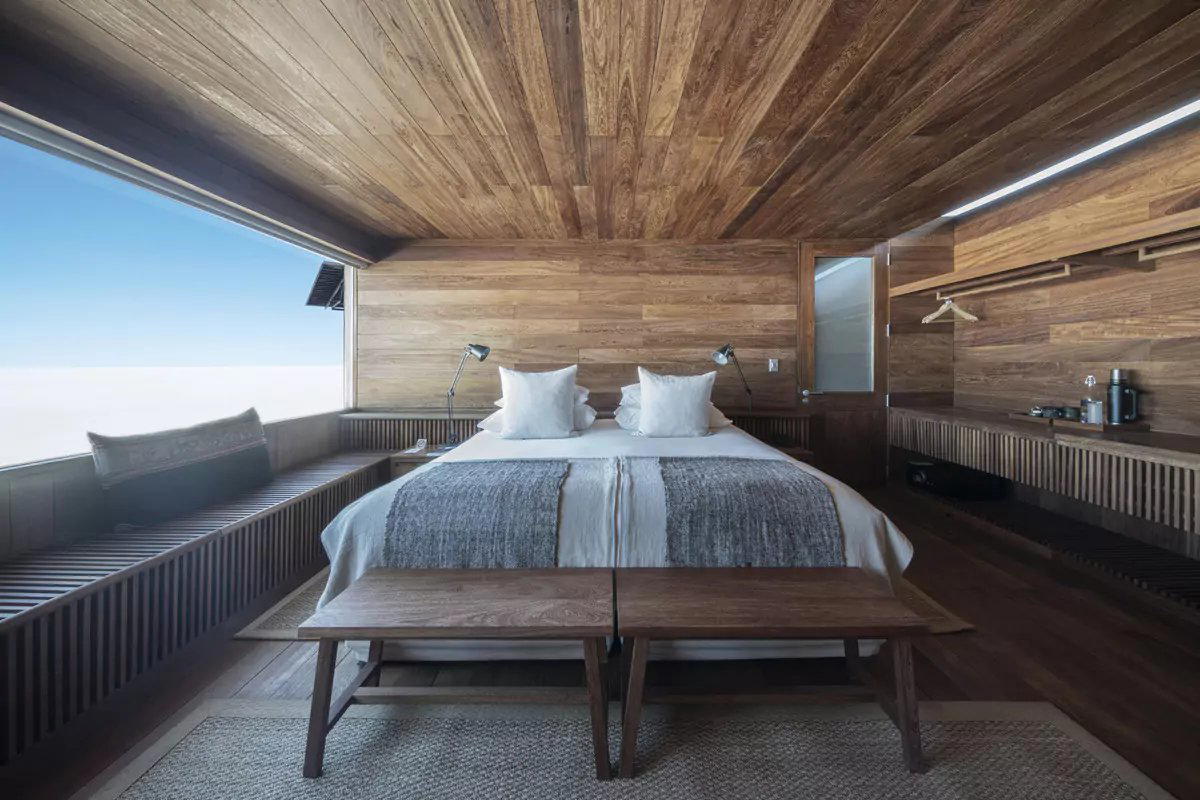
At a Glance
- Scenic
- Rustic
- Intimate
- Cozy
- Whimsical
- Romantic Getaway
- Family Vacation
- Wellness Retreat
- Weekend Escape
- Panoramic View
- Destination Spa
- Terrace
- Garden
- Spa
- Massage
- Restaurant
- Bar
- Wi Fi
- Mountain
- Spa
- Massage
- Restaurant
- Bar
- Wi Fi
Warm and intimate with rustic Andean charm, featuring exposed salt walls and floors, colorful woven textiles, fireplace seating areas, and cozy furnishings that create a magical, secluded atmosphere.