Fairmont Washington, D.C., Georgetown


Fairmont Washington, D.C., Georgetown sits at 2401 M Street NW, where a $27 million renovation has repositioned it as one of the capital's more considered addresses for power-adjacent stays. The property holds a 2026 Star Wine List award and a redesigned lobby featuring gold and silver geometric forms that frame an aerial view of the city. It draws a politically connected crowd that has made it a long-running fixture in Georgetown's hotel circuit.
 Discover on Pearl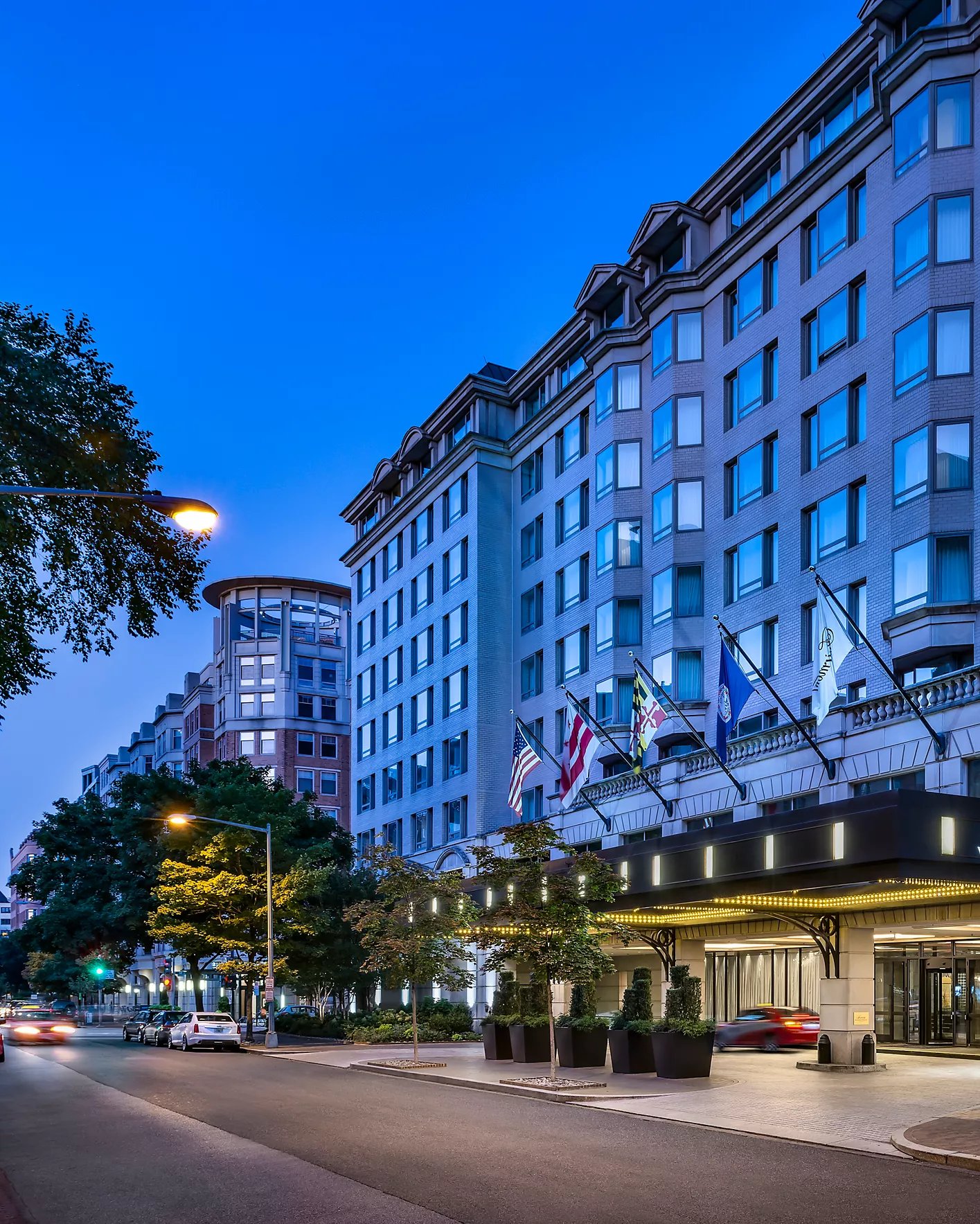
Where Georgetown's Political Gravity Meets a Renovated Interior
Washington hotels divide roughly into two camps: those that trade on history and institutional formality, and those that have invested in physical reinvention to hold a newer, design-aware traveler. The Fairmont Washington, D.C., Georgetown belongs firmly to the second category after a $27 million renovation that altered not just the look of the property but its standing in a competitive field. For comparison, properties like Rosewood Washington, D.C. and The Hay-Adams Hotel have built their reputations on continuity with Washington's established order; the Fairmont's renovation signals a different kind of ambition.
The lobby is the clearest statement of that shift. Gold and silver geometric forms float overhead, designed to evoke an aerial view of the capital, and the effect lands somewhere between architectural installation and civic pride. It is the kind of entrance that reads well to a guest arriving from a long flight into Dulles or Reagan National, and it calibrates expectations before a key is ever handed over. Georgetown's M Street address puts the hotel at the quieter, residential edge of one of the city's most politically dense neighbourhoods, within reach of both the K Street corridor and the waterfront's newer developments.
The shortlist, unlocked.
Hard-to-book tables, cellar releases, and concierge-planned trips.
Get Exclusive Access →The Retreat Argument in a City That Rarely Stops
Washington does not naturally invite the retreat mindset. The city runs on proximity to power, and its hospitality culture reflects that, favouring the breakfast meeting and the late dinner over the restorative afternoon. Against that backdrop, the case for a wellness-oriented stay inside a renovated Georgetown property is stronger than it might appear in other American cities. When the political calendar compresses and the schedule becomes unsustainable, having a hotel that functions as a recovery base rather than simply a place to sleep becomes a meaningful differentiator.
The Fairmont format, as a global chain with consistent wellness infrastructure across its portfolio, typically offers fitness facilities and spa programming calibrated for business travelers who also want structured recovery. This is a different proposition from the full-destination wellness model you find at places like Canyon Ranch Tucson or the coastal withdrawal of Little Palm Island Resort and Spa, where the environment itself is the treatment. At a Georgetown Fairmont, the wellness offer is embedded in a full-service urban hotel, which makes it accessible to the guest who has two hours between commitments rather than two weeks clear of them.
Properties like Amangiri in Canyon Point or Post Ranch Inn in Big Sur are built around the logic of geographic remove: the landscape itself does the therapeutic work. Urban wellness in Washington requires a different architecture, one that creates separation through design and programming rather than miles. The renovation's emphasis on a reimagined common space suggests attention to that problem.
A Wine Program That Has Earned External Notice
The 2026 Star Wine List award is a concrete credential that places the Fairmont Washington in a specific tier of hotel wine programs. Star Wine List evaluations are based on list depth, range, and price fairness, and recognition in 2026 indicates the program has been assessed against peers recently enough to be current. For a hotel whose competitive set includes properties like The Jefferson and Riggs Washington DC, earning a named wine award gives the food and beverage operation a measurable point of distinction beyond the renovation itself. Guests who use hotel dining as a serious part of their stay, rather than a fallback option, will find this credential worth noting.
In Washington's hotel dining context, this matters more than in cities where standalone restaurants dominate. The capital's power-lunch and working-dinner culture means hotel restaurants and bars carry real social weight. A wine list recognised by a specialist publication signals that the beverage program is being run with the same seriousness that the renovation brought to the physical space. For broader context on where the Fairmont sits within Washington's food and drink scene, our full Washington, D.C. restaurants guide maps the city's dining character across neighbourhoods and price tiers.
Georgetown's Hotel Tier and Where the Fairmont Sits Within It
Georgetown occupies a specific register in Washington hospitality. It is residential and insulated in a way that the downtown corridor is not, which appeals to guests who want proximity to political Washington without being inside its most transactional blocks. The neighbourhood's hotel offer is smaller than it might appear: options at the upper tier are limited, which gives each property a clearer identity by default. The The Dupont Circle Hotel and Eaton D.C. occupy adjacent neighbourhoods with different guest profiles, while Pendry Washington DC at The Wharf draws a younger, waterfront-oriented traveler. The Fairmont's position at 2401 M Street places it in Georgetown proper, which carries a different social gravity than those alternatives.
For travelers calibrating options across the broader luxury market, it is worth noting how Washington compares to comparable capital-city stays. Raffles Boston and The Fifth Avenue Hotel in New York City represent the Northeast corridor's renovation-driven repositioning strategy, where established properties have used capital investment to reclaim ground from newer independents. The Fairmont's $27 million renovation fits that same pattern: a recognized brand using a significant physical upgrade to defend its position against a field that now includes design-led independents and boutique flagships.
Planning Your Stay
The Fairmont Washington, D.C., Georgetown is located at 2401 M Street NW, within walking distance of Georgetown's main commercial strip and the C&O; Canal towpath, which functions as both a running route and a quieter alternative to the neighbourhood's busier streets. Reagan National Airport (DCA) is the closest major gateway, typically 20 to 30 minutes by car depending on traffic, and serves the majority of domestic routes into Washington. Dulles International (IAD) is the better option for transatlantic arrivals and is roughly 45 minutes out. For travelers arriving by rail, Union Station connects to the rest of the city via Metro, with a short cab or rideshare ride completing the journey to Georgetown. The property's renovation-era infrastructure suggests it is currently in its strongest physical condition, which makes now a reasonable window for a first or return visit. Guests interested in comparable wellness-anchored urban stays elsewhere in the country should also consider Hotel Bel-Air in Los Angeles or Aman New York for reference points on what that format looks like at full scale. For something closer in character but set against a rural backdrop, Troutbeck in Amenia, Sage Lodge in Pray, and SingleThread Farm Inn in Healdsburg represent the retreat-first end of the spectrum that an urban Georgetown stay deliberately trades away in favour of access and proximity.
The shortlist, unlocked.
Hard-to-book tables, cellar releases, and concierge-planned trips.
Get Exclusive Access →Frequently Asked Questions
Awards and Standing
Comparable venues for orientation, based on our database fields.
| Venue | Awards | Cuisine | Notes |
|---|---|---|---|
| Fairmont Washington, D.C., Georgetown | This venue | ||
| Rosewood Washington, D.C. | Michelin 2 Key | ||
| Pendry Washington DC — The Wharf | Michelin 1 Key | ||
| Four Seasons Hotel Washington, D.C. | |||
| Waldorf Astoria Washington DC | |||
| The Ritz-Carlton Georgetown, Washington, D.C. |
Preferential Rates?
Our members enjoy concierge-led booking support and priority upgrades at the world's finest hotels.
Get Exclusive AccessThe shortlist, unlocked.
Hard-to-book tables, cellar releases, and concierge-planned trips.
Get Exclusive Access →