A family-run alpine resort in Maria Alm at the foot of the Hochkönig massif, die HOCHKÖNIGIN blends 76 rooms with an extensive spa and the High Queen Bar. Earth tones, blonde wood, and deliberate design choices throughout give it a character that most corporate mountain properties don't attempt. Rates from $332 per night position it in the considered mid-to-upper tier of Austrian alpine hospitality.
 Discover on Pearl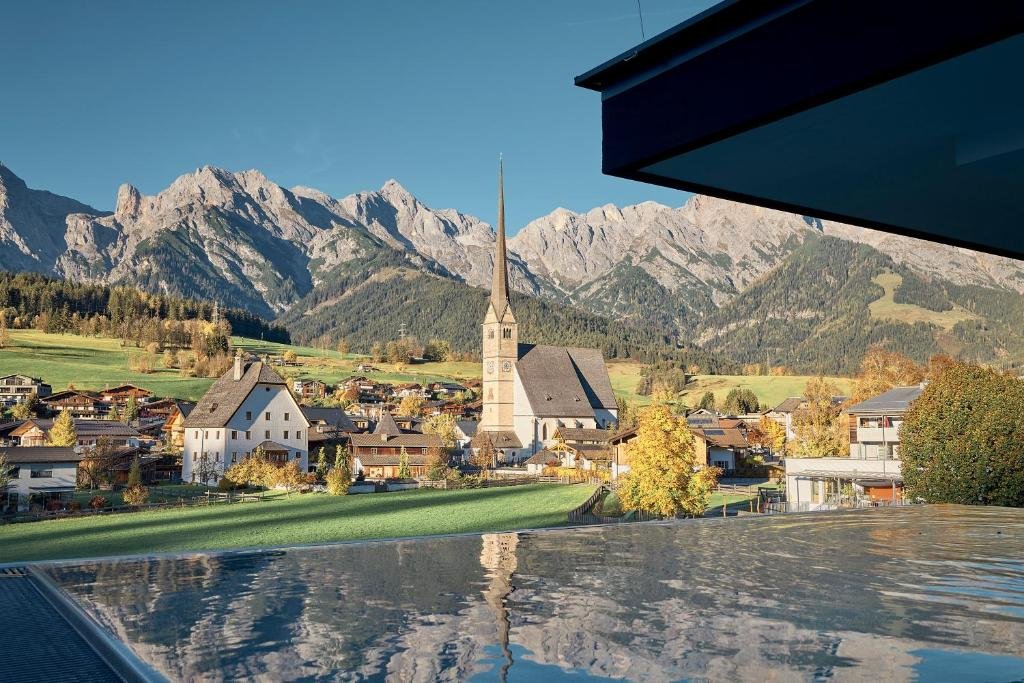
Where the Hochkönig Sets the Terms
Maria Alm sits at the northern edge of the Hochkönig ski circuit in the Salzburger Land, a region that draws serious alpine travelers rather than the crowd chasing Kitzbühel's social scene or Lech's price ceiling. The village is compact, the terrain is demanding, and the hotels here are expected to do more than provide a bed between runs. In this context, die HOCHKÖNIGIN Mountain Resort occupies a specific position: a family-operated property with 76 rooms, a full spa program, and an interior language that takes design as seriously as the skiing outside. Rates start at $332 per night, placing it in the upper-mid bracket of Austrian alpine accommodation, comparable in positioning to properties like Aktiv & Wellnesshotel Bergfried in Tux and Alpen-Wellness Resort Hochfirst in Obergurgl, though each occupies a different corner of the Austrian Alps.
The Interior Argument
Austrian alpine hotels have historically defaulted to two modes: the heavy-timber chalet aesthetic that signals tradition, and the minimalist concrete-and-glass approach that signals modernity. Die HOCHKÖNIGIN takes a third path. The rooms balance earth tones and blonde wood with whimsical lighting fixtures and patterned wall treatments — a combination that reads as contemporary without erasing the alpine reference entirely. This is not decoration for decoration's sake. The palette choice acknowledges the mountain environment while the fixture and surface details introduce a layer of visual personality that most resort hotels at this scale tend to flatten out.
The blonde wood in particular functions as a visual anchor. It appears warm without tipping into the amber heaviness of traditional Stuben interiors, and it gives the spaces a brightness that holds even on overcast winter days when the light outside is flat and grey. The patterned wall treatments add contrast without clutter — the kind of decision that takes restraint to execute and that distinguishes rooms designed by someone with a considered point of view from rooms assembled around a mood board.
For readers who use hotel interiors as a benchmark when comparing properties, the peer set here extends beyond Austria. The design approach at die HOCHKÖNIGIN is closer in sensibility to what smaller design-led alpine properties across Switzerland and northern Italy have been building toward over the past decade: an aesthetic that is specific to place but not enslaved to convention. Within Austria specifically, the contrast is instructive when set against the grand historic register of Hotel Sacher Wien or the castle-hotel formality of Rosewood Schloss Fuschl in Hof bei Salzburg , those properties anchor their identity in heritage architecture. Die HOCHKÖNIGIN builds its identity through designed intention in a contemporary shell.
The Spa and the High Queen Bar
In the Austrian alpine hotel market, the spa has shifted from amenity to expectation. Properties at the $300-plus price point are now assessed partly on the scale and quality of their wellness offering, and a thin spa program reads as a gap rather than a neutral feature. Die HOCHKÖNIGIN carries an extensive spa , the depth of which positions it alongside properties where recovery and relaxation form a genuine second pillar alongside the mountain activity program. After a day on the Hochkönig's terrain, this matters practically as much as it does on paper.
The High Queen Bar functions as the social hinge of the property. In alpine hotels, the bar tends to be either an afterthought or the most considered room in the building , there is rarely a middle ground, because post-ski socializing has its own rituals and guests notice quickly whether the space was designed for it. A named bar with a distinct identity suggests the latter at die HOCHKÖNIGIN. It provides a reason to stay in the building rather than heading to the village, which is the practical test any hotel bar needs to pass in a destination where the alternative is a short walk to local Stuben and Gasthäuser. For a broader look at what Maria Alm offers beyond the hotel, see our full Maria Alm bars guide and our full Maria Alm restaurants guide.
The Hörl Family Factor
Family ownership in alpine hospitality carries a specific meaning that corporate hotel groups have spent considerable effort trying to replicate without success. When the owning family also operates an organic farm nearby , as the Hörls do in Maria Alm , the connection between the property and its place becomes something that can be felt in operational decisions rather than simply stated in marketing copy. The farm-to-property relationship suggests a continuity of attention that shows up in ways guests notice without always being able to name: the specificity of sourcing decisions, the way the property evolves rather than refreshes according to brand cycle.
Die HOCHKÖNIGIN has been developed and refined over time rather than opened at a fixed specification. That kind of iterative investment tends to produce properties that feel inhabited rather than staged , a quality that is harder to achieve than it sounds and that tends to register with guests returning for a second or third visit. For context on how family-run alpine properties sit within the broader Austrian luxury hotel market, the comparison is worth extending to properties like Family Nature Resort Moar Gut in Grossarl and DAS EDELWEISS Salzburg Mountain Resort in Grossarl, both of which operate in the same regional orbit.
Planning a Stay
Maria Alm is accessible via Salzburg, approximately 75 kilometers to the northwest , Salzburg Airport is the practical gateway, with road connections into the Hochkönig region taking under an hour and a half in normal winter conditions. The Hochkönig ski area connects Maria Alm with Dienten and Mühlbach, giving the circuit sufficient scale for a multi-day ski stay. Die HOCHKÖNIGIN's 76 rooms and address at Hochkönigstraße 27 place it close to the ski infrastructure rather than requiring additional transfers. Rates from $332 per night represent the entry point; peak winter weeks and the holiday period between Christmas and New Year will price above that. Booking ahead for the core ski season , January through March , is standard practice across the Salzburger Land's better properties. For a broader view of the region's accommodation options, our full Maria Alm hotels guide covers the field across price points and property types. Those extending their Austrian trip toward Salzburg city will find Schloss Mönchstein and Alpin Resort Sacher in Seefeld within reasonable range. For experiences and activities in the area, our full Maria Alm experiences guide is the place to start.
Frequently Asked Questions
How It Stacks Up
These are the closest comparables we have in our database for quick context.
| Venue | Cuisine | Price | Awards | Notes |
|---|---|---|---|---|
| die HOCHKÖNIGIN Mountain Resort | Price: $332 Rooms: 76 Rooms The Hörl family has deep roots in Maria Alm, Austr… | This venue | ||
| Rosewood Schloss Fuschl | Michelin 3 Key | Michelin 3 Keys | ||
| Rosewood Vienna | Michelin 2 Key | Michelin 2 Keys | ||
| The Ritz-Carlton, Vienna | ||||
| Hotel Sacher Wien | Michelin 3 Key | Michelin 3 Keys | ||
| Aktiv & Wellnesshotel Bergfried | Michelin 2 Key | Michelin 2 Keys |
Preferential Rates?
Our members enjoy concierge-led booking support and priority upgrades at the world's finest hotels.
Get Exclusive Access