Copal Tree Lodge, a Muy'Ono Resort

Set on a 3,000-acre sustainable farm and bordered by 15,000 acres of rainforest preserve, Copal Tree Lodge operates at the serious end of low-impact luxury in southern Belize. Twelve privately sited suites overlook the jungle canopy and the distant Caribbean. Farm-to-table dining here is less a marketing position than a daily operational commitment, with a resident forager and a chef who harvests his own seafood.
 Discover on Pearl
Pearl is the En Primeur Club membership app — saves, bookings, and concierge access live there. Same editors, same standards.
- Address
- Wilson Road, Punta Gorda
- Phone
- +1 877-417-9478
- Website
- copaltreelodge.com
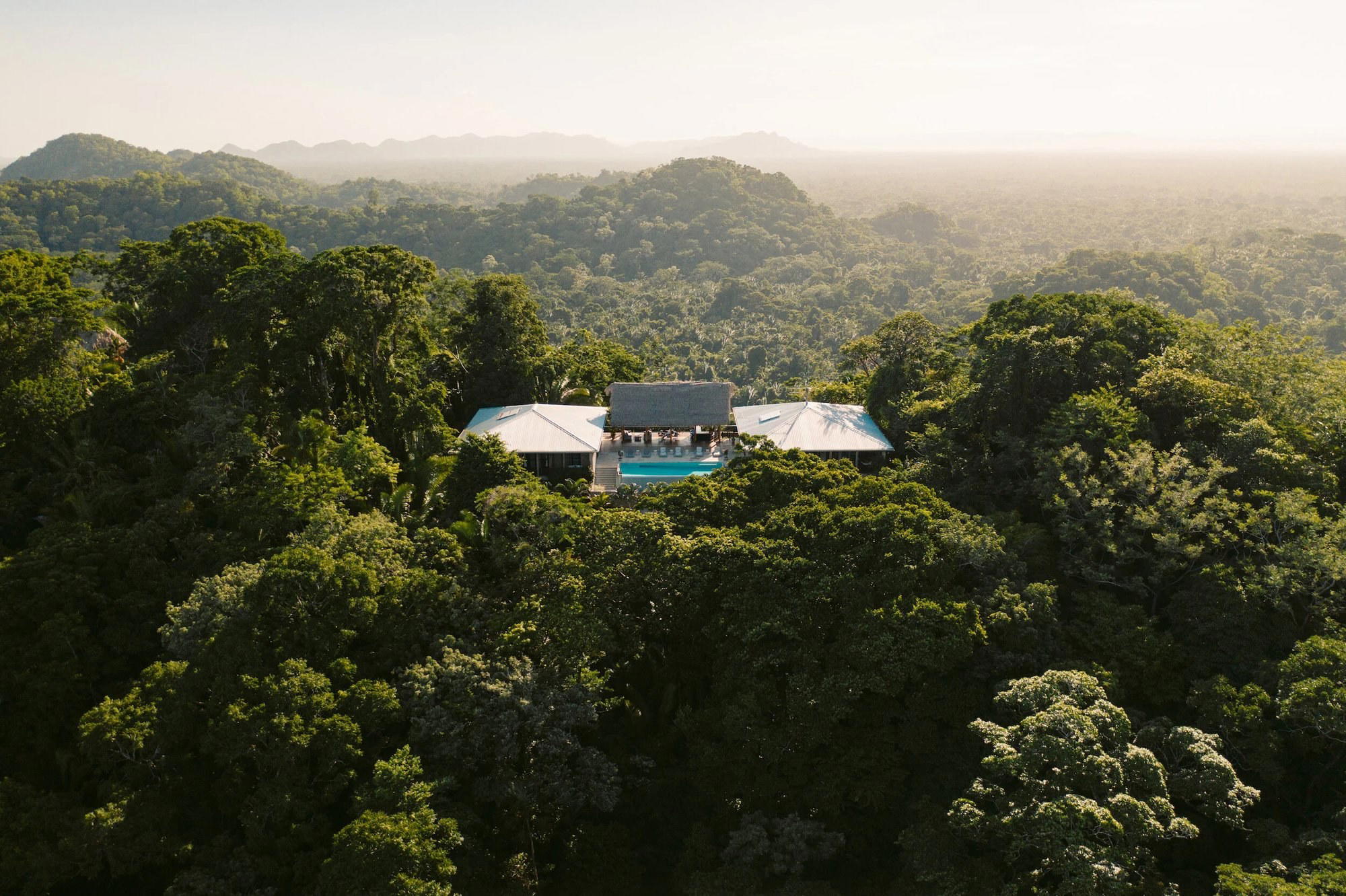
Where the Architecture Dissolves Into the Canopy
The defining design logic of the most serious eco-lodges is concealment: the built environment earns its place by disappearing into what surrounds it. Copal Tree Lodge is a 5-star hotel in Punta Gorda, Belize, with one Michelin Key. Twelve suites are scattered across a hill overlooking a 15,000-acre rainforest preserve, each sited to maximize separation from its neighbors. The result is a property that functions less like a hotel campus and more like a loose constellation of private retreats, connected by jungle paths rather than corridors. From any suite veranda, the nearest human structure is out of sight. What you get instead is canopy, birdsong, and, on a clear day, the thread of the Rio Grande winding south toward the Caribbean.
Private, screened-in verandas extend directly into the tree line, making the jungle immediately accessible without actually requiring you to leave your hammock. The bathrooms push this further with floor-to-ceiling windows that face the forest directly, collapsing the boundary between interior and exterior in a way that more conventional luxury properties spend considerable money simulating. At Copal Tree, it is simply a function of where the building sits and how its openings are oriented. That discipline in siting, rather than any single design flourish, is what gives the lodge its spatial character.
Within the broader category of Belizean eco-resorts, this positions Copal Tree in a specific tier. Properties like Hidden Valley Wilderness Lodge in Pine Ridge and Bocawina Rainforest Resort in Silk Grass occupy adjacent territory, and the Muy'Ono group's own Hopkins Bay Resort operates on the coast with a different orientation. Copal Tree is the group's most interior, most farm-embedded property, and its twelve-suite count keeps the guest-to-wilderness ratio at a level that most larger properties cannot sustain. At about $450 per night, it sits at a price point that reflects both the operational cost of genuine sustainability and the scarcity of low-density rainforest access in Central America.
The Farm as Infrastructure, Not Backdrop
The 3,000-acre working farm that surrounds the lodge is not decorative. It functions as the primary supply chain for the kitchen, which means the relationship between what grows on the property and what appears on the plate is logistical rather than conceptual. Breakfast pork, whether bacon or sausage, comes from humanely raised hogs on site, smoked over cinnamon and allspice cuttings harvested from the surrounding jungle. Fruits and heritage vegetables are grown on the farm. The coffee is sourced through a partnership with San Francisco-based Blue Bottle Coffee, whose founder has brought guests to the property to walk through the process of converting on-site beans into espresso on a La Marzocco machine.
The kitchen also employs a resident forager whose work sometimes involves days in the jungle tracking a single ingredient. The kitchen gathers conch for ceviche, catches lobster for tacos, and spears lionfish for grilled lunch service during snorkeling days. Lionfish, an invasive species across Caribbean reefs, is both ecologically sound and genuinely good to eat, and having it appear on the table hours after it was taken from the water is a supply-chain compression that most coastal restaurants cannot replicate. For comparison, Turtle Inn in Placencia offers its own dining program with local seafood at the center, but the forager-and-farm infrastructure at Copal Tree represents a different level of kitchen-to-landscape integration.
The Activities Are the Product
Southern Belize operates on a different tourism logic than the northern cayes. San Pedro and Ambergris Caye sell reef access and beach proximity. Punta Gorda and the Toledo District sell the opposite: interior wilderness, river systems, and some of the most productive flats fishing in the Western Hemisphere. Copal Tree is built around that offer. Expert guides take fly-fishers to the lagoons, rivers, and salt flats where tarpon, permit, and bonefish remain in populations that reflect how little pressure the area receives compared to better-known flats destinations. Birding guides work a trail network with positioned lookouts and scopes; the rainforest preserve adjacent to the farm supports species counts that draw serious listers rather than casual observers.
For guests oriented toward the reef, PADI-certified instructors and dive masters handle access to Belize's barrier reef, the second largest in the world. Between March and June, whale shark encounters are a documented feature of reef dives in this region. The lodge also runs mountain biking, snorkeling, jungle canoeing, and kayaking programs, which collectively means the activity calendar is dense enough to fill a week without repetition. The spa and pool function as recovery infrastructure rather than primary draws, which reflects the correct prioritization for a property of this type.
How to Get There and How to Plan
Logistics for Punta Gorda require planning. Flights to Punta Gorda from Philip S. W. Goldson International Airport (BZE) in Belize City are available via domestic carriers, and Copal Tree Lodge provides complimentary ground transfers from Punta Gorda town. Given the distance from Belize City and the domestic flight leg involved, many guests arriving internationally plan for at least one night elsewhere before or after. The whale shark season between March and June is worth factoring into dive-focused trips. Fly-fishers should research permit and tarpon runs for their intended dates. The Toledo District has low overall tourist density year-round, which means the lodge rarely pressures guests toward particular timing, but the marine calendar does.
For context on where Copal Tree sits within the global conversation about low-impact luxury, the comparison set is not primarily Belizean. Properties like Amangiri in Canyon Point and Castello di Reschio in Umbria occupy similar territory in terms of design-led properties that derive their identity from landscape integration and constrained key counts. Our broader Punta Gorda travel and restaurants guide covers the wider southern Belize context for guests building a longer itinerary. Those who prefer the coast should also consider Thatch Caye Resort for a contrasting format at the opposite end of the country's geography.
Continue exploring
More in Punta Gorda
Hotels in Punta Gorda
Browse all →
Bars in Punta Gorda
Browse all →
At a Glance
- Romantic
- Scenic
- Elegant
- Intimate
- Honeymoon
- Romantic Getaway
- Wellness Retreat
- Family Vacation
- Infinity Pool
- Private Villa
- Destination Spa
- Garden
- Terrace
- Panoramic View
- Waterfront
- Wifi
- Pool
- Spa
- Fitness Center
- Concierge
- Restaurant
- Bar
- Yoga
- Farm Tours
- Kayaking
- Hiking Trails
- Bicycle Rental
- Rum Distillery
- Chocolate Facility
- Mountain
- Garden
- Waterfront
Serene and immersive with natural jungle sounds, candlelit dining, open-air palapa structures, and soft ambient lighting that highlights rainforest views and the rhythm of nature.