← Guides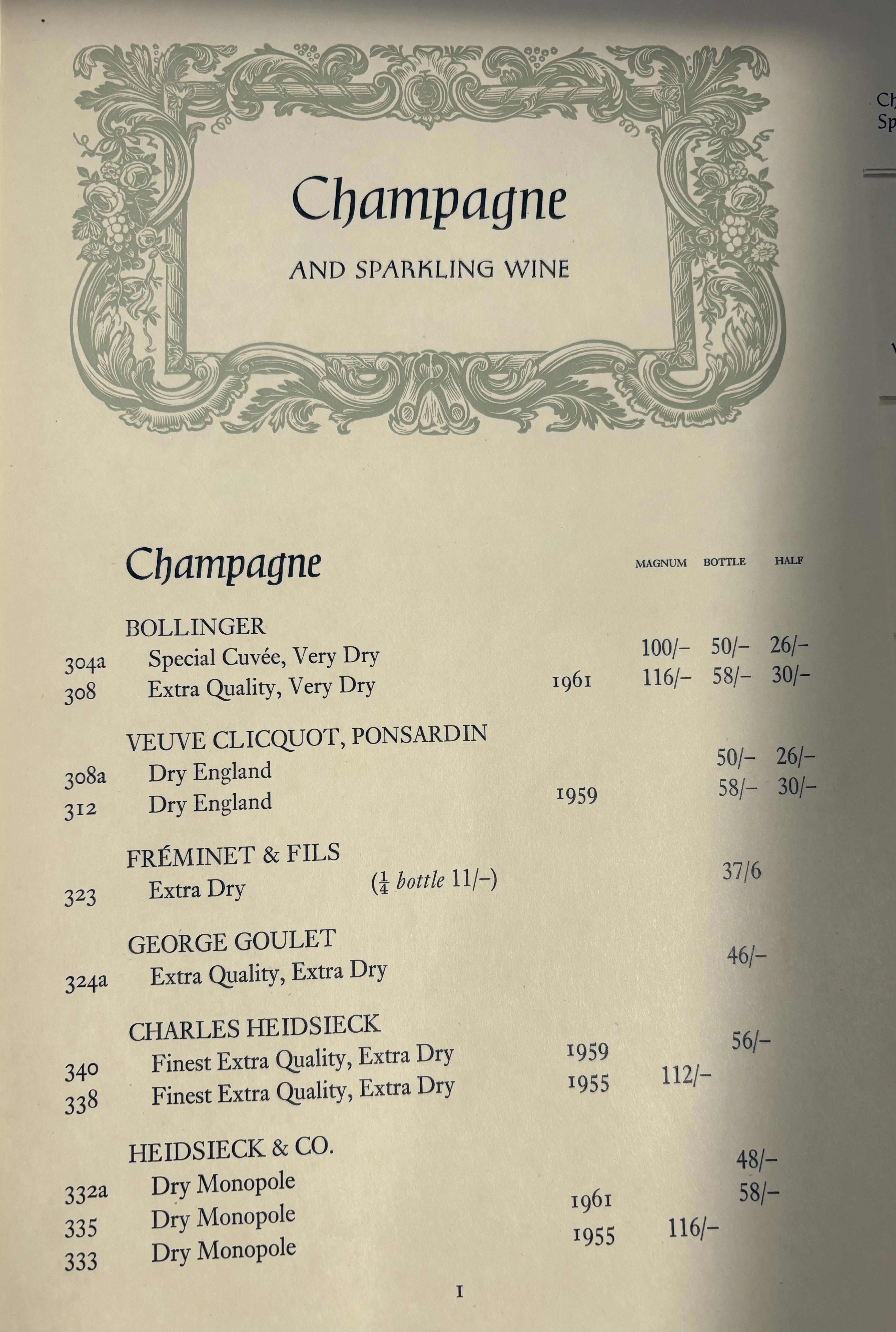
A mid-1960s Gleneagles Hotel wine list shows German whites, first-growth Bordeaux, Burgundy grands crus and more Cognac than Scotch.
A mid-1960s Gleneagles Hotel wine list shows German whites, first-growth Bordeaux, Burgundy grands crus and more Cognac than Scotch.
The Gleneagles Hotel wine list analyzed by Patrick Schmitt MW was printed in the mid-1960s and shows a Perthshire hotel pouring famous Champagne houses, first-growth Bordeaux Châteaux, Burgundy grands crus, German whites, Mateus, Provençal rosé and more Cognac than Scotch. The list, loaned to Schmitt by Ron Emler, his long-standing city editor, lands just as restaurant wine pricing has become dinner-table conversation for anyone who still reads the back pages before choosing a table (Thedrinksbusiness1).
Schmitt’s piece for the drinks business gives collectors and travelling drinkers a rare hotel-cellar snapshot: what an international Scottish resort considered essential around 1965, which categories carried social weight, and how a list priced in shillings and pence framed Champagne, Bordeaux, Burgundy, German whites and Cognac before fine wine became so tightly tied to allocations and secondary-market arithmetic.
A hotel list can be more revealing than a merchant catalogue because it shows wine at the moment of service, a bottle chosen over dinner, not packed away in bond. At Gleneagles, that meant a room of golfers, Hollywood names, sportspeople and international guests being offered first-growth claret and grand cru Burgundy alongside a German white section that dwarfed the other white categories. The hierarchy on the page is not quite the hierarchy many drinkers would expect now.
The Gleneagles Hotel wine list belongs to a specific setting: Gleneagles Hotel in Perthshire, Scotland, a resort known in the 1960s for more than its golf course. According to Schmitt, the hotel served as a luxury playground for international elites, with Hollywood stars and star sportspeople among its summer guests. The list was not assembled for a modest dining room flattering local taste. It was written for guests who expected the old names.
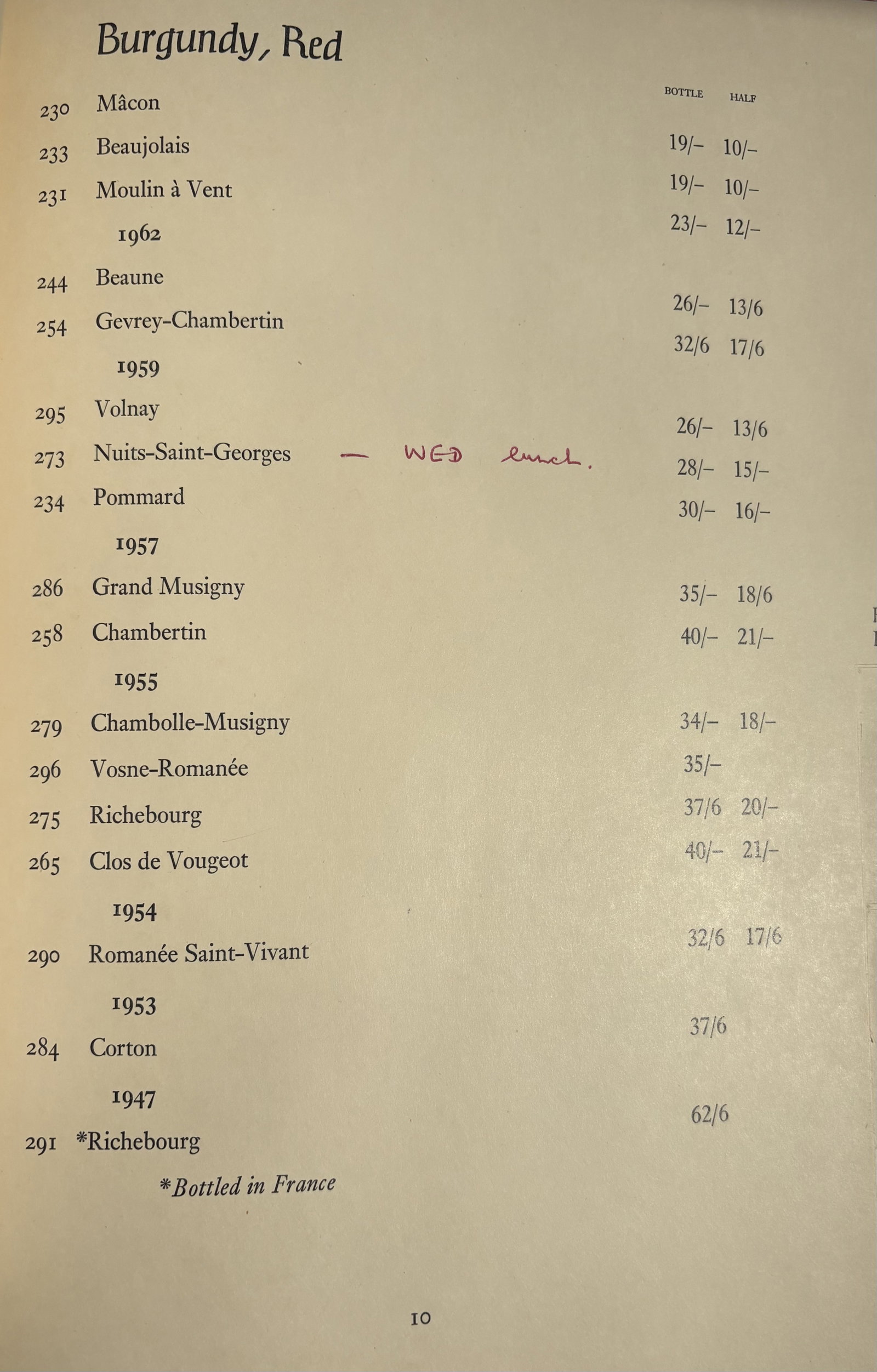
The bottles named by category read like the wine ambitions of a mid-century grand hotel: famous Champagne houses, first-growth Châteaux from Bordeaux, grands crus from Burgundy and a single Provençal rosé. What Schmitt’s analysis does show is the shape of the programme: Champagne for ceremony, Bordeaux and Burgundy as the red-wine spine, Germany as the main white-wine country, and Cognac taking more space than Scotch in a Scottish hotel.
The currency places the reader in time. Schmitt notes that the 1960s list was priced in shillings and pence, with 20 shillings to the pound. Before any modern comparison, you have to step through that old notation, a small act of translation that changes how the list feels. A bottle was not yet a line on a phone screen. It was a hotel price printed for a guest deciding what to drink that evening (Thedrinksbusiness1).
The line that stops the modern reader is not the presence of first-growth Bordeaux or grand cru Burgundy. It is the Provençal rosé. Schmitt reports that the single Provençal rosé on the Gleneagles list was priced higher than either a premier cru Meursault or a deuxième cru claret on the same list. Read that twice. Then imagine presenting the same relationship to a table of Burgundy buyers today.
That one price does not rewrite the history of Meursault, claret or Provence. It does show that hotel pricing has always carried its own internal logic. Fashion, supply, supplier relationships, guest expectation and the theatre of a grand room all influence the number beside a bottle. A Provençal rosé priced above premier cru Meursault is not just a curiosity; it shows that a wine list is never a pure hierarchy of vineyards.
The rosé section ran to five entries, including Mateus from Portugal. That detail gives the page its period signature. Mateus occupied space beside the one Provençal rosé in a list that also carried the canonical names of Champagne, Bordeaux and Burgundy. Grand cru Burgundy in one section, Mateus in another, both available to the same guest at the same Scottish resort (Thedrinksbusiness1).
For wine travellers, this kind of archival detail changes how you read a hotel cellar. You stop asking only whether the list contains famous bottles and start asking what else the buyer thought guests wanted. Rosé was not absent. It had five entries. Provence was not treated as a throwaway on that page. One bottle carried a price that outran categories now treated with much sharper collector focus.
If the Provençal rosé provides the jolt, the German white section provides the lesson. Schmitt reports that German wines formed the largest white-wine category by far on the mid-1960s Gleneagles list, divided between Rhine and Moselle sections plus a lone Franconia entry. German whites comfortably outnumbered white Bordeaux, and white Bordeaux itself sat slightly ahead of white Burgundy.
That ordering feels distant from many modern fine-dining lists, where white Burgundy often exerts the stronger pull and German Riesling, however admired by sommeliers, may still occupy fewer lines than its quality deserves. At Gleneagles around 1965, Rhine and Moselle had enough presence to be split into their own sections. Franconia appeared as a separate outlier. White Bordeaux had more space than white Burgundy.
The responsible reading stays with structure rather than speculation. Still, structure is enough. Rhine. Moselle. Franconia. Those headings tell you that the hotel expected guests to navigate German wine with some confidence, or at least accept it as part of the standard grand-hotel repertoire.
There is a travel lesson in that too. A Gleneagles guest in the mid-1960s might have moved from Champagne into German white wine before claret. That sequence feels almost radical now only because our own habits have narrowed around different prestige cues. The archive loosens the grip.
On the red side, Schmitt describes the 1960s list as mainly Bordeaux and Burgundy, with surprisingly few vintages stated. That absence is as revealing as the famous regions themselves. The modern collector has been trained to read vintage first, then producer, then cuvée, then condition, then price. A hotel guest at Gleneagles may have encountered a less forensic page, one where appellation and château category carried more of the communication (Thedrinksbusiness1).
First-growth Châteaux from Bordeaux and grands crus from Burgundy appeared on the list. deuxième cru claret appeared in the context of the Provençal rosé price comparison. Those phrases place the list firmly inside the classic fine-wine canon, but the sparse vintage information complicates any easy comparison with today’s market. Without vintage specificity, the modern reader cannot map those entries neatly onto auction data or drinking windows. The list resists the spreadsheet.
That resistance is useful. It reminds us that fine wine did not always present itself as a collectible asset first and a drink second. Hotel lists were built for choosing, pairing and opening. Even when the names were grand, the act was immediate. A guest did not need a merchant’s condition report to order claret with dinner.
Schmitt’s analysis also sits inside a present-day debate about the high cost of drinking sought-after bottles in hotels and restaurants. The article notes that restaurants derive a share of profit from drinks and typically apply a percentage margin to bottles, which can make higher-priced wines much more expensive once they reach the wine list. The old Gleneagles document gives that debate a longer horizon. Mark-ups are not new. What has changed is the price base of many bottles before the restaurant adds its margin.
Among the more Scottish details in the Gleneagles Hotel wine list is its refusal to behave as expected. Schmitt calls attention to the drinks selection beyond wine: for a Scottish hotel, the list carried more Cognac than Scotch. That does not make Scotch unimportant at Gleneagles; it tells us what the broader after-dinner ritual looked like for the hotel’s audience at the time.
Cognac belonged to the grammar of grand dining. After Champagne, claret, Burgundy or German white, a guest could remain in the French orbit through the final glass. The fact that Cognac occupied more space than Scotch in Perthshire points to the international posture of the hotel. Gleneagles was not merely serving Scotland to visitors. It was staging a version of cosmopolitan luxury that placed French categories at the centre of the table and after it.
This is where a hotel list becomes a cultural document. The wine and spirits pages reveal which regions had authority, which drinks signalled polish, and which categories the buyer believed an elite guest would recognise. In the mid-1960s Gleneagles extract, Champagne, Bordeaux, Burgundy, German whites and Cognac all occupy that social field. Scotch appears, but not as the dominant after-dinner language.
For today’s visitor, that reversal adds texture to the estate’s story. A Perthshire resort with a famous golf course and international guests was using its list to speak beyond locality. The modern traveller may arrive expecting Scottish produce, Scottish drinking culture and a strong sense of place. The mid-century guest encountered Scotland through a hotel fluent in French wine and brandy.
Schmitt makes clear that a direct comparison with Gleneagles today is not simple. Many historic wines are no longer made, and dining at the resort now spans several restaurants, including the two-Michelin-starred Andrew Fairlie. The Gleneagles Townhouse in Edinburgh sits under the same ownership and publishes its wine list online, giving modern readers another point of comparison.
Those practical details matter if you are tempted to turn the archive into a travel plan. The original list belongs to Gleneagles Hotel in Perthshire; the present-day orbit includes Andrew Fairlie at the resort and The Gleneagles Townhouse in Edinburgh. One is anchored in the country-house rhythm of Perthshire, the other in the capital. Both sit under the same ownership, but they are not interchangeable experiences.
For a wine-focused traveller, the appeal is not simply to ask whether the current list repeats the old one. It cannot. The market has moved, producer availability has changed, and several bottles from the mid-1960s document cannot be matched cleanly to current equivalents. The better exercise is comparative reading: which regions still command space, which categories have expanded or contracted, and how the list handles the tension between trophy bottles and bottles meant to be opened without ceremony.
The old and new lists also speak to different forms of scarcity. In the 1960s document, scarcity appears retrospectively: some wines are gone, some formats of service have vanished, and the old hotel pricing exists only because a list survived and Ron Emler loaned it to Schmitt. In the current world, scarcity often appears before the bottle reaches the table, through allocations, short supply and restaurant mark-ups on already sought-after wines.
A historic hotel list is not a price guide in the modern sense. It is a record of what one serious venue believed it could sell to its guests at a particular moment. The Gleneagles Hotel wine list gives collectors several useful signals: category hierarchy, relative pricing, the presence or absence of vintages, and the breadth of drinking culture around the meal.
The next time a hotel sommelier places a list in front of you, read it as an archive in progress. Sixty years from now, someone may study its Champagne pages, its Burgundy pricing, its German section, its rosé choices and its after-dinner bottles with the same raised eyebrow Schmitt brings to Gleneagles around 1965. The bottles will matter, but the ordering of the page may tell the sharper story.
Get the App
Take the shortlist into the En Primeur Club app for concierge access, saved places, and the next step after discovery.
Get Exclusive AccessMore from the editors