White Horse Tavern
The White Horse Tavern at 26 Marlborough Street holds a place in Newport's colonial streetscape that few American drinking establishments can match. Dating to 1673, it operates in one of the oldest tavern structures in the United States, where low-beamed ceilings and wide-plank floors set a physical context that no amount of interior design can manufacture. The draw is historical gravity meeting a working bar program.
 Discover on Pearl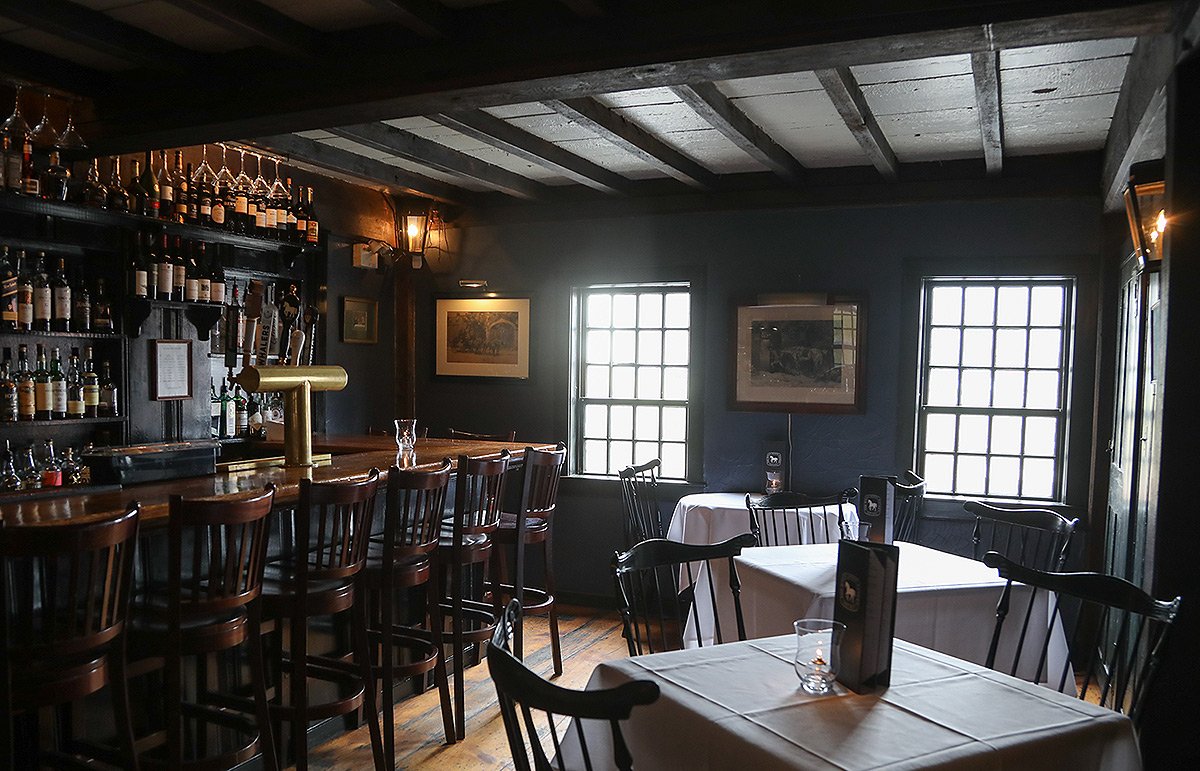
A Room That Pre-dates the Republic
Walking down Marlborough Street toward 26, the building announces itself before any sign does. The gambrel roof, the asymmetric fenestration, the way the structure sits slightly lower than the modern street grade — these are not design choices but the residue of 1673 construction, when Newport was a thriving colonial port and a tavern at this address served as a meeting point for merchants, mariners, and local government. Rhode Island's colonial council held sessions here. The physical building carries that institutional gravity, and it is the first thing you absorb before you reach the door.
Inside, the bones remain largely intact. Low, exposed beams cross the ceiling at heights calibrated for seventeenth-century proportions. Wide-plank floors have absorbed centuries of foot traffic. Hearths that once provided the only heat source in a Rhode Island winter still anchor the room structurally and visually. Very few drinking establishments in the United States operate in spaces of comparable age on original foundations; the White Horse Tavern makes no pretense of recreating the past because the past, architecturally speaking, was never fully dismantled.
The shortlist, unlocked.
Hard-to-book tables, cellar releases, and concierge-planned trips.
Get Exclusive Access →How the White Horse Sits in Newport's Drinking Scene
Newport's bar scene divides broadly along two axes: waterfront venues oriented toward summer tourism and year-round establishments that serve a local and regional dining clientele. The White Horse occupies a position distinct from both. Its address in the Historic Hill neighborhood places it a few blocks from the harbor bustle of Bannister's Wharf, but the clientele and the physical environment skew toward slower, more deliberate evenings. It is not a destination for the same crowd that cycles through the marina bars on a summer Friday.
Within Newport specifically, Clarke Cooke House and Fluke Newport represent the more polished waterfront dining-and-drinking tier, while Bert's Bar & Brasserie and Local Ocean Seafoods anchor the casual neighborhood end. The White Horse occupies a different register: historical prestige attached to a working dining room and bar, where the draw is as much the room itself as what is being poured. See our full Newport restaurants guide for a broader mapping of where to eat and drink across the city.
The Back Bar and What It Signals
American colonial taverns operated on a remarkably narrow spirits repertoire: rum from the Caribbean trade, locally produced cider, imported Madeira and Canary wines, and whatever whiskey could be sourced domestically. A tavern in 1673 Newport was not a place of curated selection — it was a place of available supply. The contemporary White Horse Tavern operates under a different framework, and the gap between those two eras of spirits access is part of what makes the bar program worth reading carefully.
The editorial angle on American bars that occupy historic structures is that the physical antiquity can become a crutch, drawing visitors on heritage alone while the drinks program coasts. The more serious establishments in this category use the historical context as a frame and then build a back bar worthy of the room. At the White Horse, the spirits selection reflects the tavern's position in Newport's upper dining tier , the kind of list that includes aged American whiskeys, rum expressions that carry some historical resonance given Newport's colonial rum trade connections, and a range of digestifs and aperitifs that speak to a kitchen-adjacent bar culture rather than a purely casual one.
Bars at this tier nationally , venues like Kumiko in Chicago, Jewel of the South in New Orleans, and Bar Leather Apron in Honolulu , share a common principle: the back bar is curated to reflect a point of view rather than assembled to maximize volume. ABV in San Francisco and Julep in Houston take similarly considered approaches to spirits selection, where the depth of the list signals the seriousness of the program. The White Horse operates with comparable intent, if with a different physical and historical context than any of those venues. Superbueno in New York City and The Parlour in Frankfurt demonstrate how radically different spaces can still apply the same curation discipline , the principle travels even when the address does not.
Historical Context as Critical Frame
The White Horse's claim to being among the oldest operating taverns in the United States is documentable: the structure dates to 1673, pre-dating the founding of the republic by over a century. That credential functions differently from a Michelin star or a 50 Best listing , it is not a quality signal in the contemporary culinary sense but a historical legitimacy signal that places the establishment in a category with almost no peers. There are very few buildings in American food-and-drink culture that carry this kind of verifiable institutional age on original or substantially original foundations.
What that credential does and does not do is worth stating plainly. It attracts visitors who would not otherwise come to Newport specifically for the bar scene. It provides a room that no amount of capital expenditure can replicate. It does not automatically produce a serious spirits list or a well-executed menu , those outcomes require active program decisions independent of the building's age. The White Horse has managed to hold both: a heritage asset and a functioning dining and drinking operation that takes its contemporary obligations seriously.
Planning Your Visit
The White Horse Tavern sits at 26 Marlborough Street in Newport's Historic Hill district, roughly equidistant from the waterfront and the main commercial corridor of Thames Street. Newport is accessible from Providence by car in approximately 30 minutes and from Boston in roughly 90 minutes; the Pell Bridge connects the island to the mainland. Because the dining room operates in a finite historic structure with limited covers, booking in advance is advisable for dinner service, particularly from May through October when Newport's visitor volume peaks significantly. Walk-in availability at the bar is more flexible, but the room is small enough that even bar seating can be tight on weekend evenings during the summer season. Dress code and specific hours are not confirmed in our database; checking directly before arrival is the practical course.
The shortlist, unlocked.
Hard-to-book tables, cellar releases, and concierge-planned trips.
Get Exclusive Access →Frequently Asked Questions
A Pricing-First Comparison
A quick look at comparable venues, using the data we have on file.
| Venue | Price | Awards | Notes |
|---|---|---|---|
| White Horse Tavern | This venue | ||
| Bert’s Bar & Brasserie | |||
| Clarke Cooke House | |||
| Perro Salado | |||
| Fluke Newport | |||
| Local Ocean Seafoods |
Need a Table?
Our members enjoy priority alerts and concierge-led booking support for the world's most difficult bars and lounges.
Get Exclusive AccessThe shortlist, unlocked.
Hard-to-book tables, cellar releases, and concierge-planned trips.
Get Exclusive Access →