Tribeca Grill
Tribeca Grill has anchored the corner of Greenwich and Franklin Streets since 1990, occupying a former coffee warehouse that shaped the neighborhood's transition from industrial to destination dining. The room's cast-iron columns and exposed brick set the tone for a kitchen that has long emphasized American sourcing at a price point that sits comfortably within Tribeca's mid-to-upper casual register.
 Discover on Pearl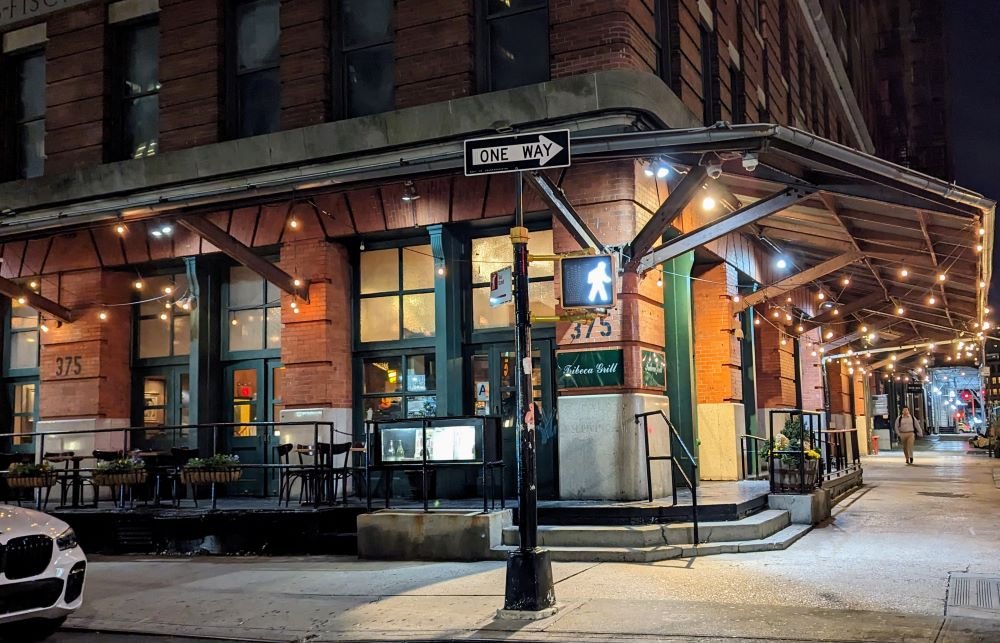
A Warehouse Room That Helped Define a Neighborhood
When Tribeca Grill opened in 1990 at 375 Greenwich Street, the neighborhood was still finishing its conversion from light-industrial use to residential and commercial destination. The former coffee warehouse that houses the restaurant kept its bones: cast-iron columns, exposed brick, and high ceilings that give the dining room a volume most newer Manhattan restaurants cannot replicate. That physical context matters because it shaped how the kitchen positioned itself. A room with that much history and mass tends to resist menu showboating. The emphasis here has consistently been on American produce and protein handled with restraint, a posture that made more sense as the farm-to-table movement arrived and eventually became the dominant mode of serious American dining.
Tribeca's dining character has shifted considerably over three decades. The neighborhood now runs from casual lunch spots near the parks to serious tasting-menu destinations in converted lofts. Tribeca Grill occupies neither extreme. It belongs to the layer of established American grill rooms that pre-date the current era of hyper-conceptual menus, and it has maintained that position while many of its 1990s-era peers closed or pivoted. For our full New York City restaurants guide, that persistence in a particular format is itself a data point worth reading carefully.
What the Sourcing Posture Signals
American grill rooms of Tribeca Grill's generation established their credibility through sourcing relationships that newer restaurants now treat as a founding principle. The logic was direct: a room this size, serving this many covers across lunch and dinner, needed reliable regional suppliers rather than ad hoc market runs. That infrastructure, built over decades, produces a kitchen that knows its raw materials with a consistency that younger, smaller rooms sometimes struggle to match.
The broader pattern across New York's established American grill category is worth noting here. Restaurants that opened in the late 1980s and 1990s and survived did so by building supplier relationships that gave them access to regional meat, fish, and produce before those relationships became fashionable. The farms and fishermen they worked with are now also supplying the city's newer tasting-menu rooms, but the older grill rooms have the length of relationship that translates into allocation priority and product knowledge. What a kitchen knows about a specific lamb producer or an East Coast oyster bed after twenty-plus years of ordering cannot be replicated quickly.
That sourcing depth is the strongest editorial case for Tribeca Grill's continued relevance. The room is not making arguments about innovation. It is making arguments about provenance, consistency, and what happens when a kitchen has been working with the same regional producers long enough to understand their seasonal rhythms in granular detail.
The Wine Program and What to Drink
Grill rooms of this generation typically built wine lists around domestic producers, particularly California Cabernet and Oregon Pinot Noir, alongside a French backbone for formal occasions. That architecture reflects the wine culture of the early 1990s, when American fine dining was consolidating its confidence in domestic viticulture. A list built on those foundations has the advantage of depth in older vintages of producers that smaller, newer programs cannot afford to stock. For guests arriving with a specific bottle in mind, the reservation and wine inquiry process should be confirmed directly with the restaurant before visiting.
New York's cocktail culture now gives grill-room guests strong options on either side of a dinner at a place like Tribeca Grill. Downtown Manhattan has a concentration of serious bar programs. Attaboy NYC works without a menu, building drinks from a conversation about preferences, while Angel's Share has sustained its reputation for Japanese-inflected precision cocktails since the 1990s, making it a natural companion to a dinner in the same era of downtown history. Amor y Amargo focuses on bitters-driven drinks and is worth knowing if you want something bitter and low-ABV before or after. Superbueno takes a different direction entirely, with a Latin-inflected cocktail program that pairs well with a lighter pre-dinner aperitivo approach.
For those planning around a broader trip and curious how New York's bar scene compares to other American cities, the range runs from the grain-to-glass precision of Kumiko in Chicago to the Southern herb-forward work at Jewel of the South in New Orleans, the agave-led program at Julep in Houston, and the craft-forward approach at ABV in San Francisco. Internationally, Bar Leather Apron in Honolulu, Allegory in Washington, D.C., and The Parlour in Frankfurt on the Main each represent distinct regional takes on the serious cocktail bar format.
Booking and Planning
Tribeca Grill has operated at 375 Greenwich Street continuously since 1990, which means it has a booking history and floor plan that most newer rooms cannot offer. The cast-iron warehouse space fits a large room, and that capacity generally means reservations are more accessible than at the neighborhood's smaller, higher-concept destinations. For a Saturday dinner or a business lunch during a busy week, booking at least a week in advance remains sensible. The restaurant is reachable directly for reservations, and weekday lunch tends to have more flexibility than weekend evenings. Tribeca is accessible via the Franklin Street station on the 1 line, placing it within easy reach of most of lower Manhattan.
When Tribeca Grill Makes Sense as a Choice
The room suits occasions where the conversation or the company matters more than the menu's ambition. A dinner for out-of-town guests who want a serious American room without a tasting-menu commitment, a business lunch in a space with enough acoustic separation to talk comfortably, or a meal that anchors a longer evening in lower Manhattan before drinks elsewhere: these are the scenarios where Tribeca Grill performs at its most logical. It does not compete with the city's current wave of tasting-menu destinations, and it does not try to. Its argument is a different one: a room with physical presence, sourcing relationships measured in decades, and a format that does not require the diner to commit the entire evening to a single culinary program.
For guests who want to compare before booking, The Long Island Bar in Cobble Hill and Dirty French in the Lower East Side represent different takes on the same general question of what serious American-adjacent dining looks like when it is not chasing innovation for its own sake. Each occupies a different price register and neighborhood personality, but all three share the quality of knowing what they are and declining to apologize for it.
Frequently Asked Questions
- What should I drink at Tribeca Grill?
- The wine list reflects the American grill tradition built on domestic producers, particularly California and Oregon, alongside French options for formal occasions. Older-vintage depth is one of the structural advantages of a list built over decades rather than assembled recently. For cocktails before or after, Attaboy NYC and Amor y Amargo are nearby options worth knowing.
- What's the defining thing about Tribeca Grill?
- Continuity. The restaurant has operated at the same Greenwich Street address since 1990, in a converted coffee warehouse whose physical scale sets it apart from most of Manhattan's newer dining rooms. In a city where restaurants close and reopen constantly, that three-decade presence in a single format carries real weight, and it is the primary reason the sourcing relationships and room character are difficult to replicate quickly.
- How hard is it to get in to Tribeca Grill?
- The room's larger capacity relative to the neighborhood's boutique-concept restaurants generally makes reservations more accessible. Weekend evenings require advance booking of at least a week, while weekday lunch tends to have shorter lead times. Guests should confirm directly with the restaurant for current availability, as hours and booking policies are not publicly listed through third-party databases.
- When does Tribeca Grill make the most sense to choose?
- It makes the clearest sense when the occasion calls for a serious American room without the commitment of a tasting menu or the price point of the city's top-tier destinations. Business dinners, group meals, and evenings anchored in lower Manhattan all align with what the room does well. The warehouse setting and accessible reservation window make it a practical choice when flexibility matters as much as ambition.
- Is Tribeca Grill connected to the early celebrity-investor restaurant model that shaped 1990s New York dining?
- Yes. Tribeca Grill is among the most documented examples of the early 1990s celebrity-backed restaurant format that emerged in lower Manhattan as the neighborhood developed. That structure, where marquee names brought visibility and investor capital to serious kitchen operations, helped establish Tribeca as a dining destination at a time when the area's commercial identity was still forming. The model became a template studied by later restaurant groups across American cities.
Comparison Snapshot
A compact peer set to orient you in the local landscape.
| Venue | Cuisine | Price | Awards | Notes |
|---|---|---|---|---|
| Tribeca Grill | This venue | |||
| The Long Island Bar | World's 50 Best | |||
| Dirty French | ||||
| Superbueno | World's 50 Best | |||
| Amor y Amargo | World's 50 Best | |||
| Angel's Share | World's 50 Best |
Need a Table?
Our members enjoy priority alerts and concierge-led booking support for the world's most difficult bars and lounges.
Get Exclusive Access