The Campbell
Grand Central Terminal's former private salon turned cocktail bar, The Campbell operates in a category that few New York drinking rooms can claim: genuine architectural provenance. The vaulted ceilings, Florentine-painted beams, and fireplace anchor a room that was never designed as a bar but functions as one of the city's most atmospheric drinking spaces, a pre-Prohibition sensibility applied to a contemporary cocktail program.
Pearl is the En Primeur Club membership app — saves, bookings, and concierge access live there. Same editors, same standards.
- Address
- 15 Vanderbilt Ave, New York, NY 10017
- Phone
- +1 917 209 3440
- Website
- thecampbellnyc.com
- Directions
- Get directions
 Saves & bookings on Pearl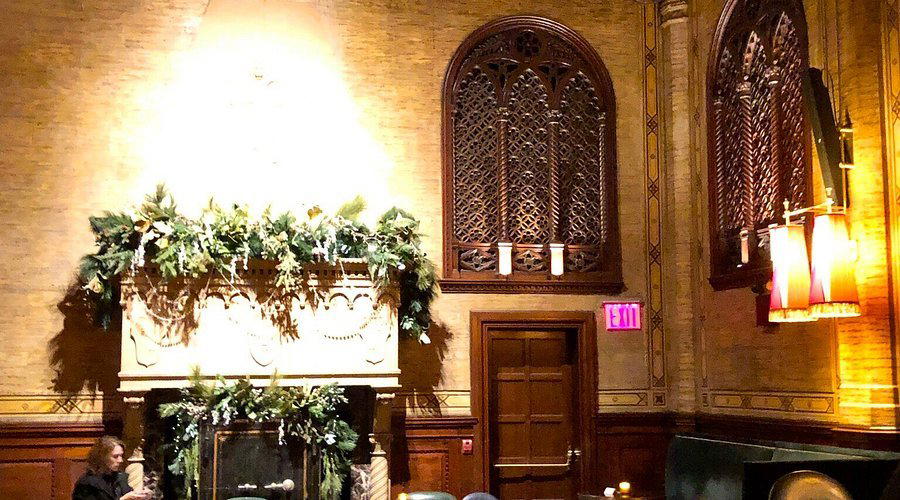
A Railroad Baron's Office, Repurposed
New York has produced plenty of bars that perform history, exposed brick, Edison bulbs, cocktail menus printed on aged parchment. The Campbell earns its atmosphere through a different route: the room itself was built in the 1920s as the private office and salon of financier John W. Campbell, who leased the space inside Grand Central Terminal and fitted it out accordingly. The vaulted ceiling carries hand-stenciled Florentine detailing. There is a stone fireplace. The proportions are those of a private library rather than a commercial venue. When the space eventually became a bar, it did not need to simulate a gilded past. It simply opened the door.
That architectural provenance places The Campbell in a distinct tier of New York drinking rooms. The city's cocktail scene has moved through several phases, the hidden-door speakeasy era of the mid-2000s, the technical precision movement that followed, and the current moment, where bars increasingly compete on programmatic clarity and credentials. The Campbell operates orthogonally to all of it. The draw here is spatial, not conceptual: you are drinking in one of the few rooms in Manhattan that was designed for someone's personal use, by someone with the resources to do it properly, inside a terminal that is itself a civic monument.
The Room as the Argument
The design logic of the bar repays attention. The scale is institutional, ceilings high enough to absorb noise without killing it, windows that let in a wash of ambient light from the terminal concourse below. The seating arrangement divides the space into zones: bar stools for the transit crowd stopping in briefly, deeper seating for those who plan to stay. The fireplace, non-functional by most accounts but visually dominant, anchors the room's far end and gives it a focal point that most bars achieve only through mirror-backed shelving.
Lighting does a significant amount of work here. The Florentine-painted beams and the warm palette of the original materials absorb and soften the room's illumination in a way that contemporary bar builds, however expensive, rarely replicate without heavy contractor intervention. The effect in the evening is that the room feels inhabited rather than staged. That distinction matters in a city where the line between authentic atmosphere and produced atmosphere is usually the difference between a place people return to and one they photograph once.
Grand Central Terminal's wider context adds a layer that few drinking venues in any city can claim. The bar sits within a Beaux-Arts structure completed in 1913, and the terminal itself draws roughly 750,000 visitors on peak days. That footfall creates a clientele mix that skews toward the transient, commuters, travelers, tourists in midtown for the afternoon, but the room's weight tends to slow people down. The bar occupies a position in the building that is removed enough from the main concourse to feel considered, not accidental.
Where It Sits in the New York Bar Scene
New York's serious cocktail bars have clustered in particular ways over the past decade. The East Village and Lower East Side remain dense with technically ambitious programs: Attaboy NYC operates on the bespoke-order model, building drinks around the guest rather than the menu. Amor y Amargo has defined a niche around amaro and bitters-forward drinking with a specificity that few bars globally have matched. Further downtown, Angel's Share brought Japanese bar craft to the East Village before that phrase had any particular currency. And Superbueno represents a newer strand of ambitious Latin-inflected drinking rooms that compete on both flavor and environment.
The bar competes with none of these on technical program grounds. Its competitive set is narrower and stranger: bars whose primary argument is architectural or historical. In that frame, it performs well. The room is harder to replicate than any cocktail menu, and the Grand Central address adds a legitimacy that no amount of design budget fully purchases. Internationally, bars built around singular spaces, Bar Leather Apron in Honolulu for its intimacy and craft, The Parlour in Frankfurt on the Main for its European salon register, demonstrate that atmosphere-led bars can maintain serious reputations when the environment has genuine character rather than designed character.
Elsewhere in the United States, bars anchored by their setting and local tradition rather than cocktail innovation, Jewel of the South in New Orleans, Julep in Houston, Kumiko in Chicago, ABV in San Francisco, Allegory in Washington, D.C., show that place-based identity and drinks quality are not mutually exclusive. The bar leans harder on the former than most, which makes it a different kind of proposition rather than a lesser one.
Practical Considerations
The location at 15 Vanderbilt Ave puts the bar directly inside Grand Central Terminal, which means access is direct from the 4, 5, 6, 7, and S subway lines, and the bar sits on a natural path between those platforms and the 42nd Street exits. That convenience cuts both ways: it makes the bar easy to add to an itinerary without a dedicated trip, and it means the early-evening commuter window between roughly 5pm and 7pm tends to fill the bar with transit traffic. Those who prefer the room at lower volume and higher atmosphere will find it functions differently after 8pm, when the commuter wave clears and the space reasserts its original register.
Side-by-Side Snapshot
Comparable venues nearby, for context on price, style, and recognition.
| Venue | Cuisine | Price | Notes |
|---|---|---|---|
| The CampbellThis venue — the venue you are viewing | cocktail_bar | $$$$ | Not listed |
| Keens Steakhouse | lounge | $$$$ | Midtown-Times Square |
| Pen Top | rooftop_bar | $$$$ | Midtown-Times Square |
| Loosie Rouge | cocktail_bar | $$$$ | Williamsburg |
| Sushi Sasabune | sake_bar | $$$$ | Upper East Side-Lenox Hill-Roosevelt Island |
| Dirty French | lounge | $$$$ | Lower East Side |
Continue exploring
More in New York City
Bars in New York City
Browse all →
Restaurants in New York City
Browse all →
Hotels in New York City
Browse all →




At a Glance
- Elegant
- Historic
- Sophisticated
- Well Known
- Intimate
- Date Night
- After Work
- Special Occasion
- Historic Building
- Live Music
- Seated Bar
- Lounge Seating
- Classic Cocktails
- Craft Cocktails
Current opening hours
- Monday
- 12 PM–2 AM
- Tuesday
- 12 PM–2 AM
- Wednesday
- 12 PM–2 AM
- Thursday
- 12 PM–2 AM
- Friday
- 12 PM–2 AM
- Saturday
- 12 PM–2 AM
- Sunday
- 12 PM–2 AM
Hours can change for holidays and private events. Last verified .
Dim warm lighting, historic wooden ceilings, stone fireplace, and elegant wood paneling creating a mesmerizing old-world glamour atmosphere.