La Noxe
La Noxe occupies a discreet address in Chelsea's Flower District, accessible via a side entrance on West 28th Street. The venue sits within a bracket of destination bars that reward planning over impulse visits. Arrive with a reservation, arrive with context, and the experience returns accordingly.
Pearl is the En Primeur Club membership app — saves, bookings, and concierge access live there. Same editors, same standards.
- Address
- 315 7th Ave, Entrance, 162 W 28th St at, New York, NY 10001
- Phone
- +1 917 261 4883
- Website
- lanoxenyc.com
- Directions
- Get directions
 Saves & bookings on Pearl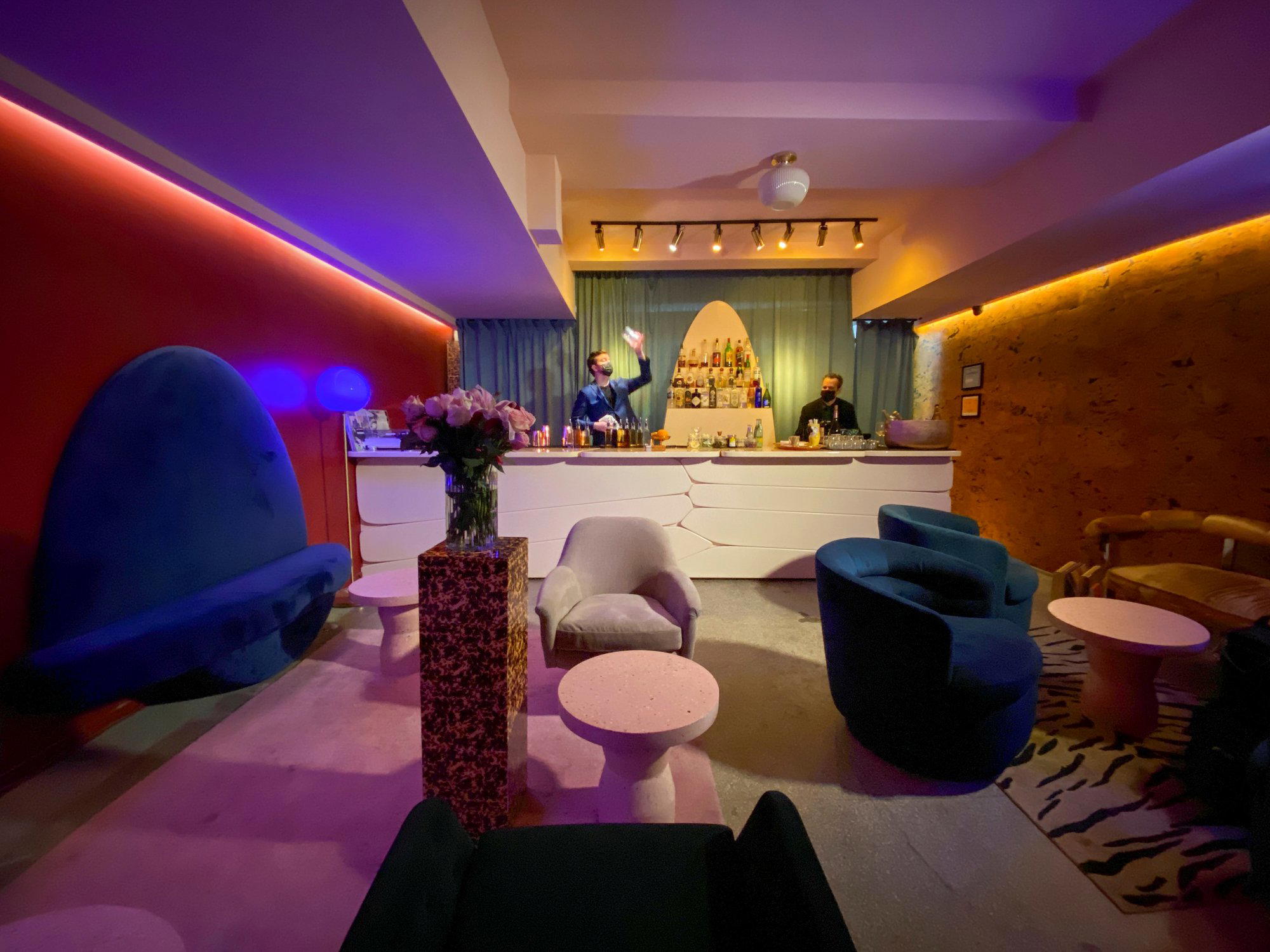
Finding La Noxe: The Address as First Signal
West 28th Street between Sixth and Seventh Avenues has historically belonged to wholesale flower sellers, a neighborhood identity that persists in the storefronts and loading docks even as bars and restaurants have moved in alongside them. La Noxe enters through that context: the primary address lists 315 7th Ave, but the actual entrance sits on West 28th Street, a detail that already tells you something about how this venue operates. Secondary entrances, split addresses, and discreet access points are standard shorthand in New York for bars that communicate primarily through word-of-mouth and direct booking rather than street-level signage and walk-in traffic.
That physical positioning places La Noxe inside a broader pattern in the city. Across lower Manhattan and the outer edges of Midtown, a cluster of bars and dining rooms have made the finding part of the experience — not as a theatrical gimmick in the speakeasy tradition, but as a filter. The demographic that reads an address carefully, confirms an entrance, and arrives informed tends to match the room's intended tone. Chelsea's Flower District provides useful camouflage for that kind of operation.
The Booking Question: What the Lack of a Website Signals
No website. No listed phone number. Both fields are absent from La Noxe's public record. In 2024 New York, that combination is less common than it once was, and when it appears it narrows the interpretation: the venue either runs at capacity through repeat clients and direct referral, or it is in a soft-launch or transitional phase where public-facing infrastructure has not yet been built out.
For anyone planning ahead, the practical implication is clear. Without a website or phone listing, the standard booking path — browse, confirm, reserve, does not apply. Reaching La Noxe requires either a direct connection or discovery through someone already inside that network. That is not an obstacle for every traveler; for a specific kind of visitor, it is precisely the draw. New York's most sought-after counters and rooms have long operated on this model. Attaboy NYC, which does not take reservations and runs a bartender-chooses format, built a sustained reputation on the same logic: remove the frictionless path and the clientele self-selects.
The editorial angle here is not that obscurity is a virtue in itself. It is that certain formats in New York are structured around depth of engagement rather than volume of access, and the booking mechanics are the first evidence of which category a venue occupies. La Noxe's current profile puts it firmly in the access-limited tier. If you are planning a trip to New York and want to include it, build extra lead time into your research. Check our full New York City restaurants guide for venues with verified booking paths alongside La Noxe in your planning.
Where This Sits in New York's Bar and Dining Scene
Chelsea and the Flower District are not primary destinations for bar programming in the way that the East Village, Lower East Side, or the West Village tend to be. That geography matters. Venues in this part of the city are not competing for foot traffic with the density of options that exists further south or across to the East Side. The trade-off is deliberate: less competition for casual passers-by, but also less ambient discovery. Bars in this bracket succeed on destination intent, not on being in the right place at the right time.
The comparison set for access-limited or deliberately low-profile venues in New York runs across neighborhoods. Angel's Share in the East Village has operated through a similar logic for decades, requiring patrons to know the building and the door. Amor y Amargo on East 6th Street runs a focused bitters-and-vermouth program that draws a specific clientele rather than a general one. Superbueno on the Lower East Side sits in a different style bracket but operates with the same destination intent. The through-line is a bar that has decided what it is and communicates that to the people who will find it, rather than broadcasting to everyone.
Nationally, this approach appears in cities where a high concentration of serious programs creates room for specialists. Kumiko in Chicago runs a structured omakase cocktail format with advance booking as a core part of the experience. Jewel of the South in New Orleans and Julep in Houston each define themselves around a specific tradition rather than a broad menu. ABV in San Francisco, Allegory in Washington, D.C., and Bar Leather Apron in Honolulu all demonstrate that the low-profile, high-intentionality format holds across markets. Even internationally, The Parlour in Frankfurt operates within a similar register. What distinguishes these venues from bars that are merely quiet is the combination of intentional format, access mechanics, and a clientele that treats the booking process as part of the experience rather than an inconvenience.
Planning Around Sparse Information
When a venue's public record is thin, no hours, no price range, no awards, the planning calculus shifts. Confirmed details anchor the visit; absent details require backup options and flexible timing. For La Noxe, that means arriving in Chelsea with a plan B already considered, particularly for an evening when the Flower District is quiet and walk-in alternatives in the immediate area are limited.
The address at 315 7th Ave with entrance on 162 West 28th Street is precise enough to confirm a location. That physical specificity, dual address points, entrance noted separately, suggests an established physical space rather than a pop-up or temporary operation. The venue exists; the public-facing information around it simply has not been built into standard directories yet, or is maintained through channels that bypass them.
Logistics at a Glance
| Venue | Booking Path | Walk-in Viable | Neighborhood |
|---|---|---|---|
| La Noxe | Direct / referral (no website listed) | Unconfirmed | Chelsea / Flower District |
| Angel's Share | Walk-in, no reservations | Yes, with caveats | East Village |
| Attaboy NYC | No reservations, walk-in only | Yes | Lower East Side |
| Amor y Amargo | Walk-in / limited reservations | Yes | East Village |
| Superbueno | Reservations available online | Limited | Lower East Side |
Where the Accolades Land
A small set of peers for context, based on recorded venue fields.
| Venue | Awards |
|---|---|
| La NoxeThis venue — the venue you are viewing | Not listed |
| The Long Island Bar | World's 50 Best |
| Superbueno | World's 50 Best |
| Amor y Amargo | World's 50 Best |
| Angel's Share | World's 50 Best |
Continue exploring
More in New York City
Bars in New York City
Browse all →
Restaurants in New York City
Browse all →
Hotels in New York City
Browse all →





At a Glance
- Romantic
- Cozy
- Elegant
- Sophisticated
- Date Night
- Special Occasion
- Group Outing
- Speakeasy
- Historic Building
- Design Destination
- Lounge Seating
- Booth Seating
- Seated Bar
- Craft Cocktails
- Classic Cocktails
Current opening hours
- Monday
- 6 PM–1 AM
- Tuesday
- 6 PM–1 AM
- Wednesday
- 6 PM–1 AM
- Thursday
- 6 PM–2 AM
- Friday
- 6 PM–2 AM
- Saturday
- 6 PM–2 AM
- Sunday
- 6 PM–1 AM
Hours can change for holidays and private events. Last verified .
Red-tinted intimate room with velvet couches, glowing bar, retro 1970s-era decor with animal print accents and colorful lighting, dimly lit and cozy.
Know Before You Go
- Getting there
- 315 7th Ave, Entrance, 162 W 28th St at, New York, NY 10001