Knife and Fork Inn
One of Atlantic City's oldest surviving dining institutions, the Knife and Fork Inn at 3600 Atlantic Ave has operated through Prohibition, the casino boom, and every wave of resort reinvention since. Its staying power owes as much to its spirits program and back bar depth as to its kitchen. For visitors mapping the city's pre-casino dining character, it remains a primary reference point.
 Discover on Pearl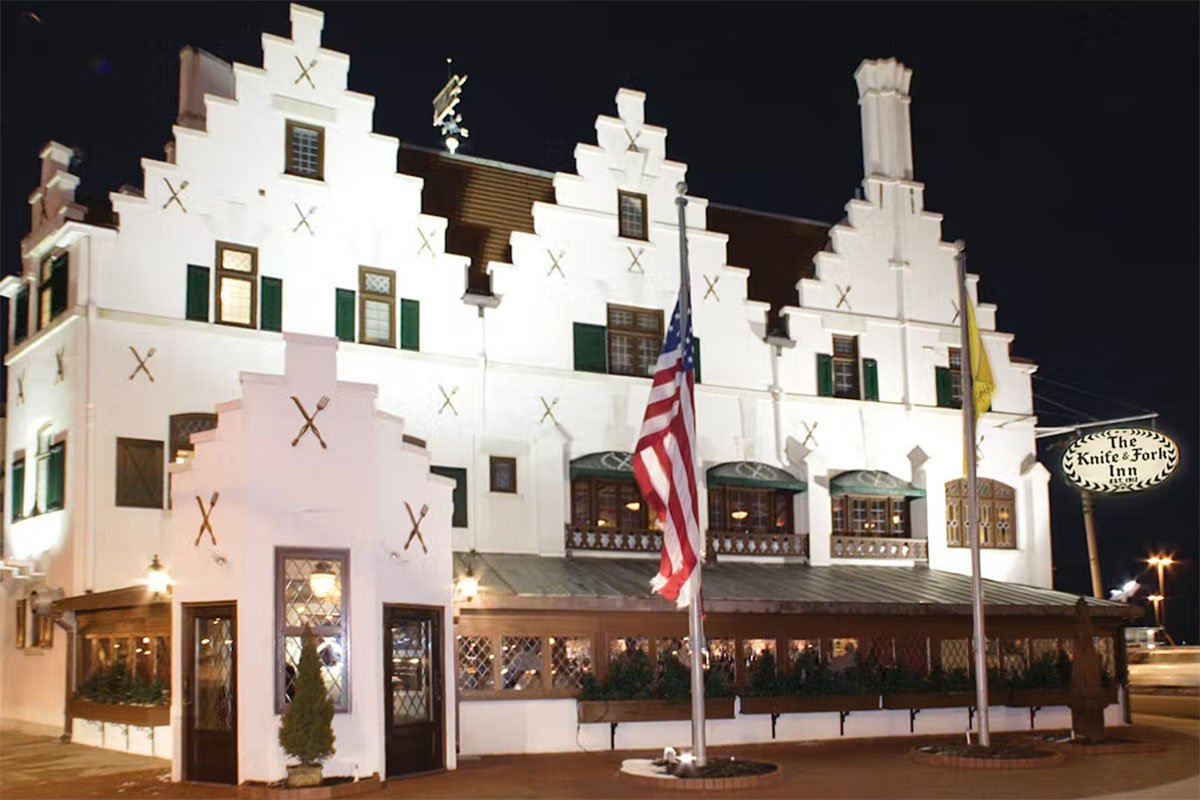
A Room That Prefers the Past
Arriving at the corner of Atlantic and Pacific avenues, the Knife and Fork Inn presents itself the way old resort architecture tends to: with the confidence of something that has outlasted every trend that tried to replace it. The building, a Tudor-revival structure that dates to 1912, sits at 3600 Atlantic Ave, and its exterior gives the first signal about what the interior will demand of you: some patience with formality, and a genuine interest in what was being poured and eaten in Atlantic City before the casino era redrew the city's identity entirely.
Atlantic City's dining scene has always split between its resort-facing, high-turnover operations and its older, more fixed institutions. The Knife and Fork Inn belongs firmly to the latter category. Where much of the city's current food and drink culture orbits the casino corridors, venues like the Knife and Fork and Dock's Oyster House represent a different Atlantic City: the pre-gaming resort town that once attracted a national crowd on the strength of its boardwalk, its seafood, and, during certain decades, the depth of what was available to drink.
The Back Bar as the Real Argument
The editorial angle that makes the Knife and Fork Inn genuinely interesting in 2024 is not its dining room, though that room carries its own weight. It is the depth of the spirits program and the back bar, which has accumulated over decades in a way that purpose-built cocktail bars simply cannot replicate. American bars that have operated continuously since before Prohibition carry a different kind of inventory logic: bottles acquired in different eras, collections that reflect the shifting geography of American spirits, and a curatorial sensibility that predates the craft cocktail movement by generations.
That context matters when you position the Knife and Fork Inn against the current generation of American cocktail programs. Bars like Kumiko in Chicago or Bar Leather Apron in Honolulu represent the deliberate, technically constructed end of the contemporary bar world: menus engineered with precision, ingredient sourcing documented, every element of the guest experience calibrated. The Knife and Fork Inn operates from the opposite direction. Its depth is cumulative rather than curated in the contemporary sense, the result of institutional longevity rather than a founding brief.
This is not an argument for one model over the other. Julep in Houston, ABV in San Francisco, and Allegory in Washington, D.C. have each built serious reputations through rigorous contemporary programming. What the Knife and Fork Inn offers is rarer in the American context: access to a spirits collection shaped by time rather than by a single opening concept. For visitors who track rare bourbon allocations, aged Cognac, or pre-Prohibition-adjacent American whiskey, an institution with this timeline has likely encountered those categories across multiple market cycles.
The American South and East Coast have always produced institutions of this type, where the bar program and the dining program exist in genuine parity. Jewel of the South in New Orleans approaches historical depth from a different angle, grounded in the Creole cocktail tradition. The Knife and Fork Inn's reference points are mid-Atlantic and resort-era rather than Southern, but the logic of accumulated institutional knowledge applies in both cases.
Atlantic City's Resort-Era Dining Tradition
To understand the Knife and Fork Inn's position in the city, it helps to understand what Atlantic City was before legalized gambling arrived in 1978. The resort attracted a Philadelphia and New York crowd that expected formal dining and serious wine service, and the city's leading restaurants competed on those terms. The Knife and Fork Inn was among the operations that set that standard, and its address on Atlantic Ave placed it within the original resort corridor rather than on the Boardwalk itself, which gave it a slightly different character: a locals' and regulars' room as much as a tourist destination.
That dual function has served it through multiple cycles of Atlantic City reinvention. When casino dining redefined expectations in the 1980s and 1990s, the Knife and Fork Inn held to its format. When the casino era began contracting and the city's dining scene started diversifying again, the institution was already there, unchanged in its essential proposition. Tony's Baltimore Grill, another Atlantic City institution with deep roots, represents a different price tier and register, but both venues illustrate the same point: the city's oldest dining operations have survived precisely because they did not attempt to compete with casino programming on casino terms.
For visitors mapping Atlantic City's food and drink character beyond the casino floor, our full Atlantic City restaurants guide provides a framework for understanding how the city's dining tiers relate to each other and where each venue sits within them.
How It Sits Against the National Bar Scene
The current American cocktail moment favors transparency, technical discipline, and documented sourcing. Bars like Superbueno in New York City, Bar Kaiju in Miami, and The Parlour in Frankfurt each demonstrate how far the global cocktail bar conversation has moved toward specificity of concept and precision of execution. An institution like the Knife and Fork Inn does not compete in that conversation, and it does not need to. Its peer set is the category of long-standing American dining establishments whose back bars reflect history rather than a launch strategy.
The distinction is worth making clearly. Visiting a spirits program built over decades is a different experience from visiting a bar whose collection was assembled for an opening. The former may lack the editorial clarity of a concept-driven list, but it offers something that cannot be constructed: the artifact quality of a collection that has passed through different hands, different eras, and different market conditions. For the spirits-focused traveler, that is the more interesting object of study.
Planning a Visit
Knife and Fork Inn sits at 3600 Atlantic Ave, on the corner of Atlantic and Pacific, in a building that has been a fixture of the neighborhood since 1912. Given the absence of current booking and hours data in our records, visitors are advised to confirm directly before arrival, particularly for weekend evenings when the room draws both local regulars and out-of-town guests. Atlantic City is most heavily visited between Memorial Day and Labor Day, and the fall shoulder season offers the same room with considerably less competition for tables. The venue's address puts it within easy reach of the Boardwalk hotels on foot, though the character of the block is distinctly residential and old-resort rather than casino-adjacent.
Frequently Asked Questions
- What drink is Knife and Fork Inn famous for?
- The Knife and Fork Inn's reputation in Atlantic City is grounded more in its accumulated spirits selection and back bar depth than in any single signature cocktail. As one of the city's oldest continuously operating dining institutions, dating to 1912, its bar program reflects decades of acquisition across American whiskey, classic spirits, and wine rather than a single award-winning creation. Visitors with a serious interest in aged American spirits or pre-contemporary-cocktail-era service will find the most to engage with here.
- What's the standout thing about Knife and Fork Inn?
- In a city whose dining identity has been largely defined and redefined by casino resort programming since 1978, the Knife and Fork Inn represents institutional continuity of a kind that Atlantic City has very few examples of. Its address at 3600 Atlantic Ave, its Tudor-revival building from 1912, and its position as a pre-casino-era dining reference point give it a context that newer venues in the city, regardless of quality or investment, cannot replicate. For visitors comparing Atlantic City's dining tiers, it occupies a category of its own: not the most technically current, but the most historically grounded.
- Is the Knife and Fork Inn a good choice for a special occasion dinner in Atlantic City?
- Among Atlantic City's older dining institutions, the Knife and Fork Inn has historically positioned itself as a formal occasion venue, with a room and a service register suited to celebratory dinners rather than casual meals. Its 1912 building and resort-era character make it a reference point for the kind of Atlantic City dining that predates the casino corridor. Visitors planning a special occasion should confirm current hours and reservation availability directly, as operational details are not captured in our current records.
Price and Positioning
These are the closest comparables we have in our database for quick context.
Need a Table?
Our members enjoy priority alerts and concierge-led booking support for the world's most difficult bars and lounges.
Get Exclusive Access