Julius'
Julius' has occupied the corner of West 10th and Waverly since 1867, making it one of the oldest bars in New York City. A Greenwich Village institution with bare wood, dim light, and a frank lack of pretension, it sits in a different register from the cocktail-program bars nearby. The beer is cold, the crowd is mixed, and the history arrives with your first drink.
Pearl is the En Primeur Club membership app — saves, bookings, and concierge access live there. Same editors, same standards.
- Address
- 159 W 10th St, New York, NY 10014
- Phone
- +1 877 746 0528
- Website
- juliusbarny.com
- Directions
- Get directions
 Saves & bookings on Pearl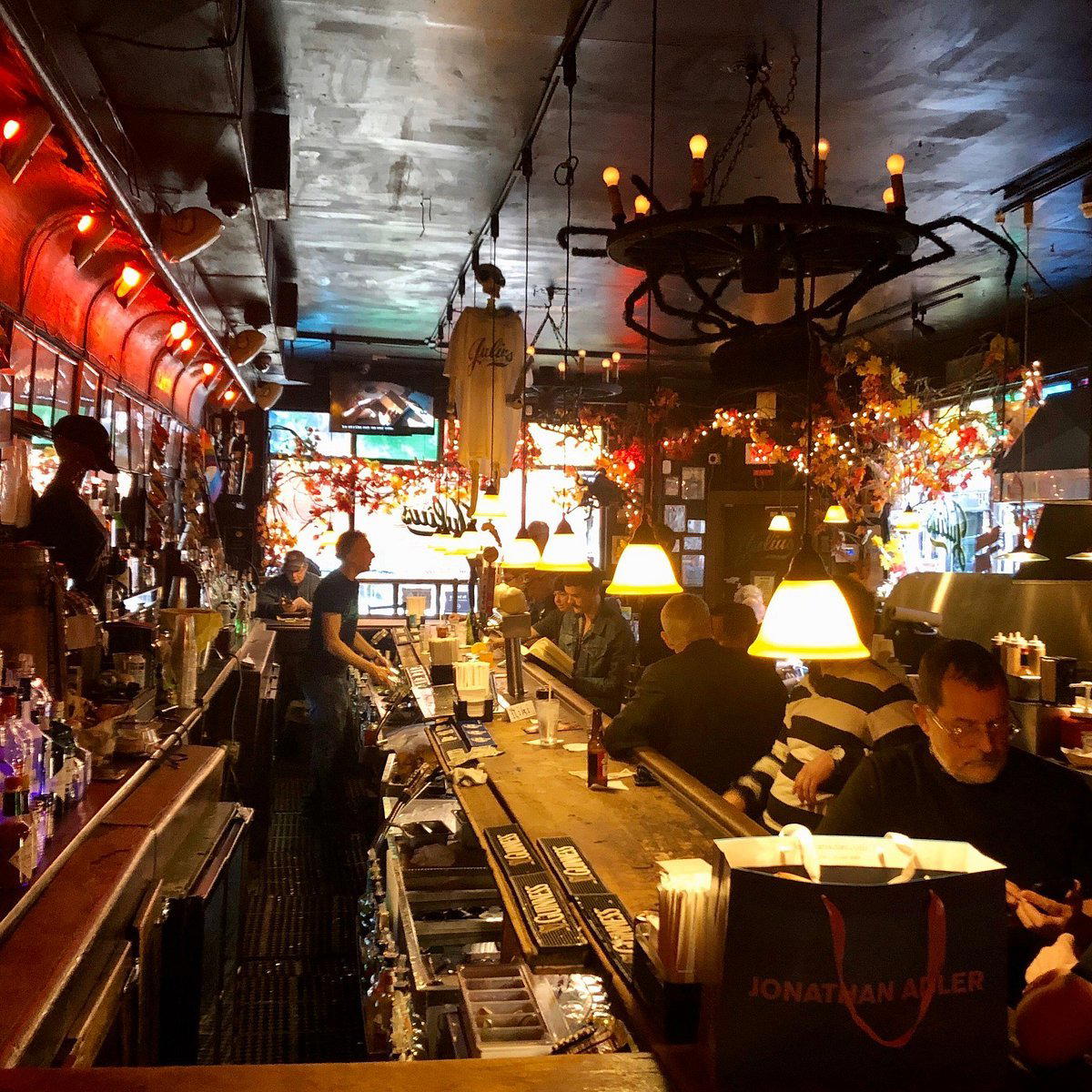
The Corner That Time Has Largely Ignored
West 10th Street in Greenwich Village has absorbed more than a century and a half of New York's appetite for reinvention, and Julius' has watched most of it from the same corner. The bar's exterior is the kind that gets photographed for its refusal to modernize: a narrow storefront, old lettering, the faint suggestion that walking in might take you somewhere that predates your concerns. Inside, that impression holds. Bare wood, worn surfaces, low light, and a room that functions as a bar rather than a concept. The atmosphere is not cultivated retro — it is simply the accumulated residue of a place that has been operating since 1867.
That founding date places Julius' among New York's genuine institutional bars, a category that includes perhaps a dozen addresses across the five boroughs with comparable claims to age and continuity. In Greenwich Village specifically, where bars open and close within the span of a lease cycle, that kind of longevity shapes the room's social character. People arrive knowing where they are. The conversation is easier for it.
What the Room Communicates
The sensory register at Julius' is almost the inverse of New York's current premium bar scene. Where addresses like Angel's Share trade in studied minimalism and curated quiet, or Attaboy NYC in improvised intimacy behind a barely marked door, Julius' operates without that kind of programming. The sound is conversational rather than ambient. The light is low without being atmospheric in any designed sense. The bar itself is long and functional, and the stools fill early on weeknights.
What you notice first, visually, is the absence of the decorative effort that characterizes most drinking rooms opened in the last two decades. There are no shelves arranged for Instagram. The glassware is practical. The only objects on the walls are the ones that have accumulated rather than been placed. This is a bar that communicates through texture and age rather than concept, and in a city where the gap between old and new is widening by the year, that communication lands differently depending on when you walk in.
Julius' carries a separate layer of history beyond its age. In 1966, it was the site of a sip-in protest organized by members of what would become the Gay Activists Alliance, who challenged a New York State Liquor Authority policy that prohibited bars from serving homosexuals. The protest, documented at the time, secured coverage and contributed to the policy's eventual repeal. That history is part of the address, not a marketing point — it sits in the room alongside the woodwork and the old fixtures, available to anyone who knows to look for it.
How It Fits the Village Bar Circuit
Greenwich Village has always maintained two distinct bar registers operating in parallel: the craft-forward rooms that rotate menus seasonally and the older, plainer spaces that trade on continuity rather than program. Julius' anchors the latter end of that spectrum, which is not a criticism, it is a function that the neighborhood requires and that newer bars cannot replicate on any timeline.
The comparison set for Julius' is not Superbueno, with its bright Latin American spirits focus, nor Amor y Amargo, which runs one of the most disciplined amaro-and-bitters programs in the city. Those bars are doing something Julius' has never attempted and has no reason to attempt. Julius' belongs to a smaller category of places whose value is archival and social rather than technical: bars where the point is the room and the company rather than the drink program.
Across American cities, bars in this category occupy an increasingly pressured position. In San Francisco, ABV operates in a neighborhood where vintage bars regularly succumb to rent pressure. In Houston, Julep has built a Southern spirits program partly in response to the disappearance of the kind of long-running neighborhood rooms that Julius' represents. In Chicago, Kumiko and in Washington D.C. Allegory are explicitly program-driven in a way that creates contrast with what institutional bars provide. The point is not that Julius' is better or worse than those addresses, it is that it fulfills a function in the city's drinking culture that no recently opened room can substitute for, however well-executed its cocktail list.
Internationally, bars that have survived into genuine institutional status share a gravitational quality that is hard to describe and easy to feel. Bar Leather Apron in Honolulu, Jewel of the South in New Orleans, and The Parlour in Frankfurt on the Main each carry versions of that quality, though their approaches differ. Julius' version is purely accumulated: nothing has been done to create it.
Planning Your Visit
Julius' sits at 159 West 10th Street in Greenwich Village, close enough to the intersection with Waverly Place that it is findable on foot from the A/C/E/B/D/F/M trains at West 4th Street or the 1/2/3 at Christopher Street-Sheridan Square. The bar does not take reservations and does not appear to operate a booking system of any kind, arrival is walk-in, which suits the room's character entirely. Weekend evenings fill the front bar early; arriving before 8pm on a Friday gives you the room before it compresses. For the broader Village and Lower Manhattan drinking context, the EP Club New York City guide covers the full range from historic rooms to current program bars.
Recognition Snapshot
A small set of peers for context, based on recorded venue fields.
| Venue | Awards |
|---|---|
| Julius'This venue — the venue you are viewing | Not listed |
| The Long Island Bar | World's 50 Best |
| Superbueno | World's 50 Best |
| Amor y Amargo | World's 50 Best |
| Angel's Share | World's 50 Best |
Continue exploring
More in New York City
Bars in New York City
Browse all →
Restaurants in New York City
Browse all →
Hotels in New York City
Browse all →




At a Glance
- Classic
- Well Known
- Cozy
- Intimate
- Casual Hangout
- After Work
- Late Night
- Historic Building
- Seated Bar
- Booth Seating
- Classic Cocktails
Current opening hours
- Monday
- 4 PM–2 AM
- Tuesday
- 4 PM–2 AM
- Wednesday
- 4 PM–2 AM
- Thursday
- 4 PM–2 AM
- Friday
- 4 PM–4 AM
- Saturday
- 12 PM–4 AM
- Sunday
- 12 PM–2 AM
Hours can change for holidays and private events. Last verified .
Dimly lit neighborhood dive with vintage decor, historic photos, and a welcoming Cheers-like atmosphere.
Know Before You Go
- Getting there
- 159 W 10th St, New York, NY 10014