Holdren's Steaks & Seafood
A Newbury Park institution for classic American surf-and-turf dining, Holdren's Steaks & Seafood has anchored the Conejo Valley's steakhouse tradition for decades. The room leans into old-school comfort: dark wood, settled atmosphere, and a menu built around prime cuts and fresh seafood. For residents between Thousand Oaks and Camarillo, it remains a reliable anchor in a dining scene increasingly pulled toward casual formats.
 Discover on Pearl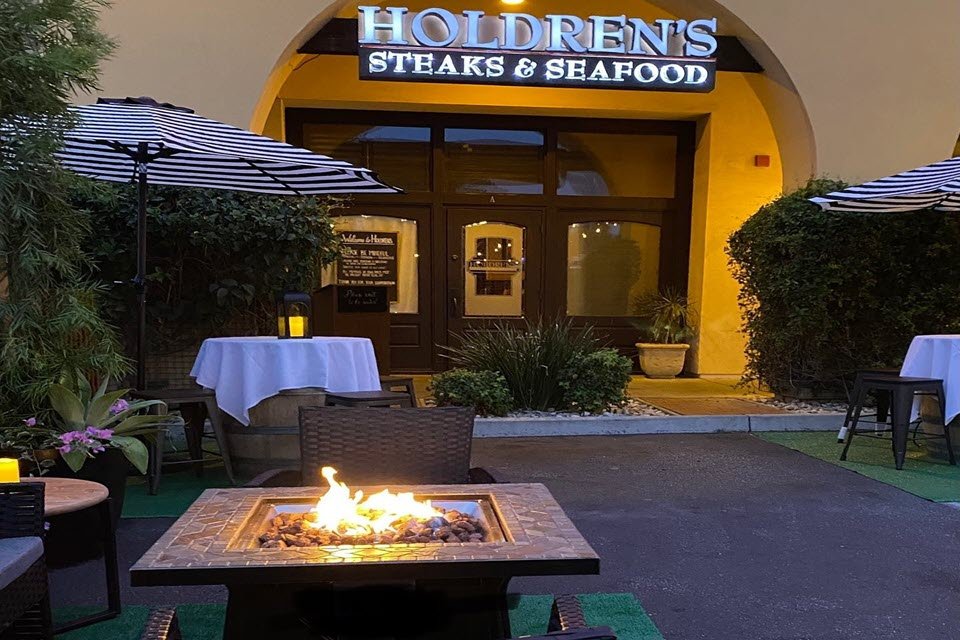
The Room Before the Menu
There is a particular architecture to the American steakhouse that predates open kitchens, chef's counters, and Instagram-optimized interiors. Dark wood paneling, leather-adjacent upholstery, low lighting calibrated for conversation rather than content creation, and a floor plan that prioritizes booth privacy over communal energy. Holdren's Steaks & Seafood at 1714-A Newbury Rd operates squarely within that tradition. The physical environment signals its era and its intentions before a single plate arrives: this is a room designed for the unhurried dinner, for the kind of occasion that measures success in hours spent rather than dishes photographed.
That aesthetic is not accidental, and in the Conejo Valley context, it carries real utility. Thousand Oaks and its surrounding communities have historically leaned toward family-format dining and suburban casual, which makes a properly appointed steakhouse room a rarer proposition than it might appear on paper. The setting at Holdren's functions as a counter-argument to the prevailing format in the area: it asks you to slow down, order a second drink, and treat dinner as the event itself.
Surf-and-Turf as Tradition
The dual-category format, steaks and seafood occupying equal billing on a single menu, has a long history in American fine-casual dining and reached its commercial peak through the postwar decades when prime beef and fresh fish were both status signals. Holdren's anchors itself in that tradition. The pairing is not a novelty positioning or a trend response; it reflects a genuine commitment to two protein categories that demand distinct sourcing, preparation discipline, and kitchen competence to execute at the level the format implies.
In the broader Southern California dining scene, this combination tends to split into two lanes: white-tablecloth steakhouse chains operating at metropolitan price points, and local independents that vary considerably in execution quality. Holdren's occupies the independent tier in a suburban market, which places it in a different competitive set than the capital-backed groups that dominate Los Angeles proper. Within Thousand Oaks specifically, the dining mix leans heavily toward international casual formats, with venues like Moqueca Brazilian Restaurant, Saffron Indian Cuisine & Bar, and E⁺ MON Sushi Westlake Village each staking out distinct ethnic culinary territory. A dedicated surf-and-turf house running on American steakhouse logic sits in a separate category from all of them.
Atmosphere as the Core Proposition
At restaurants built around the steakhouse model, atmosphere and menu are not separate considerations. The physical environment actively shapes what the food means. A rib-eye eaten under flat fluorescent light at a laminate table communicates something different from the same cut served in a room where the lighting is warm, the noise level allows a full sentence to complete, and the booth has enough depth that your dinner companion is not sitting in another table's conversation. Holdren's invests in the atmospheric conditions that make the protein-forward menu land as an occasion rather than a meal.
This matters more in suburban contexts than metropolitan ones. In Los Angeles, the surrounding neighbourhood provides ambient energy that a restaurant can borrow. In Newbury Park, the surrounding retail environment along Newbury Road does not generate that same ambient energy on its own. Restaurants in this geography have to create their own atmosphere from the inside out, which raises the stakes for interior decisions around lighting, acoustics, seating density, and service cadence. The Holdren's room appears built with that self-sufficiency in mind.
For context on how bar and hospitality programs in neighboring cities have approached the challenge of building contained atmosphere, venues like Oak and Iron in Thousand Oaks demonstrate one local answer. Further afield, programs at Kumiko in Chicago and Bar Leather Apron in Honolulu show how the most durable hospitality rooms earn their reputations through spatial discipline rather than novelty.
Positioning in the Conejo Valley Dining Context
The Conejo Valley has not historically generated the kind of culinary press coverage that Pasadena, Silver Lake, or even Ventura attract, which means restaurants here operate largely on local word-of-mouth and long-term community loyalty rather than external editorial momentum. For a venue like Holdren's, that dynamic cuts both ways. It insulates the restaurant from trend cycles that churn through more media-visible dining districts, and it means that a loyal customer base accumulated over years carries more operational weight than a single favorable review.
The trade-off is limited visibility to visitors and new residents who rely on editorial sources to orient their dining choices. The full Thousand Oaks restaurants guide covers the broader local scene, including international formats that have carved distinct niches in the area. Holdren's position within that scene is as a legacy format in a market that has diversified considerably around it, which, depending on your priorities, reads either as durability or as a lack of evolution.
Nationally, the conversation around American steakhouse dining has split between modernist reinterpretations, where technique-forward kitchens rethink the category entirely, and traditionalist houses that hold to the format's original logic. Venues like Jewel of the South in New Orleans, Julep in Houston, Superbueno in New York City, ABV in San Francisco, and The Parlour in Frankfurt each represent different points on the spectrum between innovation and tradition in their respective hospitality categories. Holdren's reads as a traditionalist, which is a coherent and defensible position when executed with consistency.
Planning Your Visit
Holdren's is located at 1714-A Newbury Rd in Newbury Park, the western anchor of the Thousand Oaks metro area, accessible by car from the 101 freeway. Specific hours, current pricing, and booking methods are leading confirmed directly with the restaurant before visiting, as operational details for independent venues of this type can shift seasonally. Given its positioning as a neighborhood fixture rather than a destination dining draw, walk-in availability on weeknights is likely more accessible than on weekend evenings, when the occasion-dining format tends to fill the room with anniversaries and family gatherings. If you are orienting a broader evening around the area, the Newbury Park corridor offers parking that metropolitan restaurant districts rarely match.
Frequently Asked Questions
Cuisine-First Comparison
These are the closest comparables we have in our database for quick context.
Need a Table?
Our members enjoy priority alerts and concierge-led booking support for the world's most difficult bars and lounges.
Get Exclusive Access