Hodelpa Nicolás de Ovando
Set within a restored 16th-century mansion on Calle Las Damas, Santo Domingo's oldest street, Hodelpa Nicolás de Ovando occupies a category of its own among the colonial city's hotels. The property's bar draws guests and locals alike with a spirits program rooted in the Caribbean's agricultural rum tradition, positioned at the intersection of heritage architecture and serious back-bar curation.
 Discover on Pearl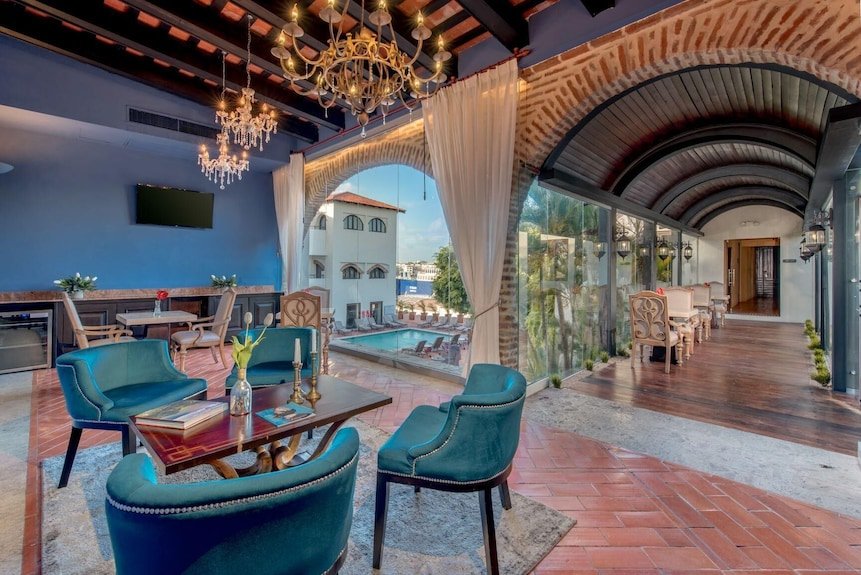
Stone Walls, Dark Rum, and the Weight of Five Centuries
Calle Las Damas is the oldest paved street in the Western Hemisphere, and walking its cobblestones toward Hodelpa Nicolás de Ovando makes that fact feel less like a tourist board claim and more like a physical sensation. The building that houses this hotel was constructed in the early 1500s, commissioned by the family of Nicolás de Ovando, the Spanish governor who shaped the colonial grid that still organises the Zona Colonial's streets. Stone arches frame internal courtyards where the temperature drops a few degrees regardless of the Caribbean heat outside, and the transition from street to interior carries the kind of architectural authority that newer properties spend fortunes trying to approximate. The bar occupies this inherited atmosphere without appearing to try — which is, in itself, a kind of editorial statement about what the property is doing here.
In a broader regional context, the Caribbean has long been a serious spirits-producing zone that international cocktail culture chronically undervalues. Rum distillation in the Dominican Republic sits within a tradition of agricultural production that predates most of the world's celebrated whisky regions by centuries. The sugarcane estates that supply Dominican rum producers are not a recent pivot toward craft credibility — they are a continuing industrial and agricultural fact. Any bar in Santo Domingo with a serious spirits program is drawing on this deep local supply chain, whether it acknowledges the context or not.
The shortlist, unlocked.
Hard-to-book tables, cellar releases, and concierge-planned trips.
Get Exclusive Access →Back Bar as a Position Statement
The bars that attract genuine spirits attention in 2024 tend to share a few observable features: depth across categories rather than width within a single one, a working knowledge of regional production rather than a global all-stars shelf, and a format that communicates that depth to the guest without requiring a lecture. Internationally, this approach has defined the reputations of places like Kumiko in Chicago, which built its recognition around Japanese whisky and liqueur curation, and 1806 in Melbourne, where the back bar traces cocktail history through the bottles themselves. In each case, the collection is the argument , you don't need the bartender to explain the philosophy if the bottles already tell it.
The Zona Colonial setting gives Hodelpa Nicolás de Ovando's bar an unusually coherent narrative starting point: the Dominican Republic's rum production represents one of the most distinctive regional spirit traditions in the world, and the hotel's address on Calle Las Damas places it within the same colonial economy that first commercialised sugarcane in the Americas. A back bar that plays to this context rather than ignoring it in favour of international standard bottles has material to work with that few properties elsewhere can claim. The question a serious spirits traveller would ask is whether the curation matches the setting , and the hotel's position as the colonial city's most architecturally significant property suggests a guest demographic that rewards rather than requires that commitment.
Where the Zona Colonial Bar Scene Sits
Santo Domingo's cocktail culture has developed unevenly. The Zona Colonial, as the primary international visitor zone, carries the highest concentration of serious bar programs, but the range in quality is wide. At one end sit the terrace rum bars that sell accessible tropical formats to visitors who arrived via cruise ship; at the other, a smaller tier of venues treating local spirits with the same structural rigor applied to cocktail programs in London, New York, or Singapore. Lulú Tasting Bar represents the city's engagement with that more considered tier, and it is worth reading alongside any assessment of what the colonial district's bar scene is building toward. Our full Santo Domingo restaurants and bars guide maps the broader picture for visitors planning across multiple nights.
Internationally, the bars that have shaped how premium hotel properties think about their spirits programs tend to occupy a specific niche: they function as credentialled destinations in their own right, not merely as conveniences for hotel guests. 28 HongKong Street in Singapore established this model early, and 69 Colebrooke Row in London demonstrated that a technically rigorous program could anchor a neighbourhood identity. More recently, Jewel of the South in New Orleans showed how deep historical research into a city's cocktail legacy could give a bar program both authority and a guest base that returns for the education as much as the drink. The parallel for Hodelpa Nicolás de Ovando is clear: the building's history is not decoration, it is the program's strongest argument for Dominican spirits as a serious category.
Rum, Terroir, and What the Caribbean Actually Produces
Dominican rum occupies a distinct position within Caribbean production. Unlike the lighter styles associated with Puerto Rico or the heavier pot-still expressions of Jamaica, Dominican producers have historically worked within a tradition that emphasises longer aging, softer profiles, and a deliberate relationship with the local climate's effect on barrel maturation. The angel's share in tropical aging conditions runs significantly higher than in temperate European spirits regions, which means that long-aged Caribbean rums achieve a concentration that would require decades more in a Scottish warehouse. This is not a marketing claim , it is a measurable difference in evaporation rates and wood interaction that experienced spirits writers and distillers document consistently.
A bar program at a property like Hodelpa Nicolás de Ovando, if constructed around this production context, has access to aged expressions from Dominican distillers , Bermúdez, Barceló, Siboney among the historic names , that represent genuine depth of category. Bars that have demonstrated comparable commitment to regional spirits elsewhere, including Julep in Houston with American whiskey and Bar Leather Apron in Honolulu with its Pacific spirits focus, show that regional specificity is not a limitation but a competitive distinction. Superbueno in New York City and The Parlour in Frankfurt have each built reputations through similar logic in their respective categories. 1930 in Milan demonstrates that a historically grounded setting and a well-constructed spirits list reinforce rather than compete with each other.
Planning a Visit
The hotel sits on Calle Las Damas in the heart of the Zona Colonial, Santo Domingo's UNESCO-listed historic district, which means it is walkable from the principal colonial monuments and within a short taxi ride of the modern city's restaurant and bar circuit. For stays, booking directly through the property is advisable for the colonial zone during the high-demand winter season, roughly December through March, when the combination of international visitors and a favourable exchange rate for North American travellers creates meaningful competition for the leading rooms. The bar operates as a hotel amenity but is accessible to non-guests, which places it within the category of hotel bars that function as neighbourhood destinations , a format more common in established European cities than in the Caribbean, and one worth treating accordingly. Visitors primarily focused on the spirits program rather than the accommodation should consider evening hours on weekdays, when the balance of the room shifts toward locals and guests with a more deliberate relationship to what they're drinking.
Frequently Asked Questions
- What is the atmosphere like at Hodelpa Nicolás de Ovando?
- The property occupies a 16th-century colonial mansion on Calle Las Damas, the oldest paved street in the Western Hemisphere. Stone archways, interior courtyards, and preserved colonial architecture create an atmosphere that operates independent of any particular décor investment , the building carries its own authority. For visitors arriving from North America or Europe, it is one of the few hotel settings in the Caribbean where the physical environment itself contextualises what you're drinking.
- What cocktail do people recommend at Hodelpa Nicolás de Ovando?
- Given the property's location in the Dominican Republic, the strongest argument goes to drinks built around aged Dominican rum , a category with genuine depth that most international visitors encounter here for the first time in a serious context. Without confirmed menu specifics on record, the most reliable approach is to ask the bartender for an aged expression from a domestic producer and let the back bar guide the format.
- Why do people go to Hodelpa Nicolás de Ovando?
- The combination of architectural significance and Zona Colonial address draws two overlapping audiences: guests seeking the most historically rooted accommodation in Santo Domingo, and drinks-focused visitors treating the bar as a destination for Caribbean spirits in a setting that matches the region's production heritage. The hotel does not need to compete on modern amenity stacking , it occupies a category its address makes largely unchallenged in the city.
- How far ahead should I plan for Hodelpa Nicolás de Ovando?
- During peak winter season, December through March, the Zona Colonial fills with international visitors and room availability at the city's most architecturally significant properties tightens considerably. Booking four to six weeks ahead is a practical minimum for that window. For bar access without a hotel stay, the walk-in format is more forgiving, though weekend evenings at the height of the season can be competitive.
- Does Hodelpa Nicolás de Ovando live up to the hype?
- The property's strongest claim is architectural and locational rather than service or program-dependent , the 500-year-old building on the oldest street in the Western Hemisphere is not a credential that requires managing expectations around. Whether the bar program has kept pace with what the setting makes possible is the more interesting question, and one that the broader regional spirits conversation is pushing every serious Caribbean bar to answer more credibly than before.
- What makes the Hodelpa Nicolás de Ovando bar a destination for spirits enthusiasts visiting Santo Domingo?
- The hotel's position within the colonial zone that first commercialised sugarcane in the Americas gives its bar program a historical argument for Dominican rum that no other property in the city can replicate on purely geographic and architectural grounds. For spirits travellers who have followed aged Caribbean rum through producers like Barceló and Bermúdez in other contexts, drinking those expressions inside a 16th-century building on Calle Las Damas adds a layer of material context that separates the experience from a comparable pour at a modern hotel bar. It is the kind of setting that rewards research done before arrival.
A Pricing-First Comparison
A fast peer set for context, pulled from similar venues in our database.
| Venue | Price | Awards | Notes |
|---|---|---|---|
| Hodelpa Nicolás de Ovando | This venue | ||
| Lulú Tasting Bar |
Need a Table?
Our members enjoy priority alerts and concierge-led booking support for the world's most difficult bars and lounges.
Get Exclusive AccessThe shortlist, unlocked.
Hard-to-book tables, cellar releases, and concierge-planned trips.
Get Exclusive Access →