Folkehuset Absalon
A converted community hall on Sønder Boulevard, Folkehuset Absalon sits at the intersection of neighbourhood social life and Copenhagen's broader tradition of communal eating. The space hosts shared long-table dinners alongside cultural programming, placing it firmly in the city's civic-dining tradition rather than its restaurant scene proper. For visitors tracking how Danes eat together, it offers a genuine point of reference.
 Discover on Pearl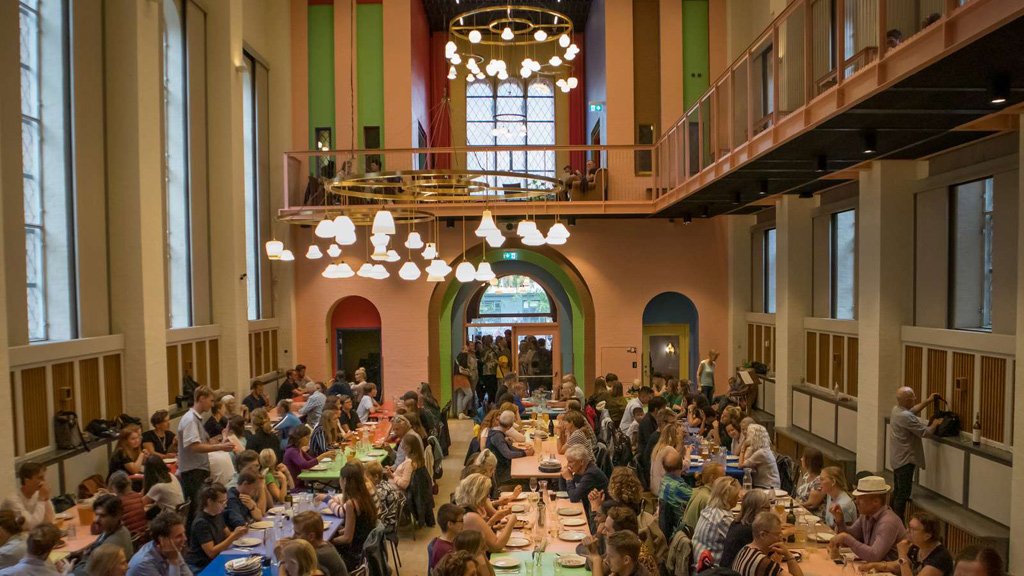
A Hall That Eats Together
Walk south from Vesterbro's main artery and the building announces itself by scale rather than signage. Folkehuset Absalon occupies a repurposed church hall on Sønder Boulevard, its high ceilings and wide nave translated into something between a neighbourhood canteen, a cultural centre, and a communal dining room. Copenhagen has a well-documented tradition of folkekökken — the people's kitchen model where shared tables and fixed menus collapse the distance between strangers — and Absalon sits near the centre of that tradition, not as a novelty but as a working institution.
The format matters here more than any individual dish. Shared long tables seat several hundred people on most evenings, with a rotating menu prepared by volunteer and community cooks rather than a brigade in the conventional restaurant sense. That structure is the editorial point: where much of the city's dining conversation centres on tasting menus and chef-driven counters, Absalon operates on the logic of collective participation. The menu changes regularly, anchored to affordable, seasonal cooking that reflects whoever is in the kitchen that week. If you arrived expecting a restaurant in the conventional sense, you would be reading the room incorrectly.
The shortlist, unlocked.
Hard-to-book tables, cellar releases, and concierge-planned trips.
Get Exclusive Access →Where This Fits in Copenhagen's Dining Map
Copenhagen's dining identity has split along increasingly sharp lines over the past fifteen years. At one end, the chef-driven tasting menu format , Michelin-starred or aspiring to it , has made the city one of Europe's more expensive places to eat seriously. At the other end, the city has preserved and in some cases expanded a civic-dining tradition that prioritises access, community, and low price points over spectacle. Absalon belongs to the latter category, and the gap between the two is wide enough that visitors should treat them as separate decisions rather than points on the same spectrum.
Within the civic-dining tier, Absalon occupies a distinctive position by virtue of its scale and its physical space. Most Copenhagen neighbourhood kitchens operate from smaller, lower-profile rooms. The Absalon building confers a certain gravity , its converted ecclesiastical bones give shared dinners a setting that reads more like a civic ceremony than a casual meal. That quality is harder to find in the city's restaurant strip and easier to find here than almost anywhere else in Vesterbro. For those tracking Copenhagen's bar and drinks scene, the area overlaps with venues like Bird, Charlie's Bar, and Ruby, which occupy a very different register but share the neighbourhood's general energy.
The Menu Architecture
What the menu reveals about Absalon is as instructive as what it contains. Community-kitchen formats that operate at this scale tend to resolve around a narrow set of constraints: low cost per head, broad dietary accessibility, and cooking that can be executed by rotating volunteer teams without consistent professional training. The result is a menu that leans toward hearty, plant-forward, or simply composed dishes rather than technique-intensive preparations. Portions are generous by Copenhagen standards, where restaurant portions have grown leaner as tasting-menu logic has permeated the mid-market.
The rotation means that no single visit locks in a definitive impression of what the kitchen produces. That variability is a feature of the model, not a flaw: the point is the format's continuity, not any individual cook's signature. Visitors who have eaten at civic-dining institutions in other Northern European cities , Amsterdam's De Foodhallen communal model, or Berlin's various collective kitchen projects , will recognise the logic immediately. The meal is the occasion for the gathering, not the gathering's purpose in itself.
Elsewhere in Denmark, wine-bar formats have developed their own version of accessible, low-intervention drinking culture, from Jysk Vin Vinbar in Aarhus to Oasis Vinbar in København K. Absalon's drinks offer tends to follow the same democratising logic as its food: approachable, priced to match the meal, without the natural-wine curation that drives some of the city's more specialist bar programmes. Smaller Danish cities have developed their own neighbourhood focal points in a similar register , Hugos No. 19 in Køge, Visselulles Vinbar in Sønderborg, and No 43 in Hørsholm each anchor their respective communities in ways that echo, at smaller scale, what Absalon does in Copenhagen. For a broader read on how these venues connect to the wider Danish hospitality scene, our full Copenhagen restaurants guide maps the city's tiers in more detail.
The Cultural Programme
Absalon's identity extends beyond dinner. The same building hosts concerts, language courses, political discussions, yoga classes, and neighbourhood assemblies throughout the week. This multiprogramme model is relatively common in Scandinavian community centres but less common at the scale and visibility that Absalon operates. The dining function is embedded within a broader civic purpose, which changes the social register of a meal here in ways that a standard restaurant visit does not replicate.
That context is worth naming explicitly for visitors coming from cities where community-centre dining tends to mean something austere or provisional. Absalon's evenings carry an atmosphere of deliberate conviviality: the room is full, the tables are long, and the assumption is that you will talk to people you did not arrive with. Whether that reads as appealing or demanding depends entirely on the visitor, but it is the condition of the format rather than an incidental detail.
Planning a Visit
Absalon sits on Sønder Boulevard in Vesterbro, within walking distance of Copenhagen Central Station and accessible by multiple bus routes along the boulevard itself. The shared-table dinner format typically runs on most evenings, though the specific schedule and menu shift week to week and the building's cultural programme sometimes affects dinner availability. Checking the venue's event calendar before visiting is advisable rather than optional. Price points sit well below Copenhagen restaurant norms, which is part of the model's function. Dress code is non-existent in any meaningful sense: the room operates on the assumption that everyone arrives as they are. For travellers whose Copenhagen itinerary already includes stops at higher-end venues or hotel bars like 71 Nyhavn Hotel, an evening at Absalon provides useful counterpoint. For those curious how the communal dining model translates to other international cities, Bar Leather Apron in Honolulu and Jewel of the South in New Orleans demonstrate how convivial hospitality operates at the other end of the craft-drinks spectrum.
The shortlist, unlocked.
Hard-to-book tables, cellar releases, and concierge-planned trips.
Get Exclusive Access →Frequently Asked Questions
Reputation Context
A small comparison set for context, based on the venues we track.
| Venue | Awards | Cuisine | Notes |
|---|---|---|---|
| Folkehuset Absalon | This venue | ||
| Bird | World's 50 Best | ||
| Charlie's Bar | World's 50 Best | ||
| Ruby | World's 50 Best | ||
| Ancestrale | |||
| Baest |
Need a Table?
Our members enjoy priority alerts and concierge-led booking support for the world's most difficult bars and lounges.
Get Exclusive AccessThe shortlist, unlocked.
Hard-to-book tables, cellar releases, and concierge-planned trips.
Get Exclusive Access →