

Star Wine List · Falstaff Wine Bar - 92 Falstaff Points
Opened in late 2024 on Gerichtstraße in Wedding, Ernst Cave occupies a stripped-back format that Berlin's bar scene rarely attempts: wine, low light, and deliberate quiet. Where most venues compete on programming and spectacle, this one competes on restraint. It arrived as a counter-argument to Berlin's louder drinking culture, and the city's early reception suggests the argument is landing.

Pearl is the En Primeur Club membership app — saves, bookings, and concierge access live there. Same editors, same standards.
- Address
- Gerichtstraße 31, 13347 Berlin, Germany
- Hours
- Mon–Thu ClosedFri–Sun 6–11 PM
- Website
- ernstcave.com
- Directions
- Get directions
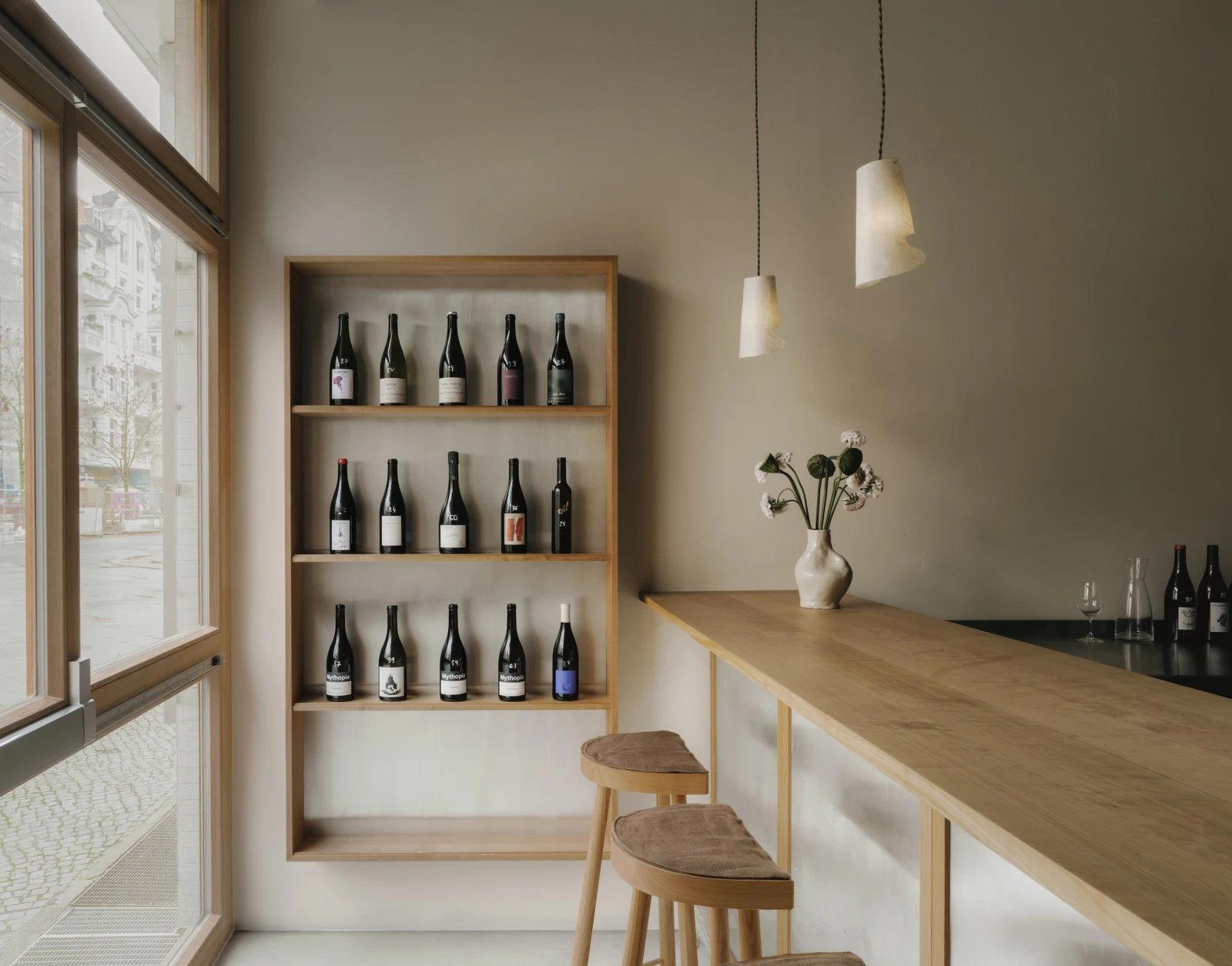
Silence as a Design Choice
Berlin's bar culture has long organised itself around the opposite of quiet. From the curated playlists of Mitte's cocktail rooms to the theatrical pours at Buck & Breck and the full-throttle programmes at Stagger Lee, the city's drinking rooms tend to layer sensation: sound, spectacle, and a defined aesthetic that does most of the communicating before a glass is poured. Ernst Cave, which opened in late 2024 on Gerichtstraße 31 in the Wedding district, takes a position almost directly opposite. The space is built around three elements: wine, light, and silence. Everything else has been removed.
That kind of editorial reduction is harder than it looks. Stripping a bar back to essentials only works when the essentials are calibrated precisely, and in Berlin — where venues routinely dress sparse interiors in concept language without following through — the execution usually reveals itself quickly. What makes Ernst Cave worth attention is not the gesture of minimalism itself but the seriousness with which the format is maintained. The cave of the name is not metaphorical decoration. It describes something about the quality of the room: contained, deliberately low-lit, oriented around what is in the glass rather than what is happening around it.
Wedding as a Location Argument
The address does some editorial work of its own. Wedding sits north of Mitte, separated from Berlin's more trafficked drinking corridors by a few subway stops and a significant shift in neighbourhood character. The area has been receiving serious operators for several years now, but it has not yet been absorbed into the tourist circuit that shapes venues in Prenzlauer Berg or Kreuzberg. A bar in Wedding makes a statement about who it is for and how it expects to be found.
For comparison: Velvet and Lebensstern operate in parts of the city with established bar-going traffic, where discovery requires less work from the guest. Ernst Cave's position in Wedding suggests a different model, one that depends on reputation travelling ahead of footfall rather than footfall generating reputation. That is a harder opening position but, when it works, produces a more self-selected clientele. Early reception indicates the approach is holding.
The Format and What It Reveals
The editorial angle at Ernst Cave is the menu architecture, and here the format says as much as the list itself. A wine-only programme in a city bar context is a position statement. Most Berlin bars that take wine seriously still offer it within a broader drinks card, spirits, cocktails, perhaps beer. Reducing the offer to wine alone changes the relationship between guest and list. There is no fallback, no cocktail to order while you decide, no spirit-forward option for guests who arrived thinking differently. The list has to carry the room, and the room has to be comfortable with the list doing that work.
This model has precedents in other European cities, Paris in particular has developed a strong strand of cave-format wine bars where the list is the entertainment and the physical environment is designed to support slow, attentive drinking rather than rapid throughput. In the German context, that format is less common. Berlin's wine bar scene has grown significantly in the last decade, but most venues retain enough programming flexibility to accommodate different drinking modes. Ernst Cave's apparent commitment to a single-format experience positions it closer to the Parisian cave model than to a typical Berlin Weinbar.
Wine lists structured this way tend to reward specific reading habits.
Berlin's Counter-Programming Strand
Ernst Cave belongs to a recognisable strand of Berlin openings that arrive as counter-arguments to the city's dominant drinking modes. The movement is not new, Buck & Breck made its reputation by running against the grain of Berlin's bar culture, operating on strict capacity limits and a format that required attention from the guest, but it keeps producing new entrants as the city's louder venues reach saturation. What changes with each iteration is the specific thing being stripped back.
Across Germany, the same tension between spectacle and restraint plays out differently by city. The Parlour in Frankfurt and Goldene Bar in Munich operate premium programmes in cities where the drinking culture skews toward craft precision over atmosphere-led concepts. Le Lion Bar de Paris in Hamburg has built a long reputation on a similar philosophy of fewer choices, better execution. What Ernst Cave is attempting in Berlin maps onto that broader German bar tradition of format discipline, even as it does so through a specifically cave-shaped lens.
Further afield, the same restraint-first model can be found at venues like Bar Leather Apron in Honolulu, which has built a considered, precision-led programme in a market where the temptation to go broad is considerable. The geography is different but the operating logic is the same: reduce the offer, increase the depth, and trust the guest to meet you there.
Planning a Visit
Ernst Cave is at Gerichtstraße 31, 13347 Berlin, reachable from Wedding S-Bahn or the U6 line via Leopoldplatz. Given that the venue opened in late 2024 and has already drawn attention in a city with considerable competition for serious drinking, booking ahead is the prudent approach, particularly for weekends. No phone or web booking details are confirmed in the available record, so checking current reservation options directly before visiting is advisable. Dress expectations are not documented, but the format, quiet, wine-focused, low-lit, suggests guests who arrive with the same register as the room will find the visit more rewarding. Those looking for broader cocktail programming on the same evening might consider pairing with Stagger Lee or one of the other venues in our full Berlin guide.
For visitors coming from outside Berlin, Wedding is not the most obvious starting neighbourhood, but it is an honest one. It tells you something about where the city's serious operators are choosing to open, and that information is worth factoring into how you plan the rest of the evening.
A Credentials Check
Comparable venues nearby, for context on price, style, and recognition.
| Venue | Cuisine | Price | Awards | Notes |
|---|---|---|---|---|
| Ernst CaveThis venue — the venue you are viewing | wine_bar | Not listed | Star Wine List · Falstaff Wine Bar - 92 Falstaff Points | Not listed |
| Mauerwinzer | wine_bar | Not listed | Star Wine List · Falstaff Wine Bar - 88 Falstaff Points | Scheunenviertel |
| 8000 Vintages | wine_bar | $30–50 | Star Wine List | Kreuzberg |
| Monu | lounge | $20–30 | Star Wine List | Kreuzberg |
| L’Apéro Bar | cocktail_bar | Not listed | Star Wine List | Kreuzberg |
| Der Kleine August | Bar | $30–50 | Star Wine List | Mitte |
Recognition history
Dated appearances from independent guides and award organizations, with the underlying list record or original source where available.
Star Wine List
Star Wine List
Falstaff Wine Bar - 92 Falstaff Points
Falstaff
Continue exploring
More in Berlin
Bars in Berlin
Browse all →
Restaurants in Berlin
Browse all →
Hotels in Berlin
Browse all →

Details
- Cozy
- Intimate
- Industrial
- Minimalist
- Date Night
- Casual Hangout
- Design Destination
- Standalone
- Seated Bar
- Natural Wine
Current opening hours
- Monday
- Closed
- Tuesday
- Closed
- Wednesday
- Closed
- Thursday
- Closed
- Friday
- 6–11 PM
- Saturday
- 6–11 PM
- Sunday
- 6–11 PM
Hours can change for holidays and private events. Last verified .
Light and open character with natural raw materials, candlelight in a stripped-down cozy space.