Dickson's Farmstand Meats
Dickson's Farmstand Meats at Chelsea Market operates where butcher-shop craft intersects with New York's broader shift toward provenance-driven food retail. The counter format, the focus on whole-animal sourcing, and the address at 75 9th Ave place it inside one of the city's most concentrated food destinations. It functions as both a retail stop and a practical primer on how serious meat sourcing works in a major urban market.
Pearl is the En Primeur Club membership app — saves, bookings, and concierge access live there. Same editors, same standards.
- Address
- 75 9th Ave, New York, NY 10011
- Phone
- +1 917 312 9708
- Website
- dicksonsfarmstand.com
- Directions
- Get directions
 Saves & bookings on Pearl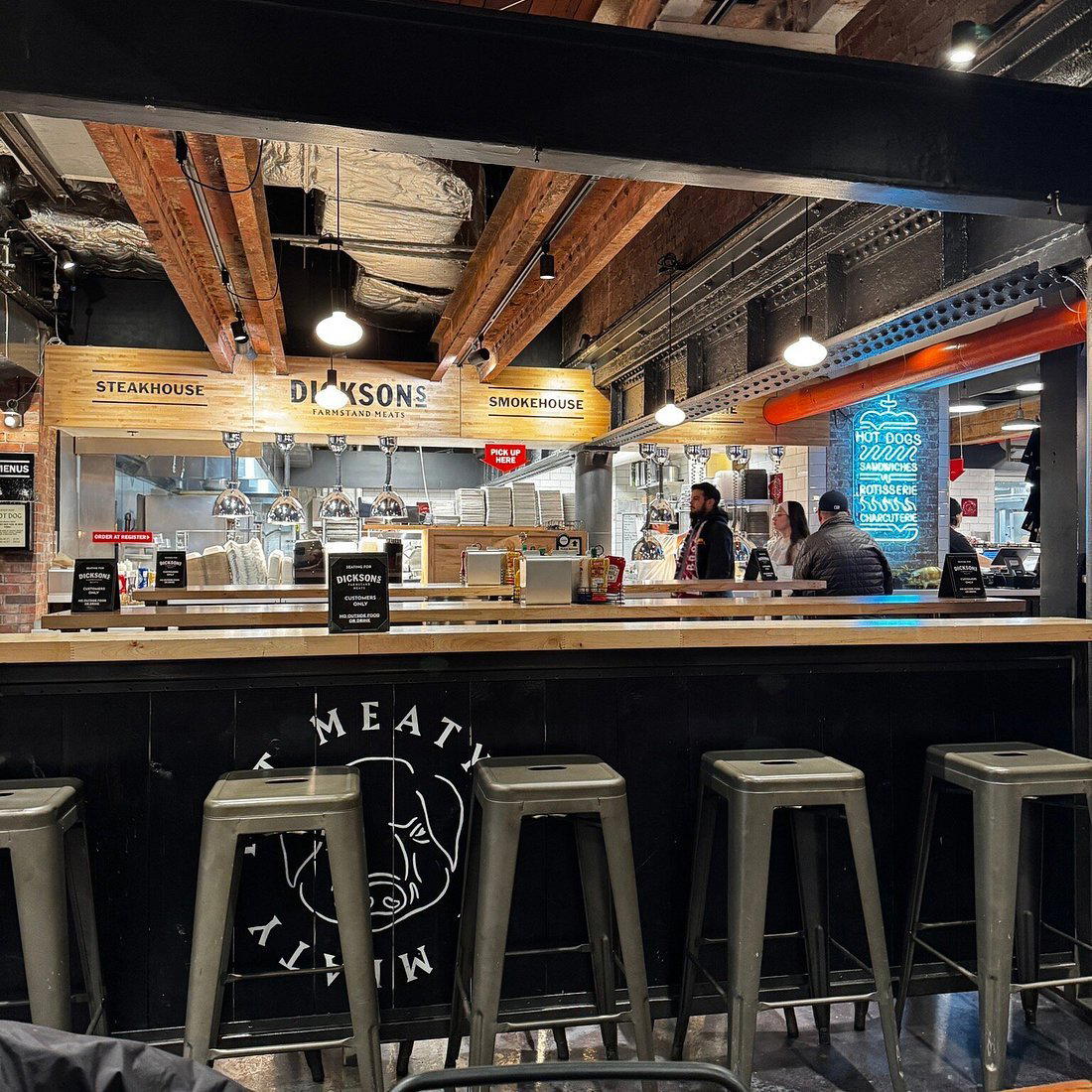
A Butcher Counter in a Market That Rewards Attention
Chelsea Market occupies a former Nabisco factory on 9th Avenue, and the building's industrial bones, exposed brick, overhead pipes, narrow corridors that open into cavernous halls, set a particular register for everything inside. You arrive expecting food retail, and the space delivers it. The market operates on a different logic than a food hall designed from scratch: the vendors feel embedded rather than staged, and that quality shapes how a counter like Dickson's Farmstand Meats reads against its surroundings. The concrete and steel frame makes the butcher case look like it belongs there.
Whole-animal butchery as a retail format re-emerged in American cities during the 2000s, partly in response to the industrialization of meat supply chains and partly as a function of the same sourcing-transparency movement that pushed farm-to-table dining into the mainstream. New York was an early city for that shift. The model asks the customer to engage with the product differently: cuts are dictated by what the animal yields rather than what supermarket demand normalizes, and the counter staff function as something closer to consultants than cashiers. Dickson's Farmstand Meats sits within that tradition at a location, 75 9th Ave, that gives it consistent foot traffic from both neighborhood residents and the tourist draw that Chelsea Market generates year-round.
What the Format Communicates
The physical layout of a serious butcher counter tells you most of what you need to know before a word is exchanged. At a provenance-driven shop, the case is organized by animal and cut in ways that reflect whole-carcass utilization: less familiar cuts share space with the standards, and signage tends to name farms rather than just grades. This is the organizing logic of the craft butchery model, and it differs from supermarket presentation in ways that are immediately legible to anyone who shops both.
Chelsea Market as a container reinforces this dynamic. The market draws a cross-section of New Yorkers and visitors who are already primed to spend time and money on food, which means the average customer at a counter like Dickson's is more likely to ask questions and less likely to default to the cheapest cut. That self-selecting audience matters for a format where the business model depends on moving the whole animal, not just the premium portions. The High Line entrance at the market's western end, and the proximity to the Meatpacking District to the north, places this stretch of 9th Avenue in a neighborhood that has absorbed significant affluence over the past two decades, a shift that has supported exactly the kind of specialist food retail that requires a customer willing to pay for sourcing information.
Where This Fits in New York's Food Retail Picture
New York supports a broader range of specialist food retail than most American cities, partly because density creates viable customer bases for narrow offerings and partly because the city's food culture has been shaped by successive waves of immigration and a media ecosystem that treats food as a serious subject. The craft butchery tier, which includes a handful of Manhattan and Brooklyn operations built around direct farm relationships and whole-animal processing, occupies a specific position in that picture. These shops are not competing with supermarkets on price or convenience; they compete on information, sourcing specificity, and the kind of product you cannot reliably source through industrial supply chains.
For the EP Club reader building an itinerary around New York's food culture, the distinction matters. Chelsea Market rewards visits that combine retail stops, where you engage with product and learn something, with adjacent dining and drinking options. The neighborhood extends logically toward some of the city's more deliberate bar programs. Amor y Amargo operates a few miles east in the East Village, where the format centers on amaro and bitters-forward drinks with the same specialist clarity that defines good craft retail. Attaboy NYC on Eldridge Street runs a no-menu format that asks the bartender to respond to the drinker's preferences, a model that parallels the consultation dynamic at a serious butcher counter. Angel's Share in the East Village has operated in the same building since the 1990s and represents a different tier of specialist knowledge, rooted in Japanese whisky and technique.
Further afield, the same sourcing-and-craft logic appears across American bar programs worth noting: Kumiko in Chicago builds its program around Japanese spirits and precise technique; ABV in San Francisco operates as an amaro-focused bar with serious depth on the back bar; Jewel of the South in New Orleans anchors its program in historical cocktail research. The common thread is a willingness to demand customer engagement in exchange for a better product. Julep in Houston, Allegory in Washington, D.C., Bar Leather Apron in Honolulu, and The Parlour in Frankfurt on the Main each represent the same specialist tier in their respective cities.
Back in New York, Superbueno in the East Village takes a different approach, Latin-inflected, high-energy, technically grounded, and represents how the city's bar scene sustains genuine variety across registers. That variety is part of what makes a Chelsea Market visit feel like one element of a broader itinerary rather than a destination in itself.
Planning a Visit
Chelsea Market operates during standard retail hours and draws its heaviest crowds on weekend afternoons, when the tourist and resident mix peaks. A weekday morning visit gives more access to counter staff and a less compressed shopping experience. The market's 9th Avenue entrance is one direct approach from the High Line. Dickson's Farmstand Meats is at 75 9th Ave, within the market's main hall.
How It Stacks Up
Comparable venues nearby, for context on price, style, and recognition.
| Venue | Cuisine | Price | Notes |
|---|---|---|---|
| Dickson's Farmstand MeatsThis venue — the venue you are viewing | beer_bar | $$ | Not listed |
| Momoya Chelsea | lounge | $$ | Chelsea-Hudson Yards |
| Spicy Moon West Village | cocktail_bar | $$ | Greenwich Village |
| L'Appartement 4F | wine_bar | $$ | Brooklyn Heights |
| Bar Americano | cocktail_bar | $$ | Greenpoint |
Continue exploring
More in New York City
Bars in New York City
Browse all →
Restaurants in New York City
Browse all →
Hotels in New York City
Browse all →






At a Glance
- Rustic
- Trendy
- Cozy
- After Work
- Casual Hangout
- Group Outing
- Standalone
- Counter Only
- Communal Tables
- Craft Beer
Current opening hours
- Monday
- 10 AM–8:30 PM
- Tuesday
- 10 AM–8:30 PM
- Wednesday
- 10 AM–8:30 PM
- Thursday
- 10 AM–8:30 PM
- Friday
- 10 AM–8:30 PM
- Saturday
- 10 AM–8:30 PM
- Sunday
- 10 AM–8:30 PM
Hours can change for holidays and private events. Last verified .
Industrial market vibe with exposed brick and bustling energy from Chelsea Market surroundings.