Babbo
A Greenwich Village address that has shaped the way New York thinks about Italian-American cooking, Babbo on Waverly Place sits in a peer set where the room, the wine list, and the kitchen operate as a coordinated whole. The collaboration between front-of-house and cellar defines the experience as much as what arrives on the plate.
 Discover on Pearl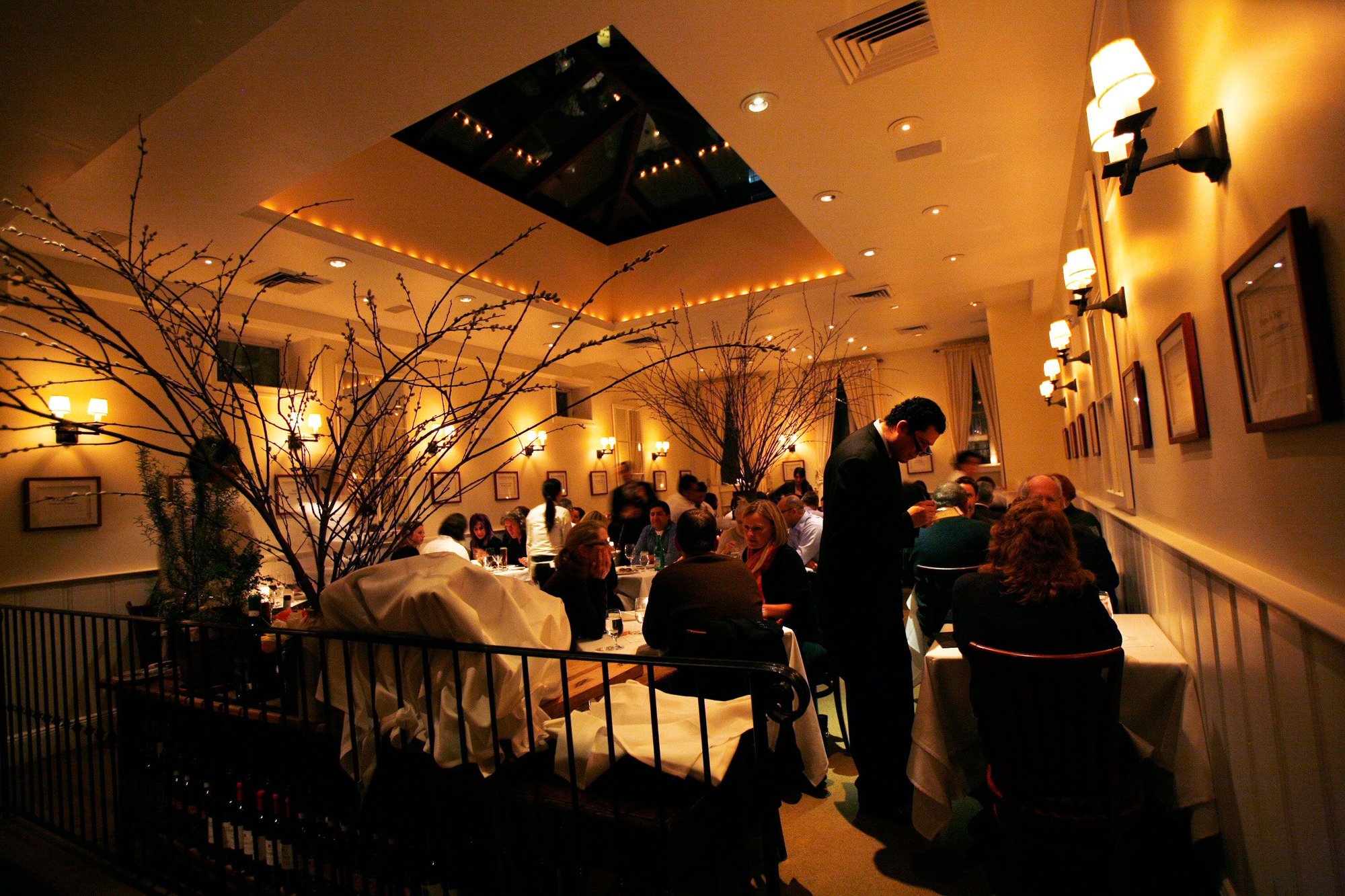
Waverly Place and What It Signals
Greenwich Village has always maintained a different relationship with Italian cooking than Midtown or the outer boroughs. The neighbourhood's smaller blocks, lower sight lines, and brownstone density created conditions where restaurants could become fixtures rather than destinations, pulling the same tables back week after week rather than chasing tourist rotation. Babbo, at 110 Waverly Place, occupies a converted carriage house on one of the Village's quietest corners, and the building itself sets expectations before you reach the door: warm light from the windows, a townhouse scale that suggests occasion without formality, a street-level entrance that feels earned rather than announced.
That physical modesty is doing editorial work. In a city where restaurant openings compete on square footage and spectacle, a two-storey room with low ceilings and closely spaced tables communicates a particular set of priorities. The noise level on a full Saturday service has long been part of the experience, not a flaw in the design, and regulars have factored it into the calculus of booking from the beginning.
The Coordination That Defines the Room
Italian-American dining at the upper tier has historically struggled with a specific tension: the cuisine carries strong popular associations that pull against fine-dining pricing and presentation. The restaurants that resolve this tension most effectively tend to do so not through any single element but through the alignment of kitchen ambition, floor confidence, and wine program depth. When those three operate as a coordinated system rather than independently managed departments, the experience holds together across courses and across the room.
Babbo has been read through this lens for years. The wine list, built around Italian producers with particular depth in the south and the islands, functions less as a beverage supplement and more as an argument about what Italian cooking is capable of when the cellar matches the ambition of the kitchen. A sommelier operating in that environment is making curatorial decisions that shape how food reads, not simply recommending bottles to match price points. The front-of-house, in turn, has to carry the weight of translating that seriousness into service that doesn't tip into stiffness, which is a narrower path than it sounds in a room this small and this loud.
This kind of operational alignment is worth noting for what it implies about repeat visits. The first time at a restaurant like this, attention goes to the food. By the second or third visit, it shifts to the system: how the floor reads a table's pace, when the sommelier pivots from a recommendation to a question, how the kitchen adjusts timing on a busy night. Babbo has been operating long enough that regulars are reading those signals, and the staff is calibrated accordingly.
Italian Cooking in New York's Upper Register
New York's Italian restaurant category spans a wider price and ambition range than almost any other cuisine in the city. At the lower end, red-sauce joints and neighbourhood trattorias maintain their own internal logic and loyal audiences. At the upper end, a smaller group of restaurants has spent the last two decades making a case for Italian cooking as a serious fine-dining category, not merely a comfortable one. That argument requires kitchen technique, sourcing discipline, and a willingness to serve offal, house-made pasta in unfamiliar shapes, and wines that most American diners haven't encountered.
Babbo has operated inside that upper register through a period when the competition around it changed considerably. New Italian openings in Manhattan have accelerated, with significant investment going into both neighbourhood trattorias and high-concept Italian tasting menu formats. The restaurants that have maintained their position across that cycle tend to share a characteristic: they never tried to become something else. The menu continues to include dishes that require a willingness to follow the kitchen's lead rather than defaulting to familiar comfort, which is a form of institutional confidence that is harder to sustain than it looks from the outside.
For visitors planning a first visit, the room and format reward some advance consideration. Reservations at Babbo require planning, typically further out than most Village alternatives, and the two-floor layout means that table position affects the experience in ways worth noting at the time of booking. The bar area offers a route in for walk-ins and shorter waits, and is a legitimate way to experience the wine program without committing to a full seated dinner. For those tracking the broader New York cocktail and drinks scene, the city's bar program has developed substantially around the Village and Lower Manhattan; venues like Amor y Amargo and Attaboy NYC represent the kind of technically serious approach to drinks that pairs logically with a dinner of this register, while Angel's Share remains one of the borough's more considered options for a pre-dinner drink. Further afield in Manhattan, Superbueno operates in a different register entirely but demonstrates the range of serious drinks programming now available across the city.
The broader national conversation about high-ambition bar programs has moved well beyond New York. Kumiko in Chicago, Jewel of the South in New Orleans, ABV in San Francisco, Julep in Houston, and Bar Leather Apron in Honolulu each represent a regional variation on the same argument: that drinks programming at a serious level requires the same systemic thinking that Babbo applies to its floor and cellar. Internationally, venues like Allegory in Washington, D.C. and The Parlour in Frankfurt on the Main extend that frame across borders.
For a complete orientation to New York's restaurant and dining scene, the EP Club New York City guide covers the full range of categories and neighbourhoods.
Planning a Visit
Babbo sits at 110 Waverly Place in Greenwich Village, reachable on foot from the West 4th Street subway station. The restaurant draws a mixed crowd of neighbourhood regulars, out-of-towners making a deliberate visit, and industry professionals who treat it as a reference point rather than a special occasion. That mix produces a room with more conversational energy than ceremony, which suits the format. Booking ahead is advisable; the restaurant's consistent demand over many years means same-week availability is uncommon, particularly for weekend dinner. If a full table isn't available, the bar remains the most practical entry point and is worth treating as an experience in its own right given the depth of the Italian wine offering.
Frequently Asked Questions
- What's the signature drink at Babbo?
- Babbo is better known for its wine program than for a cocktail identity. The Italian-focused cellar, with particular strength in southern Italian and island producers, is the drinks story here. If you're looking for a pre-dinner cocktail, the bar at Babbo is a functional option, but the more technically ambitious cocktail programs in the neighbourhood are at dedicated bars like Amor y Amargo or Attaboy NYC.
- What should I know about Babbo before I go?
- The room is genuinely loud on busy nights, the menu rewards a willingness to order beyond the familiar, and the wine list is deep enough to justify asking the sommelier for guidance rather than defaulting to what you know. Greenwich Village is the context; this is a neighbourhood institution that happens to operate at a high level of ambition, not a hotel restaurant or a tourist-facing venue.
- What's the leading way to book Babbo?
- Advance planning is the consistent advice from regular visitors. Demand has remained steady over many years, which means last-minute availability is limited, especially for weekend dinner service. If you arrive without a reservation, the bar area is a realistic option for a shorter wait and still gives access to the wine program.
- Is Babbo better for first-timers or repeat visitors?
- Both, but in different ways. First-timers benefit from going in without a fixed agenda and following the menu rather than ordering defensively. Repeat visitors tend to read the experience at a different resolution, noticing the floor coordination and wine pairings as the system they are rather than as individual service moments. The restaurant has sustained enough consistency to reward both modes.
- Does Babbo live up to the hype?
- The honest answer is that the hype has shifted shape over time. Babbo built its reputation when Italian cooking at this level was less common in New York; the field is more competitive now. What remains is a restaurant that operates as a coherent system rather than a collection of good individual elements, and that systemic quality is harder to replicate than a single strong dish or a famous name on the door.
- Is Babbo a good choice for someone specifically interested in Italian regional wine?
- Yes, and this is one of the more specific reasons to choose it over newer Italian-American openings in the city. The cellar has historically prioritised Italian producers, with coverage that extends beyond the usual Tuscany and Piedmont anchors into the south and the islands. For a diner whose primary interest is pairing serious Italian wine with kitchen cooking that matches its ambition, Babbo operates at a depth that places it in a distinct peer set within New York's Italian restaurant category. Asking the sommelier to lead on the pairing is the most direct way to access what the list offers.
At-a-Glance Comparison
A quick comparison pulled from similar venues we track in the same category.
| Venue | Cuisine | Price | Awards | Notes |
|---|---|---|---|---|
| Babbo | This venue | |||
| The Long Island Bar | World's 50 Best | |||
| Dirty French | ||||
| Superbueno | World's 50 Best | |||
| Amor y Amargo | World's 50 Best | |||
| Angel's Share | World's 50 Best |
Need a Table?
Our members enjoy priority alerts and concierge-led booking support for the world's most difficult bars and lounges.
Get Exclusive Access