

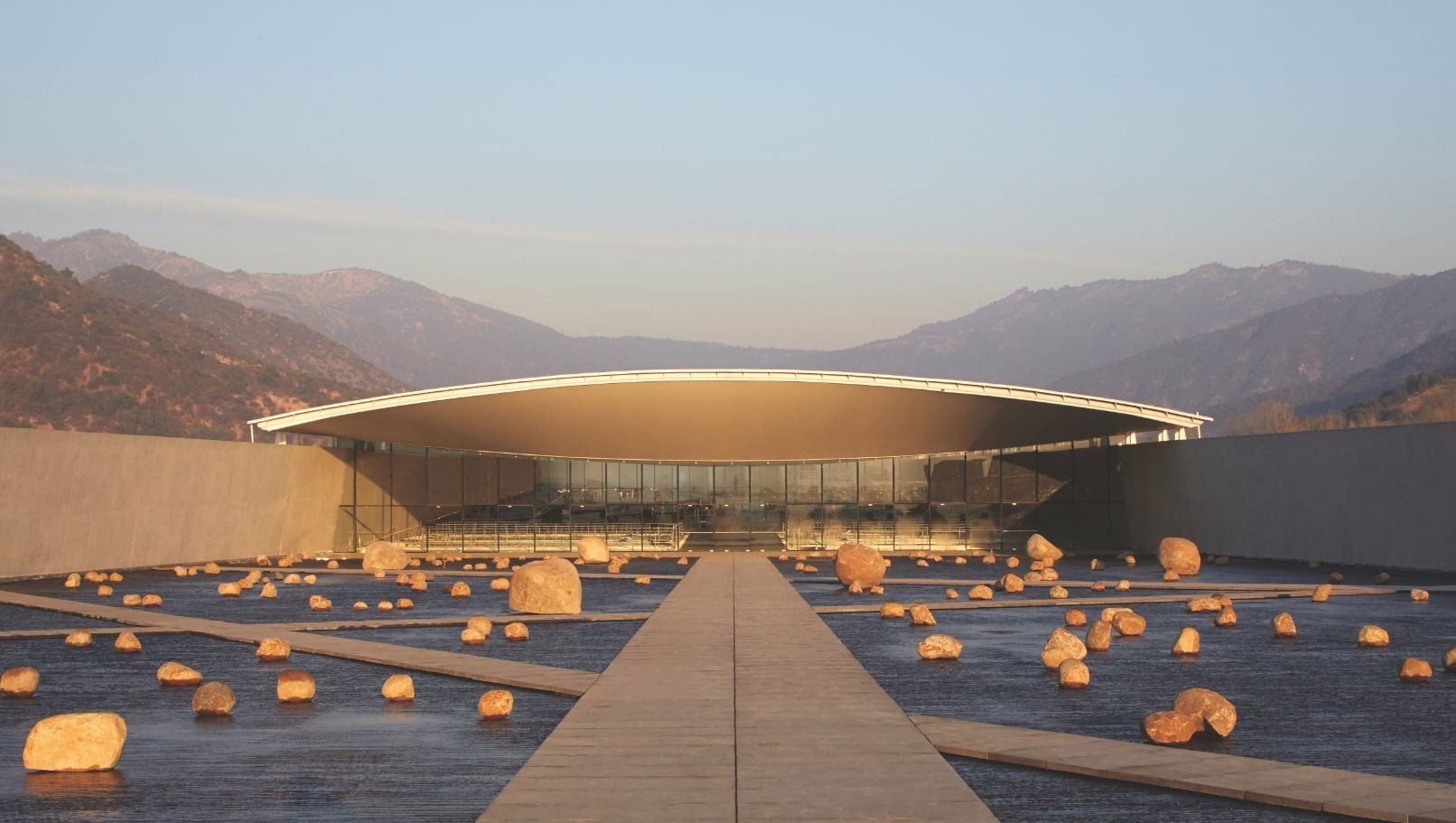
In the Millahue Valley of Chile's O'Higgins region, Viña VIK occupies a working estate beneath a titanium and bronze roof that catches Andean light from a distance. The property holds a Pearl 4 Star Prestige rating (2025) and positions itself among Chile's small cohort of estate-integrated luxury wine experiences, where the vineyard, the architecture, and the accommodation operate as a single argument about place.
Where the Andes Become the Argument
Chile's O'Higgins region has spent the past two decades building a case that its inland valleys — sheltered from Pacific fog by coastal ranges, fed by Andean snowmelt, and marked by granite and clay soils unlike anything further north — can produce wines that carry genuine terroir complexity rather than simply reliable sunshine-driven fruit. The Millahue Valley, where Viña VIK sits, sits at the more specific end of that argument. The name Millahue translates from Mapuche as "place of gold," and the valley's combination of rocky volcanic soils, significant diurnal temperature swings, and relatively low rainfall places it in a different conversation from the broader Rapel Valley it technically belongs to.
Approaching the estate, the architecture announces itself before the vines do. A titanium and bronze roof curves across the hillside, gleaming against the Andean backdrop in a way that is neither discreet nor self-effacing. This is deliberate. The building sits in a regional hospitality tradition that has moved, at its most serious end, away from colonial hacienda pastiche and toward contemporary architecture as a statement of intent about the seriousness of the wine project housed within. The roof's material choices , titanium's resistance to oxidation, bronze's capacity to age with the landscape , echo the kind of thinking that shows up in the winery itself, where long-term investment in soil and structure matters more than short-cycle returns.
Terroir as the Central Subject
The Millahue estate spans several thousand hectares, of which a fraction is planted to vine. That ratio is significant. The surrounding land , forest, scrub, hillside , acts as a buffer and a biome, and serious wine estates in Chile's interior valleys have increasingly understood that what surrounds the vineyard shapes it as much as what lies beneath it. O'Higgins' inland sub-valleys, including Millahue, benefit from cooler nights than their latitude suggests, because cold Andean air descends through the valley systems after sunset. That diurnal range, often 15 to 20 degrees Celsius between day and night during the growing season, is one of the primary reasons winemakers working here can retain acidity and aromatic complexity in red varieties that, in warmer valley-floor conditions, would read as jammy and extracted.
The soil profile at Millahue compounds this. Granite-derived sandy soils over clay substructures create drainage conditions that push vine roots deep, stressing the plant in the ways that fine wine production requires. Younger vines in these soils produce less interesting wine; the property's age and the proportion of older blocks is worth understanding when reading any flight from this estate. Among Chilean properties that have staked their identity on a specific valley rather than a broader appellation , [Viña Casa Silva in San Fernando](/wineries/via-casa-silva-san-fernando-winery) in Colchagua and [Viña MontGras in Palmilla](/wineries/via-montgras-palmilla-winery) each take similar approaches to sub-regional specificity , VIK represents one of the more architecturally and conceptually committed expressions of the model.
The Estate as Integrated Experience
What distinguishes VIK's model from a direct winery visit is the degree to which accommodation, art, architecture, and wine are designed to function as a single experience rather than discrete offerings. The interior of the hotel is hung with original artworks throughout, a collecting approach that treats the building as a living gallery rather than a decorated backdrop. This positions the property within a small cohort of wine-country hotels globally , comparable in ambition to [Abadía Retuerta in Sardón de Duero](/wineries/abada-retuerta-sardn-de-duero-winery) in Spain's Ribera del Duero, where monastic architecture and serious viticulture combine into something that resists simple category , where the wine is the anchor point but the intellectual framework extends into every corner of the property.
The Pearl 4 Star Prestige recognition in 2025 places VIK in the upper tier of EP Club's assessed properties in the region, a rating that reflects the combination of physical quality, wine production seriousness, and the coherence of the overall proposition. For context within Chile's wine tourism circuit, [Viña Santa Rita in Buin](/wineries/via-santa-rita-buin-winery) and [Viña Seña in Panquehue](/wineries/via-sea-panquehue-winery) occupy different points on the spectrum of Chilean wine estate hospitality , Santa Rita as a historically grounded estate with broad accessibility, Seña as a fine-wine-first property in Aconcagua with international co-production credentials. VIK operates in the category where architectural ambition, art patronage, and terroir-focused wine production converge, which is a smaller and more specific peer set.
Placing VIK Within Chilean Wine Geography
Chile's wine map is often read too simply from north to south, as if latitude were the only variable. The more instructive axis runs east to west: the difference between coastal, valley-floor, and Andean-foothill sites within any given region produces dramatically different wines, often within a few kilometres of each other. VIK's Millahue positioning is specifically Andean-foothill in character. Compare this to coastal O'Higgins expressions or the lower Colchagua Valley floor, and the wines read differently , more structured, with firmer tannin frameworks and higher natural acidity at equivalent ripeness levels.
Further along Chile's wine geography, [Viña De Martino in Isla de Maipo](/wineries/via-de-martino-isla-de-maipo-winery) has built its reputation on similar site-specificity thinking in Maipo, and [El Gobernador (Miguel Torres Chile) in Curicó](/wineries/el-gobernador-miguel-torres-chile-curic-winery) anchors a different kind of estate narrative further south. At the northern extreme, [Viña Falernia in Vicuña](/wineries/via-falernia-vicua-winery) demonstrates how extreme altitude and desert conditions create an entirely different Chilean wine typology. VIK's Millahue sits at none of these poles , it is not extreme in altitude, not coastal, not desert , but the valley's specific combination of factors makes it genuinely distinct within the central Chilean wine belt.
Planning a Visit
San Vicente de Tagua Tagua is the nearest town, roughly 130 kilometres south of Santiago via the Panamericana, making the property accessible as a multi-day stay rather than a day trip for most international visitors. The drive through the O'Higgins region's agricultural landscape, particularly once you turn east toward the Andean foothills, provides its own orientation to the scale of Chilean viticulture. The estate operates as an accommodation property, so access to the full experience , vineyard, wine program, art collection, architecture , is tied to staying on the property rather than arriving for a standalone tasting. Visiting during harvest season, which runs roughly February through April in this latitude, provides the most direct access to active winemaking processes and the estate at its most operationally expressive. The shoulder seasons, particularly late autumn when the vine foliage changes and Andean snowfall begins on the peaks above the valley, carry a different atmospheric quality that suits the estate's architectural drama.
For broader regional planning, our [full San Vicente de Tagua Tagua wineries guide](/cities/san-vicente-de-tagua-tagua) maps the wider estate range of the area, while the [restaurants guide](/cities/san-vicente-de-tagua-tagua), [hotels guide](/cities/san-vicente-de-tagua-tagua), [bars guide](/cities/san-vicente-de-tagua-tagua), and [experiences guide](/cities/san-vicente-de-tagua-tagua) cover the surrounding area for those extending their stay beyond the estate itself.
Frequently Asked Questions
- What is the vibe at Viña VIK?
- The property operates in a register that is architecturally ambitious and art-forward rather than traditionally rustic. The titanium and bronze roof structure, the artwork-hung interiors, and the Andean backdrop create an atmosphere closer to a serious contemporary art-and-wine estate than a conventional wine country retreat. VIK holds a Pearl 4 Star Prestige rating (2025), which reflects the premium positioning of the overall experience.
- What wines should I try at Viña VIK?
- The estate's wine program is anchored in the specific conditions of the Millahue Valley: granite-clay soils, Andean diurnal temperature swings, and inland valley conditions that produce structured, acidity-retaining reds. The property's focus on Millahue as a distinct sub-appellation within O'Higgins is the central premise of any tasting. The flagship VIK bottling is the primary expression of the estate's terroir argument and the wine most associated with the property's international recognition.
- What is Viña VIK leading at?
- The property makes its most coherent case as an integrated wine estate experience , architecture, art collection, accommodation, and vineyard terroir functioning as a single proposition rather than separable parts. The Pearl 4 Star Prestige (2025) rating confirms the quality of the overall execution. Within Chile's wine tourism options, VIK's Millahue address and the seriousness of its terroir-focused wine program place it in a small peer set at the leading of the estate-hospitality category.
Cuisine and Awards Snapshot
Comparable venues for orientation, based on our database fields.
| Venue | Classification | Awards | First Vintage | Notes |
|---|---|---|---|---|
| Viña VIK | World's 50 Best | This venue | ||
| Viña Santa Rita | World's 50 Best | |||
| Viña Viu Manent | World's 50 Best | |||
| Bodegas RE | World's 50 Best | |||
| Viña Almaviva | World's 50 Best | |||
| Viñedos de Alcohuaz | World's 50 Best |
Access the Cellar?
Our members enjoy exclusive access to private tastings and priority allocations from the world's most sought-after producers.
Access the Concierge