

One of the Douro Valley's most respected estate wineries, Quinta do Crasto sits above the Douro river in Sabrosa and holds a Pearl 4 Star Prestige rating for 2025. The property offers four guest suites in an intimate, family-run format that places visitors inside the working rhythms of the estate. For those serious about Douro terroir, the combination of vineyard access and overnight immersion sets it apart from day-visit-only producers in the region.
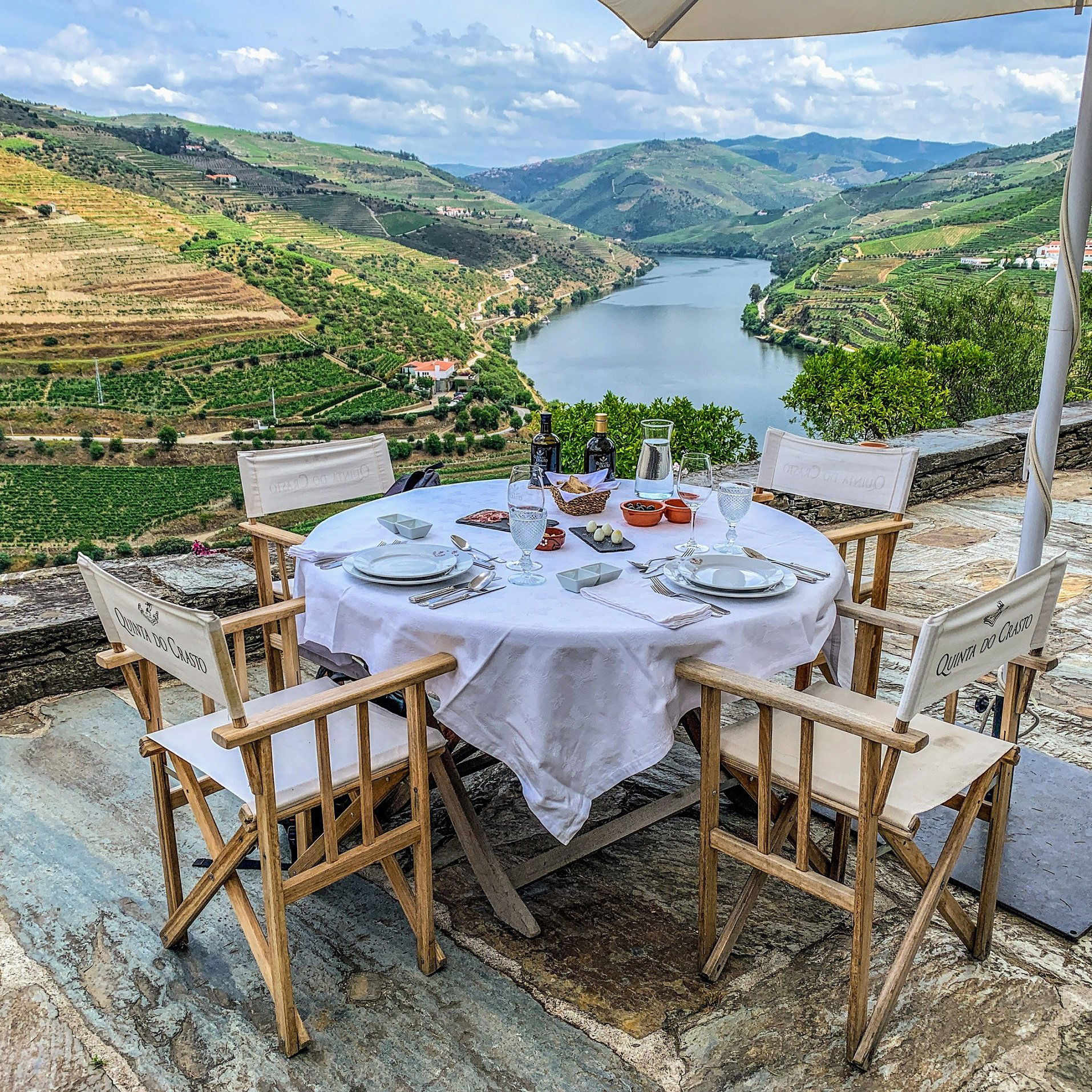
Where the Douro's Schist Speaks Loudest
The upper Douro Valley, in the sub-region around Sabrosa, is where Portugal's wine identity runs deepest. The terraced vineyards here are carved into slopes of decomposed schist and granite, soils that force vine roots downward through fractured rock in search of moisture, stressing the plant in a way that concentrates what ends up in the bottle. Summers are extreme — temperatures regularly exceed 40°C in the valley floor — and winters are sharp. That thermal range, compressed into a single growing season, is the fundamental reason Douro reds carry the weight and structure they do. Quinta do Crasto, positioned in this landscape along the river, is one of the estates where those conditions translate most directly into the glass.
The property holds a Pearl 4 Star Prestige rating from EP Club for 2025, placing it among the upper tier of Douro estates recognised for the consistency between site, production, and the experience offered to visitors. That tier is smaller than it might appear: the Douro has hundreds of quintas, but far fewer operate at the intersection of serious winemaking, considered hospitality, and genuine estate access.
The Estate as Experience
Quinta do Crasto's guest offering centres on four suites, and the format of a stay here is shaped by the working reality of the estate rather than the conventions of a hotel. The family behind the property may be present at breakfast in the dining room , an arrangement that reflects how the Douro's most compelling quinta stays tend to operate. The region has, over the past two decades, split between large-scale wine tourism infrastructure , visitor centres, tasting rooms engineered for throughput , and a smaller category of family estates where overnight guests enter a more embedded relationship with the land and the people who farm it. Quinta do Crasto belongs firmly to the second category.
That intimacy has a practical consequence for planning. Four suites means this property operates nothing like a hotel in terms of availability. Booking well in advance is the operating assumption for peak season visits, which run from late spring through harvest in October. The harvest period, when picking decisions are made daily based on sugar levels and weather forecasts, is among the most instructive times to be present on any working estate , and at this scale, guests are closer to that process than they would be elsewhere.
Terroir Expression in the Douro Context
The Douro's reputation rests historically on Port, the fortified wine that made the valley's name internationally. But since the 1990s, a second identity has developed around unfortified table wines , Douro DOC reds and whites , that draw on the same old-vine material originally planted for Port production. Touriga Nacional, Touriga Franca, Tinta Roriz (Tempranillo), and Tinta Barroca are the dominant varieties across the valley. On schist-dominant soils, these varieties tend toward structured tannins and dark fruit with mineral undercurrents; on granite, the wines are typically lighter in colour with more aromatic lift.
Crasto's position in Sabrosa places it in the Cima Corgo sub-region, historically considered the quality heartland of the Douro, where altitude moderates the valley's intense heat and older vineyard material , some vines planted generations ago in field-blend arrangements , contributes complexity that younger, single-variety plantings cannot replicate. Field blends, where multiple grape varieties are interplanted and harvested together, are increasingly recognised as one of the Douro's most distinctive and historically significant practices, producing wines that no controlled single-variety program can reproduce. Estates that have preserved this material are in a different position from those that replanted for efficiency.
For context on the broader Douro winery scene around Sabrosa, Quinta do Infantado and Quinta do Portal represent neighbouring estates worth considering alongside Crasto when planning a concentrated visit to the sub-region. Further afield in the valley, Quinta do Bomfim in Pinhão and Quinta do Seixo (Sandeman) in Tabuaço offer points of comparison for how different Douro estates approach visitor access and wine tourism format.
Positioning Within Portuguese Wine Tourism
Portugal's wine tourism circuit has matured considerably. The country now offers a range of estate experiences across its major regions , from the Alentejo, where Herdade do Esporão in Reguengos de Monsaraz operates at significant scale with an established visitor infrastructure, to the Setúbal Peninsula, where Bacalhôa Vinhos in Azeitão combines wine production with historic architecture, to Madeira, where Blandy's Wine Lodge in Funchal offers a historically framed urban wine experience. The Douro, and Sabrosa in particular, sits in a different register from all of these: the combination of dramatic river topography, centuries of Port production history, and an emerging table wine identity gives the sub-region a density of wine-relevant experience that most other Portuguese regions cannot match in a single visit.
Within the Port and Douro category specifically, Churchill's in Vila Nova de Gaia represents the lodge-based model common to Vila Nova de Gaia, where aging and blending happen in purpose-built facilities near Porto. Quinta do Crasto, by contrast, is an estate model , production, aging, and hospitality all happen on the same property, in direct proximity to the vineyards. Those are meaningfully different experiences, and the choice between them depends on whether the visitor's interest lies in understanding the Port trade's commercial and historical infrastructure or in the relationship between a specific piece of land and the wine it produces.
Planning a Stay
Sabrosa sits in the Cima Corgo, accessible from Porto (approximately 120 kilometres by road) via the A4 motorway and EN322. The town of Pinhão, on the Douro river, is the practical base for much Douro wine tourism and lies close to Crasto's address. With four suites, the property functions as an overnight destination rather than a day-trip stop, and visitors who stay multiple nights gain a more complete picture of how the estate operates across the cycle of a day , early morning in the vineyards before heat builds, afternoon tasting after work breaks, evening in a setting that has not been designed for tourist convenience so much as for living on the land. For planning around the broader area, our full Sabrosa wineries guide, restaurants guide, hotels guide, bars guide, and experiences guide cover the full range of options in and around the town.
For those building a wider Iberian wine itinerary, the contrast between Douro estate experiences and Spanish equivalents is worth considering. Abadía Retuerta in Sardón de Duero operates a large luxury hotel format on the Castilian plateau, and the differences in scale, formality, and terroir character between the two make for an instructive pairing. Further afield, Aberlour in Aberlour represents a completely different tradition , Speyside whisky production , but the underlying logic of a place-based, production-rooted visitor experience shares more with Quinta do Crasto than a conventional hotel stay would.
Frequently Asked Questions
- What wine is Quinta do Crasto famous for?
- Quinta do Crasto is associated with the Douro Valley's dual tradition of Port and unfortified table wines, drawing on old-vine Touriga Nacional, Touriga Franca, and field-blend material planted on schist-dominant soils in the Cima Corgo sub-region. The estate holds a Pearl 4 Star Prestige rating from EP Club for 2025, reflecting the quality consistency that has established its position among the Douro's recognised producers. Sabrosa's altitude and thermal range are central to the structure and concentration characteristic of wines from this part of the valley.
- Why do people go to Quinta do Crasto?
- The primary draw is direct access to a working Douro estate at a scale , four suites , where the experience remains intimate rather than managed for volume. The EP Club Pearl 4 Star Prestige rating for 2025 signals a level of overall quality that positions Crasto in the upper bracket of Douro quinta stays. For visitors based in Porto or Sabrosa, the combination of vineyard proximity, family ownership, and the Cima Corgo terroir makes it a substantive rather than incidental wine destination.
- Do they take walk-ins at Quinta do Crasto?
- With only four guest suites, walk-in accommodation at Quinta do Crasto is not a practical expectation, particularly during harvest season (September to October) or the warmer months when demand is highest. Contact details are not listed in our current database, so reaching out directly through the estate or checking availability well ahead of travel is the recommended approach. The Pearl 4 Star Prestige recognition for 2025 suggests demand is consistent enough to warrant planning ahead rather than arriving speculatively.
- What's Quinta do Crasto a strong choice for?
- If your interest is in understanding how a specific piece of Douro land expresses itself in wine , rather than a general introduction to Port or Portuguese wine tourism , Quinta do Crasto's estate-based, overnight format serves that goal directly. The four-suite scale means guests experience the property as participants rather than visitors passing through. The Pearl 4 Star Prestige rating for 2025 and its position in the Cima Corgo sub-region around Sabrosa reinforce it as a reference-point stay for serious Douro wine travel.
- How does staying at Quinta do Crasto differ from visiting a Port lodge in Vila Nova de Gaia?
- Port lodges in Vila Nova de Gaia, such as Churchill's, focus on the blending, aging, and commercial history of Port in purpose-built riverside facilities near Porto. Quinta do Crasto offers the opposite model: a single estate where production, aging, and accommodation share the same land, allowing visitors to connect wine directly to the vineyards that produced it. For those prioritising terroir understanding over trade history, the estate experience in Sabrosa provides a level of specificity that urban lodge visits are structurally unable to deliver. The Pearl 4 Star Prestige rating (2025) reinforces Crasto's standing as a reference destination within that estate category.
A Lean Comparison
A small comparison set for context, based on the venues we track.
| Venue | Classification | Awards | First Vintage | Notes |
|---|---|---|---|---|
| Quinta do Crasto | World's 50 Best | This venue | ||
| Quinta do Bomfim | World's 50 Best | |||
| Quinta do Seixo (Sandeman), Douro Valley | World's 50 Best | |||
| Quinta do Vallado | World's 50 Best | |||
| Graham's Port | World's 50 Best | |||
| Herdade do Esporão | World's 50 Best |
Access the Cellar?
Our members enjoy exclusive access to private tastings and priority allocations from the world's most sought-after producers.
Access the Concierge