Herdade do Esporão


Set amid the ochre plains of the Alentejo, Herdade do Esporão is one of southern Portugal's most established wine estates, operating its vineyard and winery on organic principles across a substantial landholding outside Reguengos de Monsaraz. Awarded EP Club's Pearl 3 Star Prestige in 2025, the estate offers a structured entry point into Alentejo wine culture, from vineyard visits to tasting experiences grounded in the region's distinctive terroir.
Where the Alentejo Plain Becomes the Wine
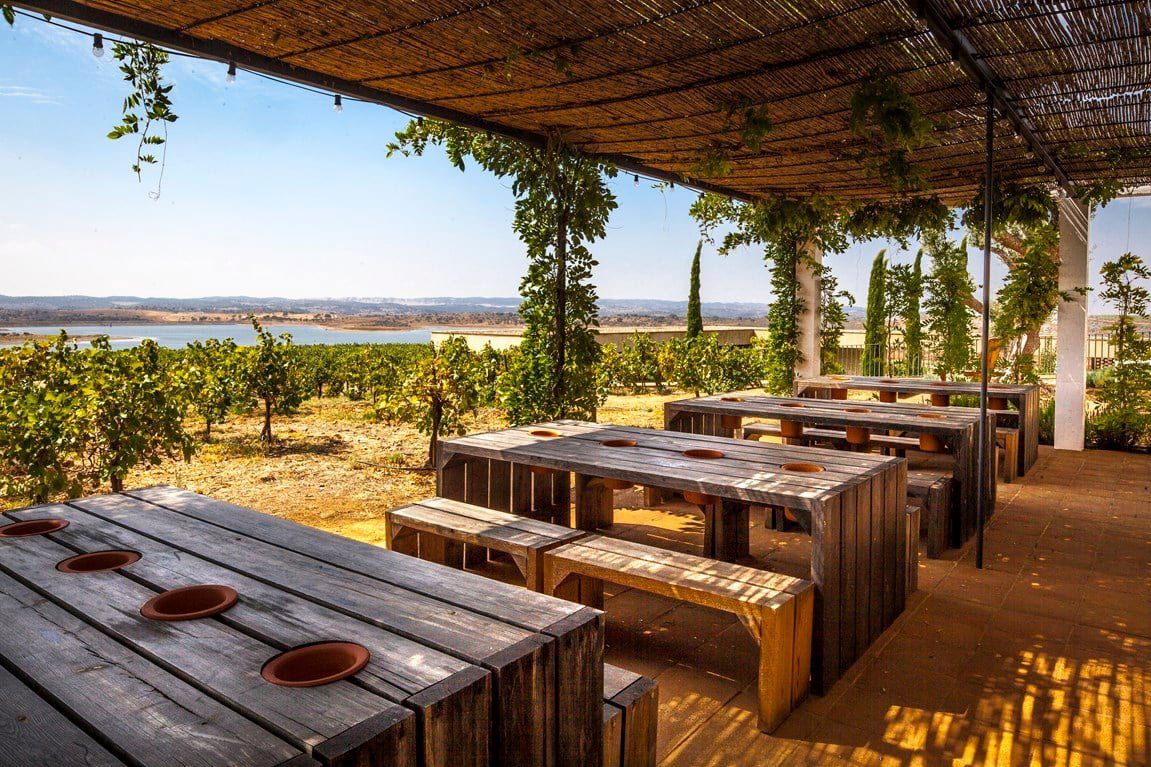
The approach to Herdade do Esporão tells you a great deal about what the Alentejo does to wine. The road from Reguengos de Monsaraz cuts through open countryside — cork oaks casting uneven shadows over rust-coloured soil, the horizon flat and wide in a way that few European wine regions replicate. By the time you reach the estate's low-slung enoturismo building, framed by vineyards that stretch further than you'd expect, the land itself has already made an argument: this is a place shaped by heat, dryness, and a particular quality of light that leaves its mark on whatever grows here.
The Alentejo has long operated as Portugal's interior counterweight to the cooler, maritime-influenced wines of the Douro or the Vinho Verde country further north. Here, the summers are long and searingly warm, the soils are predominantly schist and granite with pockets of clay, and the vine stress that results from that combination tends to produce wines with concentration, low acidity, and a structural weight that can read as rich or, in the hands of estates oriented toward restraint, as deeply composed. Herdade do Esporão sits squarely within this context, and its organic farming approach — applied across a landholding of considerable scale , is less a marketing position than a practical response to soils that respond to careful management.
The Estate as a Reading of the Region
Within the Alentejo's producer landscape, Esporão occupies a significant position. The estate has been a reference point for the region since well before Alentejo wine earned the international recognition it holds today, and its scale means it has effectively documented the evolution of the appellation across multiple decades and vintages. For a visitor arriving from outside the region, that depth of record matters: tasting across the estate's range is something closer to reading a geological survey than sampling a menu.
The organic certification of the vineyard is worth pausing on. At the scale Esporão operates, organic viticulture requires a meaningful commitment of resources and discipline , it is not incidental. The result is a vine environment managed without synthetic inputs, which in the Alentejo context means working carefully with soils that are already under pressure from heat and low rainfall. The wines produced from that farming tend to carry a specificity that is harder to achieve in conventionally managed vineyards, where the baseline is more chemically standardised. Whether you read that specificity in the wines themselves is partly a matter of palate, but the conditions exist for it to be present.
EP Club awarded the estate its Pearl 3 Star Prestige rating in 2025 , a signal that places Esporão in the upper tier of Portuguese winery experiences as assessed for the quality and depth of its visitor offer. Among Alentejo producers, few estates match the combination of scale, organic practice, and structured enoturismo programming that the estate has developed. The comparable experiences in southern Portugal tend to be either smaller and more intimate, or larger and more commercialised; Esporão holds a middle position that suits visitors who want depth of engagement without losing the sense of being in a working landscape.
Terroir as the Itinerary
The estate's visitor programme is built around the land and winery as primary subjects. Vineyard visits put guests directly into the growing environment , the opportunity to understand, at ground level, how the Alentejo's conditions translate into vine behaviour. For visitors coming from wine regions shaped by cooler climates, the differences are immediate: canopy management looks different when the priority is shade rather than sun exposure, and the spacing between rows accommodates a different relationship between plant and soil moisture. These are not abstract points; they become legible when you're standing between rows under an Alentejo afternoon.
The winery component of a visit extends that reading into the cellar. Fermentation and ageing decisions in this climate address a different set of variables than those facing winemakers in Burgundy or the Mosel, and understanding the reasoning behind those decisions , why certain vessels, why certain ageing periods, how blending decisions respond to the particular character of a given vintage , adds a layer of interpretation to the eventual tasting that guidebooks cannot provide. Esporão's winery is substantial enough to illustrate the full arc of production at scale, which is itself part of the story: this is not a boutique operation where hand-crafted singularity is the organising principle. It is an estate that has had to develop genuine technical rigour to maintain quality across volume, and the infrastructure reflects that.
Situating Esporão in the Portuguese Winery Circuit
Visitors building a broader itinerary around Portuguese wine will find that Esporão anchors the southern leg of a country with considerable regional diversity. The Douro Valley, accessible from Porto, offers a contrasting experience: schist terraces, river-facing quintas, and a winemaking tradition tied directly to the Port trade. Properties like [Quinta do Bomfim in Pinhão](/wineries/quinta-do-bomfim-pinho-winery) and [Quinta do Seixo (Sandeman), Douro Valley in Tabuaço](/wineries/quinta-do-seixo-sandeman-douro-valley-tabuao-winery) sit within that tradition, as does [Quinta do Vallado in Peso da Régua](/wineries/quinta-do-vallado-peso-da-rgua-winery). The Atlantic-influenced estates closer to Lisbon, such as [Bacalhôa Vinhos in Azeitão](/wineries/bacalha-vinhos-azeito-winery), offer yet another register , and for those who extend to Madeira, [Blandy's Wine Lodge in Funchal](/wineries/blandys-wine-lodge-funchal-winery) represents an entirely different production logic shaped by altitude and ocean air.
Within the Alentejo itself, [Adega Cartuxa (Fundação Eugénio de Almeida) in Évora](/wineries/adega-cartuxa-fundao-eugnio-de-almeida-vora-winery) and [Adega Cooperativa de Borba in Borba](/wineries/adega-cooperativa-de-borba-borba-winery) provide alternative frames of reference , Cartuxa operating with institutional roots that predate modern Alentejo wine by centuries, and the Borba cooperative representing the collective model that still shapes a significant share of regional production. Esporão, as a large private estate with a long track record and a defined organic philosophy, occupies a distinct position relative to both. See our [full Reguengos de Monsaraz wineries guide](/cities/reguengos-de-monsaraz) for additional producers in the immediate area.
Planning a Visit
Reguengos de Monsaraz is approximately 170 kilometres east of Lisbon by road, a journey that takes around two hours and is most practically managed by car , public transport connections to the town are limited, and the estate sits outside the town centre itself. The area rewards a longer stay: the walled hilltop village of Monsaraz, a few kilometres from the estate, is one of the best-preserved medieval settlements in the Alentejo, and the surrounding region includes the Alqueva reservoir, the largest artificial lake in Western Europe. For accommodation in the area, the [Reguengos de Monsaraz hotels guide](/cities/reguengos-de-monsaraz) covers options across price points. The warmest months, July and August, are also the most intense in terms of heat , visits in late spring or early autumn allow for a more comfortable outdoor experience and the added interest of either pre-harvest vine observation or, in late September and October, the harvest itself.
For a broader picture of eating and drinking in the region, see our guides to [restaurants](/cities/reguengos-de-monsaraz), [bars](/cities/reguengos-de-monsaraz), and [experiences](/cities/reguengos-de-monsaraz) in Reguengos de Monsaraz. Visitors with a specific interest in wine tourism more broadly may also find value in comparing the Esporão experience against estate models in other Iberian regions, including [Abadía Retuerta in Sardón de Duero](/wineries/abada-retuerta-sardn-de-duero-winery), which operates at a comparable scale across the border in Spain's Ribera del Duero.
Frequently Asked Questions
- What kind of setting is Herdade do Esporão?
- The estate occupies a large landholding on the Alentejo plain outside Reguengos de Monsaraz, in the rural interior of southern Portugal. The environment is open, sparsely vegetated, and characterised by the flat, ochre-toned terrain typical of this part of the country. The enoturismo facilities are purpose-built for visitor reception, and the broader setting provides direct exposure to the agricultural and natural conditions that define Alentejo wine. EP Club's 2025 Pearl 3 Star Prestige award reflects the quality of the estate experience within the Portuguese winery category.
- What do visitors recommend trying at Herdade do Esporão?
- The most consistent recommendation across visitor accounts is to engage with the estate's vineyard and winery visit in full rather than arriving for a standalone tasting. The Alentejo's distinctive terroir , schist and granite soils, low rainfall, intense sun , becomes meaningfully legible when experienced in the vineyard before the wines are poured. The estate's organic farming approach, applied at scale across its Reguengos de Monsaraz landholding, is a subject that rewards direct conversation with estate staff. Given that specific current wine releases and tasting formats can change seasonally, it is worth checking with the estate directly before visiting to understand which programmes are available and how far in advance booking is required.
Similar Picks
A quick comparison pulled from similar venues we track in the same category.
| Venue | Classification | Awards | First Vintage | Notes |
|---|---|---|---|---|
| Herdade do Esporão | World's 50 Best | This venue | ||
| Quinta do Bomfim | World's 50 Best | |||
| Quinta do Seixo (Sandeman), Douro Valley | World's 50 Best | |||
| Quinta do Vallado | World's 50 Best | |||
| Graham's Port | World's 50 Best | |||
| Quinta da Aveleda | World's 50 Best |
Access the Cellar?
Our members enjoy exclusive access to private tastings and priority allocations from the world's most sought-after producers.
Access the Concierge