

Quinta do Seixo sits in the Douro Valley above Valença do Douro, where Sandeman has shaped one of the region's most recognisable Port and Douro wine estates. Recognised with Pearl 2 and 3 Star Prestige awards in 2025, the quinta represents the Douro's capacity to produce wines of genuine structural depth from ancient schist terraces. Visitors come for the landscape as much as the wine.
Schist, Altitude, and the Douro at Its Most Direct
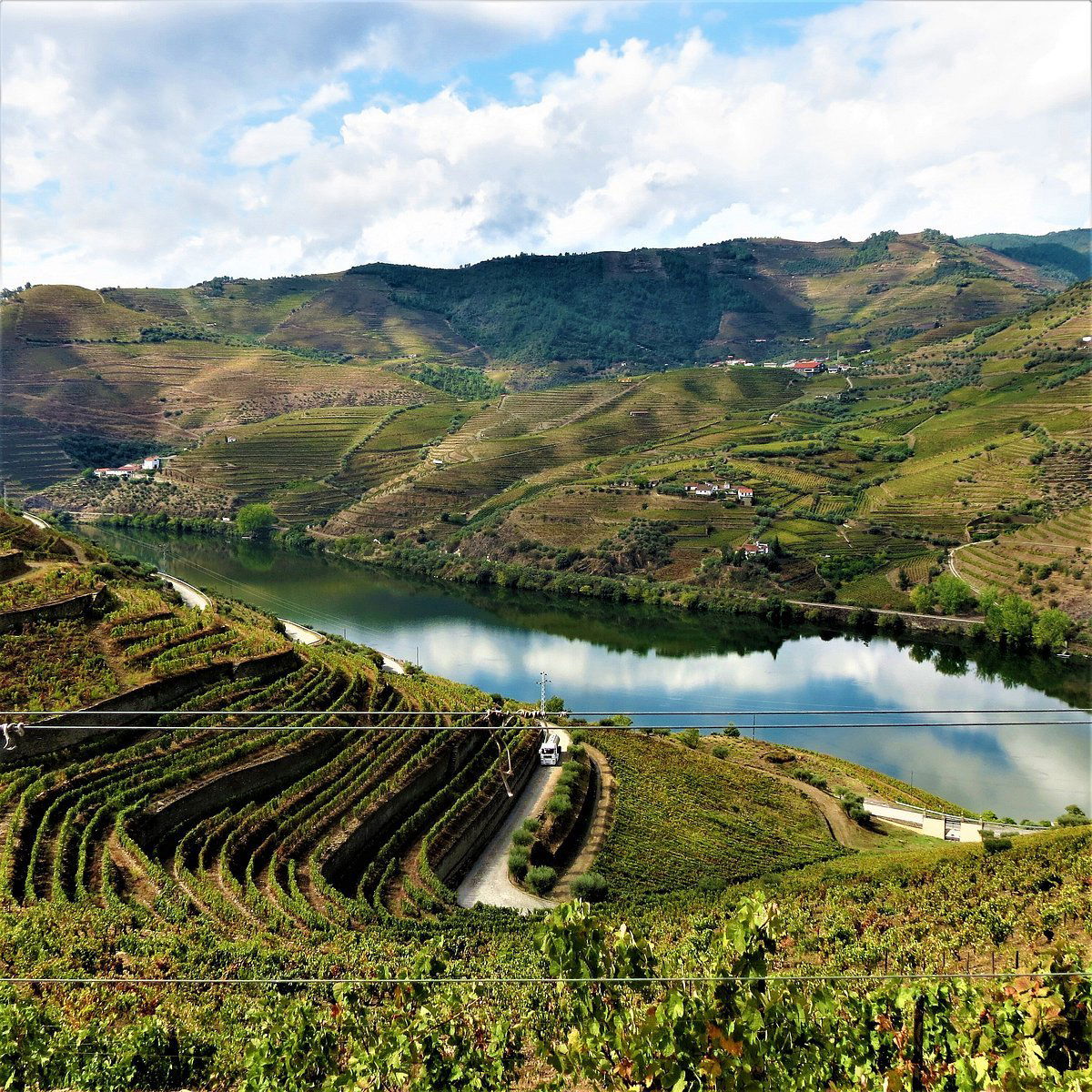
The approach to Quinta do Seixo from Valença do Douro does something that a tasting room in a city warehouse cannot: it forces the wine into physical context. The Douro Valley at this longitude is not a gentle pastoral scene. The river cuts hard through compressed schist, the terraces climb at gradients that make viticulture a matter of engineering as much as agriculture, and the temperature swings between growing season and harvest are among the most pronounced in any European wine region. Before a single glass is poured, the environment has already made an argument for why the wines taste the way they do.
That argument is what sets estate visits in the upper Douro apart from other Portuguese wine experiences. At a property like Bacalhôa Vinhos in Azeitão, the emphasis falls on Setúbal's cooler Atlantic conditions and a wider varietal programme. At Herdade do Esporão in Reguengos de Monsaraz, it is the Alentejo's heat and clay-schist mix that shapes the character. Quinta do Seixo operates inside a narrower, more austere framework — the Douro Superior's schist slopes, minimal topsoil, and a continental climate that produces wines where concentration is not engineered but unavoidable.
The Terroir Case at Quinta do Seixo
Sandeman's relationship with the Douro goes back to 1790, which means Quinta do Seixo draws on one of the older commercial lineages in the region. What that history provides, beyond brand recognition, is a long-run understanding of how particular parcels on the estate perform across variable vintages. In a region where schist depth, aspect, and altitude can shift the character of a wine from one terrace to the next, time in the land matters as much as technique in the cellar.
The Douro's schist is the defining material fact of its terroir. Unlike the granitic soils of Portugal's Minho or the limestone-clay of Bordeaux, schist is a poor, well-drained substrate that forces vine roots to descend several metres in search of water and nutrients. The result is low yields, concentrated fruit, and wines with a mineral backbone that reflects the geology directly. At Quinta do Seixo, the estate sits within the Cima Corgo and Douro Superior sub-regions, where altitude moderates what would otherwise be extreme summer heat and extends the phenolic ripening window. That combination — heat stress, poor soil, altitude moderation , is what produces Ports and Douro reds with genuine structural longevity.
The comparison with Gaia-based Port operations is instructive. Houses like Churchill's in Vila Nova de Gaia and the broader Gaia lodge tradition, where wine is shipped downriver and aged in the cooler, Atlantic-influenced environment near Porto, offer a different kind of visitor experience: urban, cellar-focused, and oriented toward the bottled product. Quinta do Seixo inverts that logic. The estate visit here is about origin, not destination , about standing where the grapes grow and understanding the physical conditions that make Douro wine what it is.
What the Visit Covers
Estate visits to Quinta do Seixo are structured around the vineyard and winery as much as the tasting room, which is the appropriate format given that the terroir is the primary subject. The schist terraces, some of them pre-phylloxera in origin, are the most direct evidence of why Sandeman's Douro wines carry the structural weight they do. Walking those terraces gives visitors a proportional sense of the labour and engineering involved in Douro viticulture , a subject that becomes abstract when discussed in a city tasting room but is immediately legible on the ground.
The quinta sits within a cluster of estate visits that reward a multi-day Douro itinerary. Quinta do Bomfim in Pinhão and Quinta do Vallado in Peso da Régua each offer adjacent perspectives on Douro terroir , Bomfim with its Symington lineage and Pinhão positioning, Vallado with a hotel component that allows for overnight immersion in the valley. Quinta do Seixo sits geographically upstream from both, closer to the Spanish border and at a point where the Douro feels more remote and less curated for tourism. That is not a drawback; it is part of the character of the visit.
For those building a broader Portuguese wine itinerary, the contrast with Atlantic-influenced properties deepens the Douro's identity. Adega Cartuxa in Évora and Adega Cooperativa de Borba in Borba represent the Alentejo's very different relationship with heat and scale, while Blandy's Wine Lodge in Funchal introduces Madeira's oxidative tradition as a counter-reference point. The Douro's terroir argument becomes clearer when set against these alternatives.
Recognition and Positioning
Quinta do Seixo received both Pearl 2 Star Prestige and Pearl 3 Star Prestige recognition in 2025, signals that place it within the upper tier of Portuguese estate experiences as assessed by the EP Club framework. These recognitions apply to the visit format and overall quality of the proposition, not merely to the wines in isolation. For a region where the gap between a serious estate visit and a perfunctory tasting can be significant, that distinction matters to visitors planning a committed Douro itinerary.
Among the peer set of major Port house estate operations, Quinta do Seixo occupies a position defined by the Sandeman heritage and the estate's upstream location. That location is not simply geographic: it corresponds to a specific climatic and geological profile that produces wines with a different weight and concentration profile than estates further west, where Atlantic influence is more pronounced. Visitors who have tasted through the Douro's sub-regional variation will recognise that difference in the glass; those encountering it for the first time will leave with a more precise understanding of why sub-regional designation matters in Port and Douro wine.
Planning the Visit
Tabuaço and the surrounding Douro Superior are most accessible between April and October, when the mountain roads are clear and the vineyard cycle offers visual context , flowering in late spring, the green canopy of summer, and the compressed drama of harvest in September and October. Harvest season (September through early October) represents the highest-demand window for estate visits across the Douro; advance booking across all properties in the valley is advisable during this period.
The address at 5120 Valença do Douro places the estate in the upper Douro, a drive from the main visitor hub of Pinhão that rewards those who have already covered the more accessible central Douro and want to push further into the valley's less-trafficked reaches. Those building a full valley itinerary should consult our full Tabuaço wineries guide alongside broader resources covering accommodation and dining in the area. For restaurants in the region, our full Tabuaço restaurants guide covers the local options; for places to stay, our full Tabuaço hotels guide maps the available range. The Tabuaço bars guide and Tabuaço experiences guide complete the picture for visitors treating this as a dedicated wine tourism base rather than a single-stop detour.
For those whose Portuguese wine interests extend beyond the Douro, Abadía Retuerta in Sardón de Duero offers a cross-border reference point on the Spanish side of the same river system, where the Duero's terroir produces a recognisably different expression of Tempranillo-led wines within the same geological and hydrological context.
Frequently Asked Questions
What should I expect atmosphere-wise at Quinta do Seixo?
The atmosphere is defined by the landscape rather than any interior design statement. The Douro at this point in the valley is narrow, the schist terraces are steep, and the sense of remoteness from urban Portugal is pronounced. Tastings take place in a setting where the vineyard is the dominant visual presence. This is not a polished city-centre experience; it is a working estate visit in one of Europe's most demanding wine-growing environments, and the atmosphere reflects that directly. EP Club awarded the estate both Pearl 2 Star and Pearl 3 Star Prestige recognition in 2025, placing it among the more considered estate visit propositions in the Douro.
What wines is Quinta do Seixo known for?
Quinta do Seixo operates under the Sandeman umbrella, a house whose Port heritage dates to 1790 and whose Douro DOC table wine programme runs alongside it. The estate's schist terroirs and upstream positioning in the Douro Superior produce wines with concentration and structural weight characteristic of the sub-region. Port, both vintage and aged tawny categories, represents the historical core of the Sandeman range; Douro red wines from the estate sit within the broader Douro DOC category, which has expanded significantly in ambition since the 1990s as producers began taking the region's unfortified wine potential seriously. The Douro now occupies a different position in the international wine market than it did two decades ago, and estate visits like this one are where that shift becomes tangible.
Peer Set Snapshot
A small peer set for context; details vary by what’s recorded in our database.
| Venue | Classification | Awards | First Vintage | Notes |
|---|---|---|---|---|
| Quinta do Seixo (Sandeman), Douro Valley | World's 50 Best | This venue | ||
| Quinta do Bomfim | World's 50 Best | |||
| Quinta do Vallado | World's 50 Best | |||
| Graham's Port | World's 50 Best | |||
| Herdade do Esporão | World's 50 Best | |||
| Quinta da Aveleda | World's 50 Best |
Access the Cellar?
Our members enjoy exclusive access to private tastings and priority allocations from the world's most sought-after producers.
Access the Concierge