
Domingo Hermanos sits on Avenida General Güemes Sur in the heart of Cafayate, Argentina's high-altitude Torrontés country, and carries a Pearl 2 Star Prestige rating for 2025. The address places it within easy reach of the valley's main winery circuit, making it a natural stop for those moving between the region's bodegas and the colonial plaza. It represents the more intimate, producer-scale end of Cafayate's wine and hospitality offer.
Where the Calchaquí Valley Does Its Serious Work
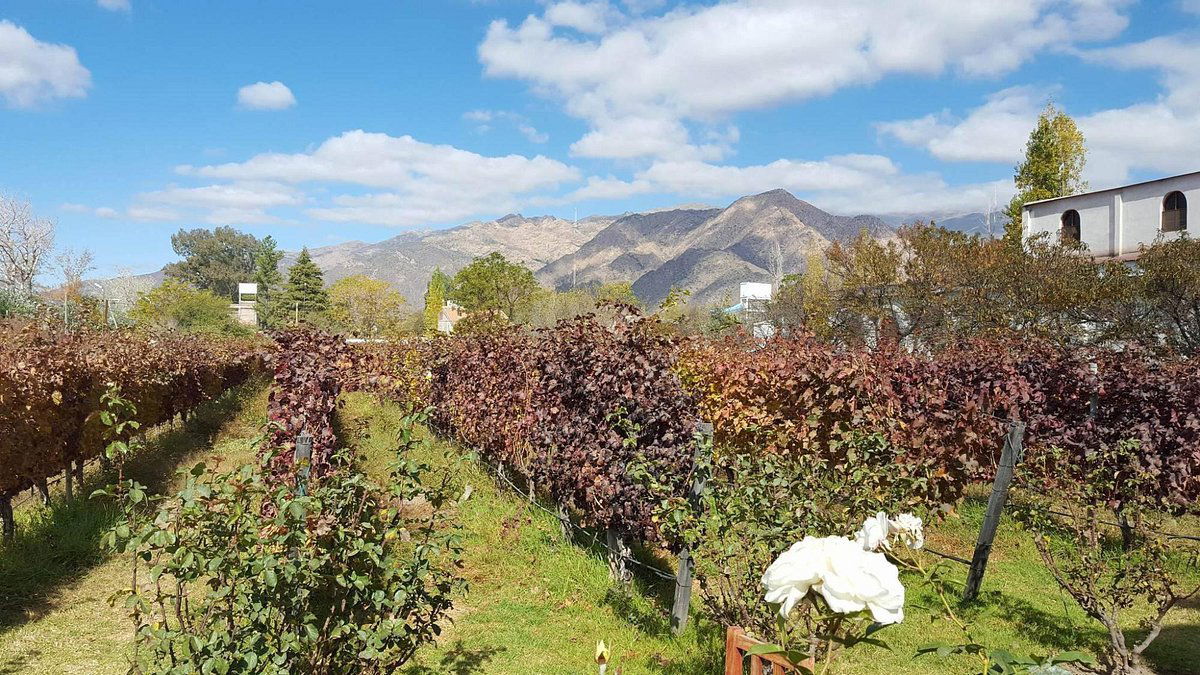
Cafayate sits at roughly 1,700 metres above sea level in the Calchaquí Valleys of Salta province, and the altitude shapes everything about how wine is grown and experienced here. The intense ultraviolet radiation, wide diurnal temperature swings, and near-absent rainfall push vines toward thick skins, concentrated aromatics, and natural acidity that no amount of cellar intervention can fully replicate. This is the context in which Domingo Hermanos operates, on Avenida General Güemes Sur at the southern approach to town, where the road from the vineyards feeds directly into the commercial and social centre of Cafayate.
The address is not incidental. Güemes Sur is where Cafayate's wine culture becomes visible to the visitor: bodegas, tasting rooms, and smaller producer operations line the avenue and the lanes running off it. Arriving from the south, you pass through working vineyard land before the town consolidates around the central plaza. Domingo Hermanos occupies that transitional zone, where production-scale seriousness meets the more accessible, visitor-facing side of the valley's wine offer.
The Sustainability Question in High-Altitude Viticulture
Argentina's high-altitude wine regions have become a testing ground for how far producers can push organic and low-intervention viticulture before the environment does the work for them. In Cafayate specifically, the combination of altitude, aridity, and isolation has always meant lower disease pressure than lower-elevation wine regions. The case for synthetic interventions is weaker here than in wetter, more temperate zones, and a growing number of producers across the valley have moved toward certified organic or biodynamic programs not as a marketing posture but as a practical acknowledgement that the terroir functions better with less interference.
This broader shift is visible across the Cafayate producer set. Bodega Nanni has operated certified organic vineyards for years and represents one of the cleaner expressions of what the valley can produce without chemical inputs. Bodega El Esteco, working at larger scale on the northern edge of Cafayate, has invested significantly in understanding which blocks respond leading to minimal intervention. Bodega Amalaya, positioned slightly differently in terms of price and market reach, has explored what the valley's blending traditions can do when the source fruit carries minimal residual chemistry.
At the smaller, more intimate end of the spectrum, producers like Domingo Molina have brought Burgundy-informed sensibilities to the question of how little you need to do to wines grown at this altitude. The common thread across these producers is a recognition that Cafayate's terroir is an asset that conventional viticulture can diminish rather than enhance. Domingo Hermanos sits within this same competitive set, where the environmental conditions and the philosophical direction of the valley's serious producers converge.
Torrontés and the Identity of the Valley
No discussion of Cafayate's wine identity makes sense without addressing Torrontés, the white grape that made the region's international reputation. Torrontés Riojano, the specific subvariety grown here, produces wines with flamboyant floral aromatics, particularly rose petal and jasmine, layered over stone fruit, and the altitude preserves the acidity that prevents those aromatics from collapsing into flatness. At its leading, it is one of South America's genuinely distinctive white wines. At its worst, it tips into diffuse, low-acid territory that the grape's critics use to dismiss the entire category.
The difference between those two outcomes is increasingly a viticulture and extraction question. Producers working with older vines, lower yields, and careful canopy management in Cafayate's UV-intense environment tend to produce Torrontés with more structure and persistence. The same principles that inform organic and regenerative viticulture, vine stress, soil biology, reduced input dependence, turn out to produce better Torrontés as a byproduct. This is why the valley's sustainability conversation and its quality conversation have become largely the same conversation.
Beyond Torrontés, Cafayate has built a credible case for Malbec at altitude, with a profile quite different from the Mendoza benchmark. The tannins tend to be finer, the fruit less plush, and the aromatic register more savoury and mineral. Cabernet Sauvignon, Tannat, and Bonarda all appear across the valley's producer roster. For a broader view of what the region is producing across all categories, our full Cafayate wineries guide maps the current landscape in detail.
Domingo Hermanos in Its Peer Set
Domingo Hermanos holds a Pearl 2 Star Prestige rating for 2025 from EP Club, which places it in the recognised tier of Cafayate's producer and hospitality offer rather than the undiscovered fringe. The Pearl 2 Star designation, within EP Club's assessment framework, indicates a property that delivers meaningfully above the area baseline and warrants specific attention from visitors with a serious interest in what the region produces.
In a valley where the hospitality offer ranges from large estate operations with full restaurant and accommodation infrastructure to very small family producers with informal tasting rooms, Domingo Hermanos occupies the more considered middle ground. Comparable properties in other Argentine wine regions with similar positioning include Bodega Lagarde in Luján de Cuyo, which operates at a similar intersection of production seriousness and visitor experience, and Bodega DiamAndes in Tunuyán, which has built a reputation for combining estate viticulture with a coherent hospitality format. At the more remote end of what high-altitude Argentina offers, Bodega Colomé in Molinos represents the extreme version of isolation-as-positioning, with vineyards climbing above 3,000 metres.
Outside Argentina, the producer-hospitality model that Cafayate's better operations are refining has parallels at estates like Abadía Retuerta in Sardón de Duero, where estate wines and guest programming are integrated rather than treated as separate revenue lines. Even further afield, the specificity of terroir expression that defines Cafayate's serious producers echoes what distillers at Aberlour have argued about provenance in spirits, that place, water source, and production philosophy are inseparable from the final product.
Planning Your Visit to Cafayate
Cafayate is reached most directly from Salta city, roughly 180 kilometres south via Route 68, a road that passes through the Quebrada de las Conchas gorge and its sequence of eroded rock formations. The drive takes approximately three hours and is itself worth timing carefully: the afternoon light through the red sandstone canyon is considerably more dramatic than the morning run south, and arriving in Cafayate by late afternoon gives you time to orient before the following day's bodega visits. The town is compact and walkable around the central plaza, with Güemes Sur accessible on foot from most accommodation.
Cafayate's harvest period runs from late February through March, when the valley is at its most active and producer visits carry additional interest. Winter months, June through August, bring cold nights but clear, dry days ideal for walking vineyards. Booking ahead for any tasting or visit with the valley's more serious producers is advisable from November onward, as the Argentine summer holiday period and the pre-harvest window both generate strong regional demand.
For a complete orientation to what Cafayate offers across dining, accommodation, and experiences, our full Cafayate restaurants guide, our full Cafayate hotels guide, our full Cafayate bars guide, and our full Cafayate experiences guide cover the current options in detail. The address for Domingo Hermanos, Nuestra Señora del Rosario at Avenida General Güemes Sur, places it on the southern approach to the town centre and is walkable from the plaza within fifteen minutes.
Also worth noting in your itinerary: Bodega Etchart, one of the valley's older established estates, operates nearby and offers a useful point of comparison for how Cafayate's wine identity has evolved over several decades.
Frequently Asked Questions
- What wines is Domingo Hermanos known for?
- Domingo Hermanos is based in Cafayate, the Calchaquí Valley region of Salta province that has built its reputation primarily on Torrontés Riojano, Argentina's most distinctively aromatic white variety, alongside high-altitude Malbec and other red varieties. The valley's viticulture conditions, intense UV radiation, wide day-to-night temperature variation, and very low rainfall, produce wines with structural acidity and concentrated aromatics that distinguish them from lower-elevation Argentine production. EP Club has awarded Domingo Hermanos a Pearl 2 Star Prestige rating for 2025, placing it among the recognised addresses in the valley's producer and hospitality offer.
- What's the standout thing about Domingo Hermanos?
- The combination of location and recognition sets it apart from the broader Cafayate field. Situated on Avenida General Güemes Sur at the southern approach to town, the address places Domingo Hermanos where the working vineyard zone meets the visitor-facing centre of Cafayate. The Pearl 2 Star Prestige rating (2025) from EP Club signals a level of quality and experience that distinguishes it from the many smaller, informal operations across the valley. Price range information is not available in our current data, so visitors should confirm rates directly when making contact.
Similar Picks
A small set of peers for context, based on recorded venue fields.
| Venue | Classification | Awards | First Vintage | Notes |
|---|---|---|---|---|
| Domingo Hermanos | 1 awards | This venue | ||
| Bodega El Esteco | 1 awards | |||
| Bodega Amalaya | 1 awards | |||
| Bodega Etchart | 1 awards | |||
| Bodega Nanni | 1 awards | |||
| Domingo Molina | 1 awards |
Access the Cellar?
Our members enjoy exclusive access to private tastings and priority allocations from the world's most sought-after producers.
Access the Concierge