
Bodega El Esteco sits on Ruta Nacional 40 at km 4343, at the southern edge of Cafayate's high-altitude wine corridor. The property holds a Pearl 3 Star Prestige rating for 2025, placing it among the most formally recognised addresses in the Calchaquí Valley. For visitors tracking Argentina's serious Torrontés and Malbec producers, El Esteco is a key reference point in the regional conversation.
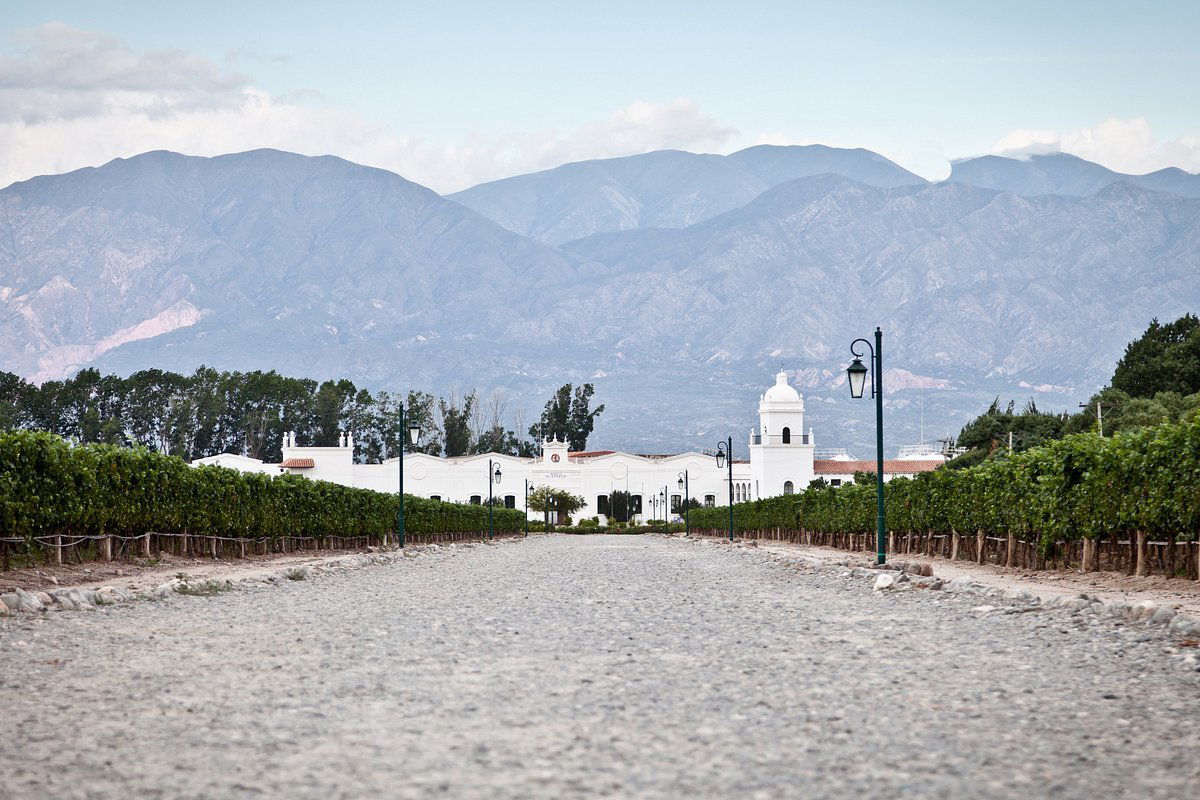
Where the Calchaquí Valley Defines the Wine
The approach to Cafayate along Ruta Nacional 40 is one of Argentina's more disorienting wine experiences. The road descends through canyon walls of oxidised red rock, the altitude drops from above 2,000 metres in the northern valley to around 1,700 metres at the valley floor, and the vineyards arrive suddenly, flat and orderly against a backdrop that looks more like the American Southwest than any European wine region. Bodega El Esteco sits on that road at km 4343, on the southern edge of Cafayate's main wine concentration, and its position on the RN40 is not incidental. This is the artery that connects Argentina's high-altitude wine country, and the bodegas that claim addresses on it are making a locational statement as much as a viticultural one.
The Calchaquí Valleys represent one of the highest-altitude commercial wine-growing zones on earth. At these elevations, the diurnal temperature range between warm days and cold nights is dramatic enough to preserve the natural acidity in grapes that would otherwise over-ripen in a region this close to the tropics. The result is a production style that differs meaningfully from Mendoza's more temperate Luján de Cuyo corridor: wines tend toward aromatic intensity, firm structure, and a freshness that makes this latitude viable for varieties that demand cool-climate conditions. El Esteco operates within that framework and carries a Pearl 3 Star Prestige rating for 2025, a designation that places it in the upper tier of formally recognised Cafayate producers.
Cafayate's Competitive Set and Where El Esteco Sits
Cafayate has developed a distinct identity within Argentine wine, built almost entirely around two varieties: Torrontés Riojano, the aromatic white that Argentina can claim as its own, and high-altitude Malbec, which expresses differently here than in Mendoza's sub-regions. The valley's premium producers have spent the past two decades refining both, moving from bulk production toward estate-focused, single-vineyard work that commands allocation and international attention.
Within this competitive set, El Esteco holds one of the valley's more historically grounded positions. Several of the valley's other recognised producers, including Bodega Amalaya and Bodega Etchart, operate with distinct house styles and ownership structures that reflect the valley's generational evolution. Smaller, artisan-scale operations like Bodega Nanni, Domingo Hermanos, and Domingo Molina occupy the craft end of the spectrum. El Esteco sits in the established, full-scale estate category, with the physical infrastructure and formal recognition that positions it as a reference producer rather than a discovery.
For context across Argentine wine more broadly, the Calchaquí approach contrasts with the estate models at Bodega Colomé in Molinos, which operates at even higher elevations further north, and the Mendoza-centred estates like Bodega DiamAndes in Tunuyán and Bodega Lagarde in Luján de Cuyo. Each reflects a different chapter of Argentina's premium wine geography. Internationally, the model of an estate bodega with formal recognition and visitor infrastructure echoes approaches taken by producers like Abadía Retuerta in Sardón de Duero in Spain, where winery hospitality and wine quality are developed in parallel rather than in sequence.
The Philosophy That High Altitude Demands
The editorial angle on El Esteco cannot avoid the fact that this is a high-altitude wine property, and high altitude demands a specific set of winemaking decisions. In Cafayate, at roughly 1,700 metres, UV radiation is intense, water stress is a consistent variable, and the growing season is compressed. Producers who work at these elevations are not simply transposing lowland viticulture to a dramatic setting. They are managing a distinct agronomic reality that requires calibrated canopy management, precise harvest timing, and an understanding of how altitude-driven acidity interacts with extraction and ageing.
The Torrontés question is central to any serious assessment of a Cafayate bodega. The variety is globally associated with Argentina and specifically with this valley, yet it has long divided critics: at its weakest, it is one-dimensional and fast-fading; at its leading, it is one of the more texturally interesting aromatic whites produced anywhere, combining floral lift with a mineral persistence that speaks directly to its high-altitude origin. How a Cafayate producer handles Torrontés, whether at the fragrant-and-approachable end or the structured-and-age-worthy end, says more about house philosophy than almost any other single decision. El Esteco's 2025 Pearl 3 Star Prestige rating suggests its positioning in this debate is weighted toward quality rather than volume.
Malbec at this altitude tells a different story than Mendoza Malbec. The tannin structure tends to be firmer, the colour deeper, the fruit profile more concentrated but less plush. It is a style that rewards drinkers who approach it as a distinct expression rather than a variant of the Luján de Cuyo standard. Producers working at this elevation, including El Esteco, are making a quiet argument that Cafayate Malbec deserves its own critical framework, separate from the one that refined Mendoza to international prominence.
The Estate Experience and How to Plan a Visit
Cafayate's wine tourism infrastructure has matured considerably over the past decade. The town itself is compact, built around a central plaza, and the bodegas cluster along the main routes into and out of the valley. El Esteco's address on RN40 at km 4343 places it in the zone most visitors pass through when arriving from the north, which means it functions as either an entry point or a final stop depending on travel direction. The most common approach is via Salta city, roughly four hours north, either by road through the Quebrada de las Conchas, which is one of the more photogenic drives in northern Argentina, or by organised transfer from Salta.
Cafayate rewards at least two days. Single-day visits from Salta are common but compress the experience into a hurried sequence of tastings. An overnight stay, options for which are covered in our full Cafayate hotels guide, allows for a morning tasting when palate fatigue is not yet a factor and for the kind of unhurried conversation with estate staff that reveals more than any brochure. For dining context, our full Cafayate restaurants guide covers the town's food scene, which leans toward regional Andean cooking with tamales, locro, and chivito (kid goat) forming the local canon. The pairing logic with high-altitude whites and structured reds is more intuitive than it sounds.
Visitors focused specifically on the wine circuit should consult our full Cafayate wineries guide for a mapped overview of the valley's producers, and those looking for after-tasting options will find the bar and drinks scene summarised in our full Cafayate bars guide. Activity and cultural programming beyond the bodegas, including peña music events and local archaeological sites, are documented in our full Cafayate experiences guide. Comparable estate visits in other wine cultures, such as those at Aberlour in Aberlour in Scotland's Speyside, follow a similar logic: the estate visit functions as the primary lens through which the production philosophy becomes legible.
What the 2025 Pearl Rating Signals
A Pearl 3 Star Prestige rating from EP Club's 2025 assessment places El Esteco in the formal upper tier of recognised Cafayate producers. This designation is not awarded on infrastructure alone. It reflects an assessment of wine quality, visitor experience, and the degree to which the estate functions as a credible representative of its region. In a valley where recognition has historically been uneven, with some serious producers under-assessed and some well-marketed names over-credited, a tiered formal rating provides a more calibrated signal than word-of-mouth alone.
For the planner building a Cafayate itinerary, El Esteco belongs in the confirmed column rather than the exploratory one. Its position on RN40, its scale, and its 2025 rating combine to make it a logical anchor around which to sequence visits to the valley's smaller producers. The Calchaquí Valley's premium wine scene is still coalescing, and estates like El Esteco function as the reference points against which newer entrants are measured.
Frequently Asked Questions
What kind of setting is Bodega El Esteco?
El Esteco is a full-scale estate bodega on Ruta Nacional 40 at km 4343, on the southern approach to Cafayate, in Argentina's Salta province. It holds a Pearl 3 Star Prestige rating for 2025, placing it in the formally recognised upper tier of Cafayate producers. As an estate property on the valley's main artery, it combines production infrastructure with visitor facilities, and its price positioning reflects its standing as an established reference producer rather than an entry-level tasting stop.
What do visitors recommend trying at Bodega El Esteco?
Cafayate's signature varieties are Torrontés Riojano and high-altitude Malbec, and any serious visit to El Esteco should engage with both. The valley's Torrontés is unlike the variety's expression anywhere else in Argentina, shaped by altitude-driven acidity and intense UV exposure. The Malbec produced here is structurally distinct from Mendoza's more celebrated versions, with firmer tannins and deeper concentration. El Esteco's 2025 Pearl 3 Star Prestige designation suggests both are produced to a level worth critical attention rather than casual sampling.
Why do people go to Bodega El Esteco?
Visitors come to El Esteco primarily because Cafayate is one of Argentina's most geographically distinctive wine regions, and El Esteco is among its most formally recognised estates. The 2025 Pearl 3 Star Prestige rating provides a calibrated external endorsement for travellers building a serious wine itinerary through northwestern Argentina. The bodega's position on RN40, combined with its scale and standing in the Calchaquí Valley's peer set, makes it a logical anchor for any structured visit to the region. Cafayate itself is roughly four hours by road from Salta, making it a committed destination rather than a detour.
A Quick Peer Check
These are the closest comparables we have in our database for quick context.
| Venue | Classification | Awards | First Vintage | Notes |
|---|---|---|---|---|
| Bodega El Esteco | 1 awards | This venue | ||
| Bodega Amalaya | 1 awards | |||
| Bodega Etchart | 1 awards | |||
| Bodega Nanni | 1 awards | |||
| Domingo Hermanos | 1 awards | |||
| Domingo Molina | 1 awards |
Access the Cellar?
Our members enjoy exclusive access to private tastings and priority allocations from the world's most sought-after producers.
Access the Concierge