
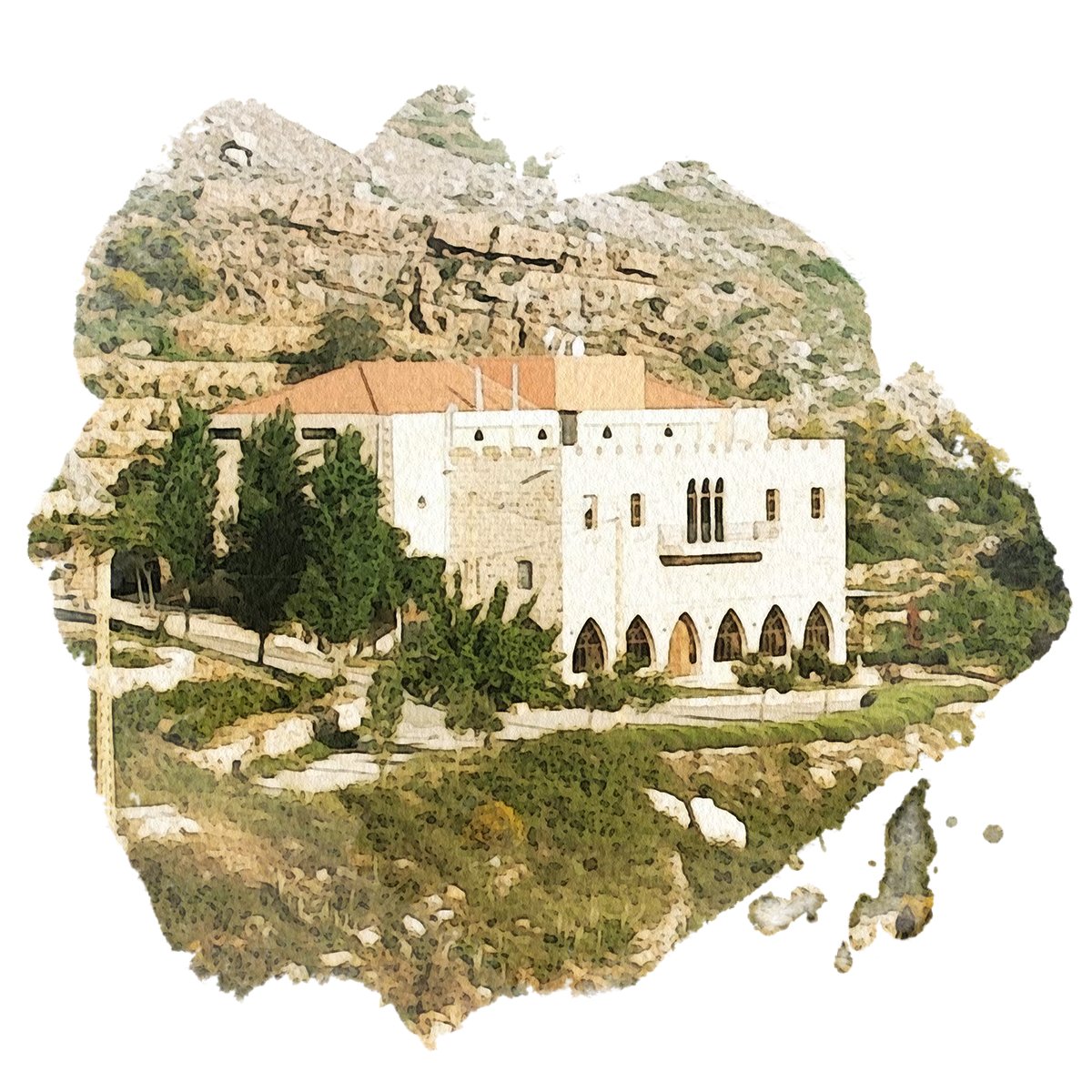
Château Cana sits on Kroum Street in Bhamdoun, in the pine-covered Lamartine Valley of Mount Lebanon — a highland wine address that earned a Pearl 1 Star Prestige in 2025. The setting alone positions it within Lebanon's smaller tier of altitude-driven estates, where elevation and forest-cooled summers shape the wines as decisively as the winemaker's hand. For those tracing Lebanese wine beyond the Bekaa, this is a serious stop.
The Valley That Named Itself After a Poet
The Lamartine Valley did not acquire its name from a tourism board or a rebranding exercise. Alphonse de Lamartine, the nineteenth-century French Romantic poet, passed through these Lebanese highlands in 1832 and wrote about pine-covered hillsides with the kind of specificity that only comes from genuine feeling. The valley kept his name, and the hillsides kept their pines. Approaching Bhamdoun today on the mountain road from Beirut, the air changes before the altitude registers on any instrument: the coastal humidity gives way to something drier, cooler, and weighted with resin. That shift is not incidental to the wines made here. It is the argument for making wine here at all.
Château Cana occupies this context on Kroum Street in Bhamdoun, at an elevation that places it well above the Bekaa floor where most internationally familiar Lebanese labels are produced. The contrast matters. The Bekaa's broad valley floor — where estates like Château Kefraya in Kafraya and Château Héritage in Bekaa Valley operate — offers a continental climate with hot summers and cold winters, good for ripening. The Mount Lebanon ridge offers something different: altitude cooling that extends the growing season, forest proximity that moderates temperature swings, and soils shaped by limestone and the gradual weathering of the mountain itself. These are not interchangeable conditions.
Elevation as Terroir Argument
Lebanese wine has spent much of the past three decades building its case through the Bekaa, and that valley deserves its reputation. But a secondary conversation has been developing on the higher slopes, where a handful of producers have tested whether altitude can produce a different register of Lebanese wine: less immediately fruit-forward, more structured, cooler in its aromatic profile. Château Cana sits within that conversation.
The Lamartine Valley's elevation above sea level means the vine experiences meaningfully cooler nights than its Bekaa counterparts. Diurnal temperature variation , the swing between daytime warmth and overnight chill , is a standard textbook condition for retaining acidity in grapes, and in mountain viticulture it operates at its most consistent. Grapes that ripen slowly under these conditions tend to hold their structural tension longer, which translates to wines that age differently and present differently in their youth. This is the core terroir claim for high-altitude Lebanese wine, and it is worth taking seriously.
Limestone subsoil across much of Mount Lebanon also contributes to drainage and mineral character in ways that differentiate the mountain wines from those grown on the Bekaa's more alluvial base. The pine forest that Lamartine described is not decorative: forest proximity affects humidity regulation and provides a natural windbreak, moderating conditions at the vine level in ways that influence the growing cycle from bud break through harvest. Producers in similarly forested mountain wine regions , whether in the Alps, the Cantabrian range, or the highlands of Greece , have drawn the same conclusion: the forest is part of the vineyard system, not separate from it.
Pearl 1 Star Prestige and What That Signals
In 2025, Château Cana received a Pearl 1 Star Prestige recognition, which positions it within the tier of Lebanese producers whose output merits formal critical attention. For a Mount Lebanon estate rather than a Bekaa producer, that recognition carries a specific implication: the altitude proposition is not simply theoretical. The wines deliver at a level that awards panels are prepared to acknowledge.
This matters when mapping the broader Lebanese wine scene. The country's established names , those with decades of export history and international press coverage , are predominantly Bekaa-based. Awards given to mountain-grown operations suggest the category is widening. Karam Wines in Southern Lebanon represents another geographic extension of this diversification, with producers across the country's different mountain and valley systems beginning to accumulate their own distinct critical profiles. Château Cana's 2025 award places it in that expanding cohort.
Internationally, the comparison for how a terroir-specific, elevation-driven estate builds recognition over time might look to producers like Albert Boxler in Niedermorschwihr , an Alsace estate whose reputation rested on site-specific, unhurried quality signals rather than volume , or Aldo Conterno in Monforte d'Alba, where vineyard parcel identity drove the critical conversation for decades before broader recognition arrived. The mechanism is the same: a distinct place, consistent expression, and the patience to let the land make the argument.
Bhamdoun and the Mountain Wine District
Bhamdoun itself is a mountain town that operated for much of the twentieth century as a summer retreat for Beirut residents and Gulf visitors seeking cooler air. The resort economy brought hotels, restaurants, and a particular kind of seasonal social life to these hillsides before Lebanon's successive crises interrupted the pattern. What remained was the land: the pine forests, the limestone ridges, the altitude, and the communities that stayed year-round.
That history shapes the character of the place now. Bhamdoun is not a purpose-built wine tourism destination. It is a functioning mountain town where viticulture is one activity among several, and where the visitor arrives into a lived context rather than a curated experience. For those who have spent time in comparable European mountain wine zones , the lower Rhône's refined flanks, the hill towns of central Italy, the mountain villages of the Douro , the dynamic will be familiar: the wine is serious, the infrastructure around it is developing rather than complete, and the visit rewards those who come with genuine interest in the place rather than expectations shaped by more established circuits.
The Lamartine Valley sits within reach of Beirut, making it accessible as a day visit or as part of a wider Mount Lebanon itinerary. Those building a more complete picture of Lebanese wine should combine a visit here with time in the Bekaa corridor, where the scale of production and the density of estates is greater. Château Héritage and Château Kefraya provide the counterpoint that makes the altitude distinction legible.
Planning a Visit
Château Cana is located on Kroum Street in Bhamdoun, in the Mount Lebanon governorate. Specific booking methods, visiting hours, and tasting formats are not publicly listed, so direct contact with the estate in advance of any visit is advisable. Mountain weather in Lebanon shifts from late autumn through winter, and the most comfortable visiting window for those prioritising both the viticulture and the landscape runs from late spring through early autumn, when the pine-covered hillsides are at their most accessible and the temperature differential from the coast is most apparent. Lebanese road conditions on mountain routes are worth researching at the time of travel given infrastructure variability.
For a fuller picture of what Bhamdoun offers beyond this estate, the our full Bhamdoun wineries guide covers the local wine picture, while our full Bhamdoun restaurants guide, our full Bhamdoun hotels guide, our full Bhamdoun bars guide, and our full Bhamdoun experiences guide map the broader context for those planning time in the Lamartine Valley.
For readers interested in how mountain and site-specific wine estates develop their critical profiles in other parts of the world, the approaches taken at Adelsheim Vineyard in Newberg, Alban Vineyards in Arroyo Grande, Accendo Cellars in St. Helena, Abadía Retuerta in Sardón de Duero, and Achaia Clauss in Patras each offer useful comparative reference points for how terroir-specific estates accumulate identity over time.
Frequently Asked Questions
- What kind of setting is Château Cana?
- Château Cana is a wine estate on Kroum Street in Bhamdoun, a mountain town in the Lamartine Valley of Mount Lebanon , a valley named after the nineteenth-century French poet who wrote about its pine-covered hillsides. The estate sits at highland elevation above the Bekaa floor, placing it in the smaller tier of altitude-driven Lebanese producers. It received a Pearl 1 Star Prestige award in 2025. Pricing and tasting format details are not publicly listed and should be confirmed directly with the estate.
- What should I know about Château Cana before I go?
- Contact the estate directly before visiting, as booking methods and visiting hours are not publicly documented. The Lamartine Valley is most accessible from late spring through early autumn. The Pearl 1 Star Prestige awarded in 2025 confirms it as a serious production address within Lebanon's emerging mountain wine category, distinct in character from the Bekaa estates that represent the country's most internationally recognised output. Visitors with a specific interest in high-altitude terroir and how elevation shapes Lebanese wine will find the context here more concentrated than at lower-altitude producers.
Fast Comparison
These are the closest comparables we have in our database for quick context.
| Venue | Cuisine | Price | Awards | Notes |
|---|---|---|---|---|
| Château Cana | (2025) Pearl 1 Star Prestige; The Lamartine Valley takes its name from the eponymous nineteenth century French poet who rhapsodized about its hillsides covered in pine trees. You will too af | This venue | ||
| Château Kefraya | ||||
| Château Héritage | ||||
| Château Heritage | ||||
| Château Oumsiyat | ||||
| Karam Wines |
Access the Cellar?
Our members enjoy exclusive access to private tastings and priority allocations from the world's most sought-after producers.
Access the Concierge