


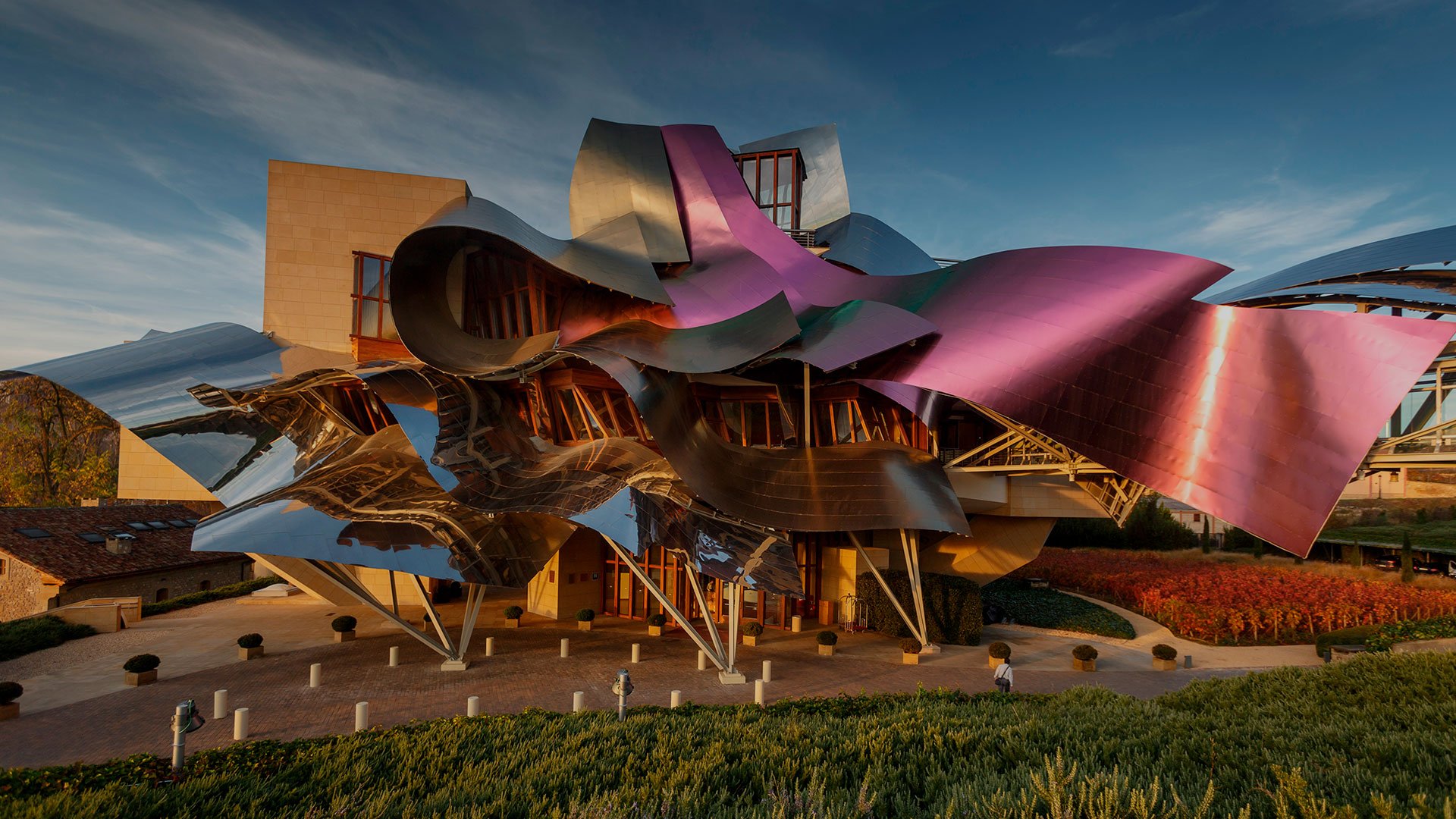
Frank Gehry's titanium-roofed hotel announces the Marqués de Riscal estate from across the Rioja Alta plateau, but the winery beneath it has been shaping the region's identity since the nineteenth century. A 2025 Decanter Silver medal and EP Club Pearl 4 Star Prestige rating place it firmly in Rioja's prestige tier. Tastings, cellar tours, and the hotel experience make it one of the region's most complete estate visits.
Where Architecture Meets Altitude: Approaching Marqués de Riscal
The first thing that registers is the roof. Frank Gehry's rippled titanium canopy catches the Basque Country light somewhere between the villages of Elciego and Laguardia, and it functions less as an entrance marker than as a provocation: a postmodernist statement planted in one of Spain's oldest wine-growing territories. The Hotel Marqués de Riscal sits above a winery that was producing Rioja before the region had a formal appellation, and that contrast between the building's deliberate futurism and the estate's deep historical roots is something visitors feel before they even step through the door.
Elciego sits in Rioja Alavesa, the sub-zone of Rioja that falls inside the Basque Country's Álava province rather than La Rioja proper. The distinction matters for wine character. The Cantabrian Mountains to the north provide shelter from Atlantic weather systems while allowing enough moisture through to temper the continental heat of the Ebro Valley below. Soils here run to chalky clay over limestone, giving Tempranillo the kind of structure and aromatic precision that distinguishes Alavesa wines from the fruitier, often more oak-forward profiles produced in warmer Rioja Alta or Rioja Oriental. When Marqués de Riscal established itself in Elciego, it was a considered choice about terroir, not just geography.
The Land Behind the Label
Rioja's three sub-zones have always produced wines with different signatures, and understanding that distinction is the most useful frame for approaching what Marqués de Riscal puts in the glass. Rioja Alavesa's relatively high altitude, combined with those limestone-clay soils and the moderating Atlantic influence, produces Tempranillo with naturally higher acidity and more restrained fruit than warmer-zone equivalents. That structure is what made the sub-zone attractive to producers seeking wines built for long ageing rather than early approachability.
The estate's 2025 Decanter Silver medal reflects a wine that continues to hold a competitive position within that tradition. In the Decanter framework, Silver represents wines assessed as genuinely distinguished within their category, which for a Rioja house of this scale and history signals consistent quality rather than a single standout vintage. The EP Club Pearl 4 Star Prestige rating reinforces that picture: this is a producer operating in the prestige segment of the regional market, with pricing and positioning that reflects its historical standing. For context, other significant estates in the broader Castilian wine corridor, including [Abadía Retuerta in Sardón de Duero](https://www.enprimeurclub.com/wineries/abada-retuerta-sardn-de-duero-winery), [Arzuaga Navarro in Quintanilla de Onésimo](https://www.enprimeurclub.com/wineries/arzuaga-navarro-quintanilla-de-onsimo-winery), and [Bodegas Protos in Peñafiel](https://www.enprimeurclub.com/wineries/bodegas-protos-peafiel-winery), occupy a comparable tier in their respective appellations.
Within Rioja itself, the estate sits in a peer group that includes [Bodegas Ysios in Laguardia](https://www.enprimeurclub.com/wineries/bodegas-ysios-laguardia-winery) and [CVNE (Cune) in Haro](https://www.enprimeurclub.com/wineries/cvne-cune-haro-winery), wineries that similarly blend historical credibility with a serious contemporary visitor proposition. [Bodegas Vivanco in Valle de Mena](https://www.enprimeurclub.com/wineries/bodegas-vivanco-valle-de-mena-winery) represents a different model, with its museum-led approach, but both sit in the category of Rioja estates where the visit is as considered as the wine itself.
Reading the Estate as a Visitor
The architectural drama of the Gehry hotel is the arrival experience, and it sets the register for everything that follows. This is not a working bodega that tolerates tourists as a secondary concern; the estate has invested deliberately in the visitor infrastructure, and the tasting and tour format reflects that. Cellar visits take visitors through production facilities and barrel halls where the relationship between Alavesa's soil characteristics and the wine's evolution in oak becomes tangible rather than abstract. The long corridors of ageing barrels, the controlled temperature, the gradual shift from the bright exterior to the subdued interior: the physical progression through the winery mirrors the patience the wines themselves require.
For those visiting Rioja primarily for the wine experience rather than the architecture, the tasting programme at Marqués de Riscal covers the estate's range with enough depth to place individual wines within their production context. The Crianza, Reserva, and Gran Reserva classifications carry specific legal minimum ageing requirements under Rioja's DO regulations, and tasting across those tiers in the estate's own cellars gives those regulatory distinctions a sensory grounding that reading about them cannot replicate. Booking in advance is advisable, particularly in the spring and summer months when Rioja draws significant wine tourism traffic from across Europe.
The Hotel as a Destination Within the Destination
The Gehry building is not incidental to understanding the estate's contemporary identity. When it opened in 2006, it placed Marqués de Riscal in a different kind of conversation: not just Rioja's historic houses competing on wine, but wine tourism as an architectural and hospitality proposition comparable to what Napa's premium estates were developing simultaneously in California. The building draws visitors who might not arrive as wine enthusiasts and converts them. That has been a deliberate part of the estate's strategy for broadening its audience without abandoning the wine credentials that justify the visit.
The hotel's restaurant and spa extend the stay into a full estate immersion, positioning Marqués de Riscal against an international peer set that includes destination wine hotels from Bordeaux to the Douro. For guests combining a Rioja wine circuit with broader Spanish wine travel, the estate pairs naturally with a visit to [Codorníu in Sant Sadurní d'Anoia](https://www.enprimeurclub.com/wineries/codornu-sant-sadurn-danoia-winery) or [Clos Mogador in Gratallops](https://www.enprimeurclub.com/wineries/clos-mogador-gratallops-winery) as part of a wider Iberian itinerary.
Planning Your Visit
Elciego sits roughly an hour's drive from Bilbao and around two hours from San Sebastián, making either Basque city a practical base for a wider trip that combines Rioja wine visits with coastal eating. Vitoria-Gasteiz, the Álava capital, is closer and offers a quieter base for those focused purely on the wine sub-zone. Tastings and tours at the estate require advance reservation; the hotel books up particularly quickly around harvest season in September and October, when the vineyards are at their most photogenic and the winery is in full production. Spring visits, when the vines are in early growth, offer shorter lead times and cooler temperatures more suited to extended tasting sessions.
For the wider Rioja picture, [our full Rioja wineries guide](https://www.enprimeurclub.com/wineries/rioja) maps the region's major estates across all three sub-zones. If you're extending the visit into broader dining and accommodation, [our full Rioja restaurants guide](https://www.enprimeurclub.com/restaurants/rioja), [our full Rioja hotels guide](https://www.enprimeurclub.com/hotels/rioja), [our full Rioja bars guide](https://www.enprimeurclub.com/bars/rioja), and [our full Rioja experiences guide](https://www.enprimeurclub.com/experiences/rioja) cover the supporting infrastructure.
Frequently Asked Questions
What should I expect atmosphere-wise at Bodegas de los Herederos del Marqués de Riscal?
The atmosphere is shaped by the Gehry building first and the historic winery second. The contrast between the titanium-clad hotel structure and the nineteenth-century cellar beneath it is immediate. Inside the cellars, the tone shifts to something quieter and more focused, with temperature-controlled barrel halls and the particular stillness of long-ageing wine. It sits in the prestige segment of Rioja's visitor offer, carrying EP Club Pearl 4 Star Prestige recognition and Decanter Silver award credentials from 2025.
What do visitors recommend trying at Bodegas de los Herederos del Marqués de Riscal?
The tasting format typically spans the estate's classification tiers from Crianza through to Gran Reserva, which is where Rioja Alavesa's limestone-clay terroir and altitude express themselves most clearly after extended oak and bottle ageing. The Gran Reserva category, requiring a minimum of five years total ageing under DO Rioja regulations, is where the sub-zone's structural characteristics become most legible in the glass. The 2025 Decanter Silver medal reflects the estate's continued standing within that tradition.
What's the standout thing about Bodegas de los Herederos del Marqués de Riscal?
In Rioja, where many historic bodegas compete on heritage, Marqués de Riscal made the architectural commission of the Gehry hotel a genuinely differentiating move. The combination of nineteenth-century wine credentials, EP Club Pearl 4 Star Prestige status, and a purpose-built destination hotel within the vineyard estate gives the visit a scope that few Rioja addresses can match. For visitors to the region, it functions as a fixed reference point: the estate that most clearly demonstrates how Rioja has pursued international wine tourism on its own terms.
Fast Comparison
These are the closest comparables we have in our database for quick context.
| Venue | Cuisine | Price | Awards | Notes |
|---|---|---|---|---|
| Bodegas de los Herederos del Marqués de Riscal | 2025 Decanter rollup: 1 awarded wines, best medal Silver, medals 1 Silver.; Pearl 4 Star Prestige (2025); Glimmering across the landscape, the rippled metal roof of Frank Gehry’s Hotel Marqués de Riscal heralds a seminal Riojan winery below. Such postmodernist flair; Glimmering across the landscape, the rippled metal roof of Frank Gehry’s Hotel Marqués de Riscal heralds a seminal Riojan winery below. Such postmodernist flair; Glimmering across the landscape, the rippled metal roof of Frank Gehry’s Hotel Marqués de Riscal heralds a seminal Riojan winery below. Such postmodernist flair; Glimmering across the landscape, the rippled metal roof of Frank Gehry’s Hotel Marqués de Riscal heralds a seminal Riojan winery below. Such postmodernist flair; Glimmering across the landscape, the rippled metal roof of Frank Gehry’s Hotel Marqués de Riscal heralds a seminal Riojan winery below. Such postmodernist flair | This venue | ||
| Pingus | ||||
| Abadía Retuerta | ||||
| Arzuaga Navarro | ||||
| Bodegas Protos | ||||
| Bodegas Vivanco |
Access the Cellar?
Our members enjoy exclusive access to private tastings and priority allocations from the world's most sought-after producers.
Access the Concierge