
Bodega La Azul sits in Tunuyán's Valle de Uco, where the Andes drop sharply enough to push viticulture toward its productive limits. The winery holds a Pearl 2 Star Prestige rating for 2025, placing it in a select tier among Mendoza's high-altitude producers. For visitors who want serious wine in an environment shaped by elevation and volcanic soils, it is a considered stop on any Valle de Uco itinerary.
Where the Andes Set the Terms
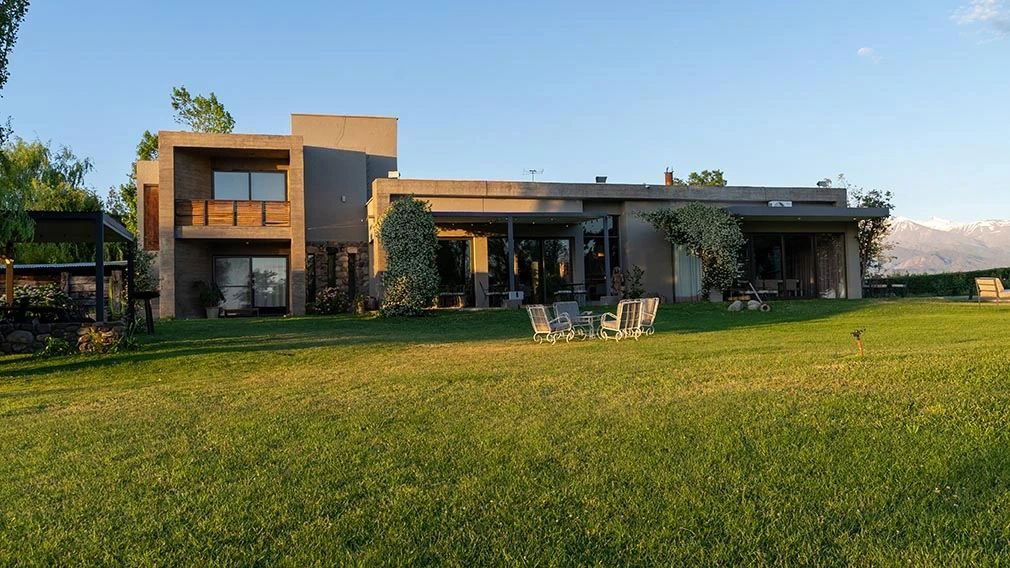
At around 1,000 metres above sea level, the Valle de Uco operates under different conditions than Mendoza's better-publicised lowland zones. The diurnal temperature swings here — sometimes exceeding 20°C between afternoon heat and night-time cold — slow grape development and preserve the kind of acidity that winemakers in warmer appellations have to engineer artificially. Approaching Bodega La Azul along the Caminos del Vino corridor in Tupungato, the scale of the Andes settles the question of terroir before you've tasted a single glass. The mountains are not scenic backdrop; they are the winemaking infrastructure, delivering snowmelt irrigation, altitude-driven UV intensity, and thermal regulation that determines the character of everything in the bottle.
This physical reality is worth holding in mind when comparing Valle de Uco producers. Unlike Luján de Cuyo, where estates such as Bodega Lagarde built their reputations across decades of lower-altitude Malbec production, the Valle de Uco's identity is more recent and more explicitly altitude-dependent. The Tupungato sub-zone, where Bodega La Azul is located, sits at the cooler northern end of the valley and is considered one of the region's higher-potential districts for structured, age-worthy wines.
Bodega La Azul in Its Competitive Set
The Valle de Uco has attracted serious investment over the past two decades, and the Tunuyán and Tupungato corridors now hold a dense concentration of quality producers. Bodega La Azul's Pearl 2 Star Prestige recognition from EP Club in 2025 places it within a defined tier: above the broad mid-market of Mendoza's export-volume wineries, and operating alongside estates that share a commitment to site-specific viticulture and limited production.
Its immediate neighbours in this tier include Bodega DiamAndes, which has built its identity around structured Malbec and Cabernet blends, and Bodegas Salentein, one of the valley's earlier high-profile entrants and a reference point for Dutch-backed investment in Argentine terroir. Further along the valley, Zuccardi Valle de Uco has earned international recognition as a benchmark for the region's potential with Malbec and white varieties alike, while Antucura and Bodega Cuvelier Los Andes represent the French-ownership strand that arrived during the early 2000s wave of European investment in the sub-region.
Bodega La Azul sits within this cohort rather than above or outside it. The 2 Star Prestige designation signals consistent quality and a recognisable point of view, characteristics that matter when visitors are allocating time across a valley where the density of serious producers makes every choice a trade-off.
The Sense of Place at Altitude
The editorial angle that shapes any honest assessment of Valle de Uco wineries is physical environment. At Bodega La Azul, the address on the Caminos del Vino puts it on one of the valley's established visitor routes, and the approach through vineyard rows planted against the Andean backdrop is the context that winemakers here reference constantly when explaining what separates their wines from Mendoza's lowland output.
High-altitude viticulture in this part of Argentina is not simply a marketing claim. The Tupungato zone's volcanic and alluvial soils, combined with the elevation, produce grapes with thicker skins and more concentrated phenolics than warmer valley floors. The same conditions that make harvesting difficult and yields unpredictable are precisely the conditions that make the wines interesting. For visitors arriving from the northern Argentine wine regions , from, say, Bodega Colomé in Molinos or Bodega El Esteco in Cafayate , the Valle de Uco registers as a different expression of Argentine altitude, denser and more Bordeaux-adjacent in its structural ambitions, though no less rooted in local character.
The view from the estate across to the Andes is the kind of visual statement that serious wine regions worldwide use to anchor their identity. Comparable framing operates at estates like Abadía Retuerta in Sardón de Duero, where a medieval monastery gives the landscape a historical anchor, or at distilleries such as Aberlour in Aberlour, where the Speyside river setting is integral to the production story. At Bodega La Azul, the mountains do similar work: they contextualise the wine before the tasting begins.
Planning a Visit
Bodega La Azul is located on the Caminos del Vino in Tupungato, Mendoza province, within the broader Tunuyán district. The valley's visitor infrastructure has developed considerably over the past decade, and the Caminos del Vino corridor is now navigable as a self-drive route with multiple estate stops in a single day. Visitors building a multi-day itinerary around the region can consult our full Tunuyán wineries guide for the complete range of producers, or cross-reference with our Tunuyán restaurants guide, our Tunuyán hotels guide, our Tunuyán bars guide, and our Tunuyán experiences guide for a fuller picture of what the district offers beyond the cellar door.
Contact details and booking procedures for Bodega La Azul are not currently listed in our database. As is standard for Valle de Uco producers of this standing, advance contact before visiting is advisable, particularly during the peak harvest season from February through April, when winery schedules tighten and walk-in availability at quality estates cannot be assumed. The shoulder seasons of spring and autumn offer more predictable access and, in the case of autumn, the visual reward of vine colour change against the Andean backdrop.
FAQ
- What's the leading wine to try at Bodega La Azul?
- The Valle de Uco's high-altitude terroir in Tupungato is most commonly associated with structured Malbec and, increasingly, white varieties such as Chardonnay and Torrontés grown at elevation. Bodega La Azul's Pearl 2 Star Prestige rating for 2025 signals a producer working at a level where single-vineyard or reserve-tier bottlings are likely the most representative of the estate's ambitions. For specific current releases, direct contact with the winery is the most reliable route, as allocations at this tier can be limited.
- What makes Bodega La Azul worth visiting?
- The combination of Valle de Uco terroir, Tupungato's sub-zonal credentials, and a Pearl 2 Star Prestige recognition for 2025 positions Bodega La Azul as a considered choice within a valley that now has more quality producers than a single-day visit can accommodate. For visitors prioritising site character and altitude-driven wine style over cellar-door spectacle, it belongs in the shortlist alongside its Tunuyán-corridor peers.
- How hard is it to get in to Bodega La Azul?
- Phone and website details are not currently in our database for Bodega La Azul. For any Valle de Uco winery at the 2 Star Prestige tier, advance contact before visiting is the sensible approach, especially during February-to-April harvest, when demand from visiting trade and consumers typically outpaces walk-in capacity. Outside of harvest, the valley generally offers more flexibility for planned visits.
- What's Bodega La Azul a good pick for?
- Bodega La Azul suits visitors who are building a structured Valle de Uco itinerary and want to include a Pearl 2 Star Prestige-rated producer in the Tupungato sub-zone. The estate sits within easy reach of other Tunuyán-corridor wineries, making it a practical addition to a day that might also take in Bodega DiamAndes or Zuccardi Valle de Uco, and it appeals to travellers whose interest in Argentine wine goes beyond Mendoza's lowland Malbec benchmark.
- How does Bodega La Azul's Tupungato location affect its wine style compared to other Mendoza sub-zones?
- Tupungato sits at the cooler, higher end of the Valle de Uco, and the elevation and volcanic soils there push grape development toward longer hang times, thicker skins, and more pronounced acidity than producers in Luján de Cuyo or Maipú typically achieve. This translates into wines with structural characteristics suited to ageing, which is part of why the sub-zone has attracted sustained investment and why a Pearl 2 Star Prestige recognition at this address carries specific terroir weight. The contrast with lower-altitude Mendoza is not marginal; it represents a genuinely different winemaking argument, one defined by restraint and site fidelity rather than fruit-forward approachability.
Reputation First
A quick peer list to put this venue’s basics in context.
| Venue | Classification | Awards | First Vintage | Notes |
|---|---|---|---|---|
| Bodega La Azul | 1 awards | This venue | ||
| Bodegas Salentein | World's 50 Best | |||
| Zuccardi Valle de Uco | World's 50 Best | |||
| Bodega DiamAndes | World's 50 Best | |||
| Antucura | 1 awards | |||
| Bodega Cuvelier Los Andes | 1 awards |
Access the Cellar?
Our members enjoy exclusive access to private tastings and priority allocations from the world's most sought-after producers.
Access the Concierge