

Set among rolling vineyards in the Garzón hills of Maldonado, Bodega Garzón pairs serious terroir-driven winemaking with a restaurant presided over by Francis Mallmann, whose open-fire techniques have defined South American cooking for decades. Awarded a Pearl 4 Star Prestige rating in 2025, the estate represents Uruguay's most complete argument for wine tourism done without compromise.
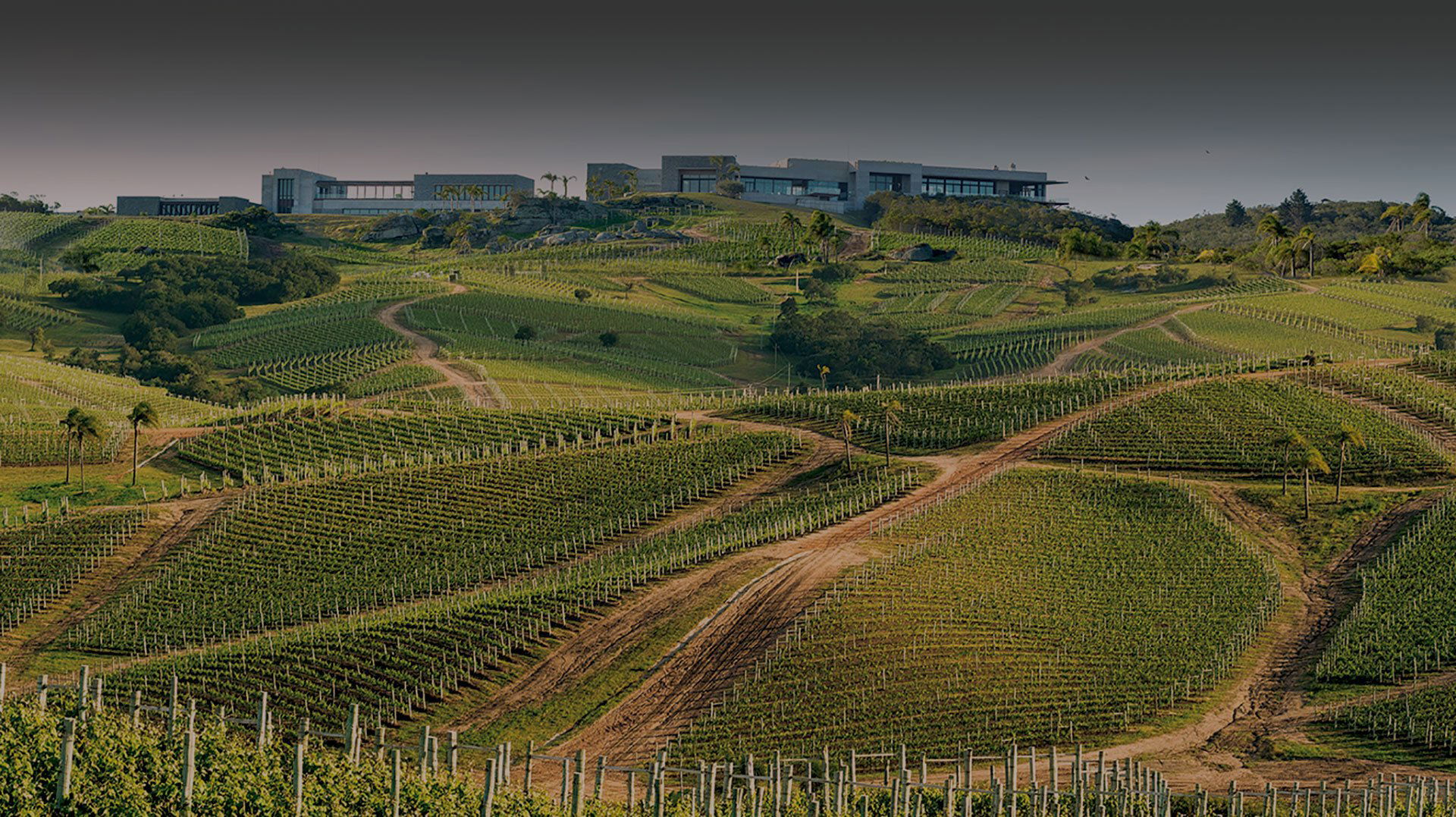
Where the Garzón Hills Begin to Speak
The road to Bodega Garzón offers the argument before the gate does. Kilometre 175 on Route 9 puts you deep into the granite and schist uplands of the Maldonado interior, a terrain that looks nothing like the river-flat viticulture common across the Río de la Plata basin. The hills here are older, the soils thinner, the elevation just enough to pull diurnal temperatures apart and slow ripening by a degree or two that, in winemaking terms, separates a blunt fruit profile from something with actual tension. By the time the winery's stone architecture resolves out of the vineyard rows, the landscape has already made a case for why this address matters.
This is the working premise of estate wine tourism in Uruguay's emerging premium tier: the physical place is the subject, and the wine is how that place gets translated. Bodega Garzón, awarded a Pearl 4 Star Prestige rating in 2025, occupies the leading of that tier in Maldonado, a department whose wine identity is still being written but which has enough singular geography to sustain genuine ambition.
Terroir in the Glass: What Garzón's Soils Actually Do
Uruguay's wine identity has long been built around Tannat, a variety that arrived with Basque immigrants in the nineteenth century and found the country's humid Atlantic climate an unlikely but workable home. Tannat elsewhere — in its Madiran heartland in southwest France — tends toward iron-fisted tannins and deep, almost brooding colour. In Uruguay's coastal departments, something softer happens, and in Garzón specifically, where granite-based soils with high mineral content underpin the vineyards, the variety arrives with more definition and less blunt force.
The altitude matters here in ways it does not at lower-lying Uruguayan estates. The Garzón hills sit at elevations that, while modest by Andean standards, are meaningful within Uruguay's relatively flat topography. Cooler nights slow the accumulation of sugar relative to phenolic development, which means harvest decisions carry a different calculus. The result, across both red and white programs, is wines that tend to read as place-specific rather than generic Atlantic-climate fruit. Albariño has found particular purchase in the region, where granite soils echo the variety's Galician origins in northwest Spain. Visitors comparing notes with peers at Bodega Oceánica José Ignacio or Bodega Sacromonte will find that the Garzón appellation produces a recognisably distinct register , more mineral tension, less tropical generosity , than the lower Atlantic sites nearby.
For travellers building a fuller picture of Maldonado's wine geography, Viña Edén offers a complementary reference point within the department. The broader Uruguayan picture extends from Bodega Bouza in Montevideo through Varela Zarranz in Canelones and Bodega Carrau in Las Piedras, with coastal outliers like Bodega Cerro del Toro in Piriápolis and the historic Bodega Los Cerros de San Juan in Colonia del Sacramento rounding out a country that has been quietly assembling a serious argument for premium wine status over the past two decades.
Fire, Smoke, and the Mallmann Effect
The restaurant at Bodega Garzón operates under a culinary logic that is almost the opposite of the winery's precision viticulture. Where the vineyards reward patience, measurement, and restraint, the kitchen under Francis Mallmann operates through elemental drama. Mallmann's reputation in South America is built on a decades-long insistence that fire is not a technique but a philosophy , that wood, ash, and uncontrolled flame produce textures and flavours that controlled heat cannot replicate. Open embers, iron plates, and hanging roasts are the instruments here, and the restaurant is built around them, architecturally and conceptually.
This pairing of serious winemaking with Mallmann-style asado cooking is not accidental. The food philosophy mirrors what the terroir does with the wine: both resist smoothing out, both carry char and mineral edge, both ask the diner to accept something rawer and more direct than resort hotel cooking tends to offer. It is one of the more coherent estate restaurant propositions in the Southern Hemisphere, where the food and wine share an aesthetic position rather than simply sharing an address.
The 2025 Pearl 4 Star Prestige award reflects a venue operating at a level where the integration of restaurant, winery, and setting functions as a single argument rather than three separate amenities bolted together.
The Estate as Destination
Wine tourism in this part of Uruguay operates on a different visitor logic than, say, Napa or Mendoza. There is no wine trail infrastructure, no shuttle buses between properties, no app that maps the tastings. Getting to Bodega Garzón at kilometre 175 on Route 9 requires a car and a degree of intention. That friction is not incidental: it selects for visitors who have decided the destination is the point, not a stop on a route.
This is consistent with how premium estate wine tourism has evolved in less-travelled regions globally. The Spanish estate model at places like Abadía Retuerta in Sardón de Duero rests on similar logic: isolation as a design feature, the estate as a self-contained world rather than a node in a larger circuit. Bodega Garzón occupies that position in Uruguay , a destination that absorbs a full day rather than a half-hour tasting window.
Planning around a Garzón visit from Punta del Este, the nearest city of scale, means a drive through interior Maldonado that doubles as orientation to the department's agricultural and topographic character. The combination of winery visit, tasting, and Mallmann restaurant lunch or dinner makes a single-day excursion both viable and complete. Reservations for the restaurant, given Mallmann's profile, carry significantly more urgency than the winery visit itself , booking ahead by several weeks is standard practice during the December-to-March summer season when Punta del Este and its surrounding region fill with Argentine and Brazilian visitors.
Where Bodega Garzón Sits in the Regional Peer Set
Uruguay's wine industry punches above its acreage in international recognition, but Maldonado as a specific wine region is only beginning to accumulate the critical mass of estates needed to register as a named appellation in the minds of international visitors. Bodega Garzón is the anchor property in that process: large enough to invest in proper visitor infrastructure, credentialed enough through its Pearl 4 Star Prestige rating and its Mallmann association to attract visitors who would not otherwise route through interior Maldonado.
For the full scope of what Maldonado offers beyond wine, our full Maldonado wineries guide maps the department's producers, while our full Maldonado restaurants guide, our full Maldonado bars guide, our full Maldonado hotels guide, and our full Maldonado experiences guide provide the surrounding context for a department that is assembling a serious premium travel proposition one estate at a time.
As a reference point for what estate wine tourism looks like at its most developed, the contrast with Aberlour in Aberlour is instructive: both are single-estate destinations in regions where the provenance story carries significant weight, both require deliberate travel rather than passing convenience, and both ask the visitor to read the landscape before they read the label. Bodega Garzón is doing that work for Maldonado, one vintage at a time.
Planning Your Visit
Bodega Garzón sits at km 175 on Route 9 in the village of Garzón, Maldonado department. The estate is leading reached by car from Punta del Este or Montevideo. The restaurant, presided over by Francis Mallmann and oriented around open-fire cooking, operates at a level of demand that makes advance reservations necessary, particularly during the austral summer months of December through March when the region draws its heaviest visitor traffic. The winery itself receives visitors for tastings and cellar tours; confirm current visit formats and availability directly with the estate before travelling.
A Credentials Check
Comparable venues for orientation, based on our database fields.
| Venue | Classification | Awards | First Vintage | Notes |
|---|---|---|---|---|
| Bodega Garzón | World's 50 Best | This venue | ||
| Bodega Oceánica José Ignacio | 1 awards | |||
| Bodega Sacromonte | 1 awards | |||
| Viña Edén | 1 awards |
Access the Cellar?
Our members enjoy exclusive access to private tastings and priority allocations from the world's most sought-after producers.
Access the Concierge