Our verdict
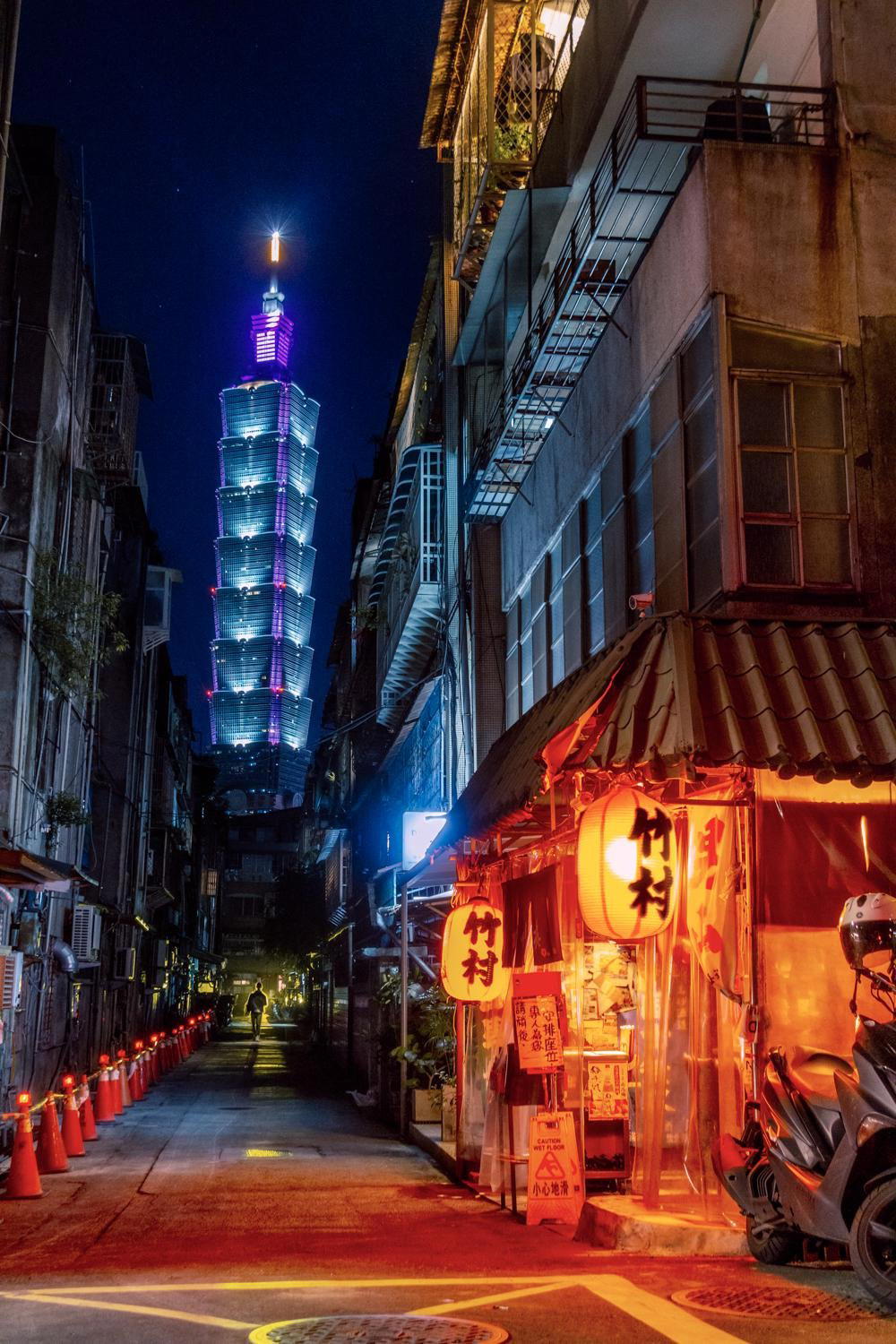
Famous TV drama filming location offering retro izakaya vibes with an well-known view of Taipei 101 framing the alleyway.

Pearl is the En Primeur Club membership app, where members save venues, book tables and use the concierge.
The menu
What to order
- 招牌蛋捲 (Signature Tamagoyaki)
- 烤飯糰 (Grilled Rice Balls)
- 竹村燒 (Zhucun Yaki)
- 串燒 (Grilled Skewers)
- 味噌湯 (Miso Soup)
Lane Life in Xinyi: What a Neighbourhood Izakaya Signals About Taipei Drinking Culture
The address alone tells you something. Tucked inside a lane off Songren Road in Xinyi District, 竹村居酒屋 sits in the kind of Taipei back-alley geography that rewards the deliberate over the accidental. Xinyi is the district most visitors associate with Taipei 101 and the polished restaurants that orbit it, places such as logy, which anchors Taipei's modern fine-dining conversation, and the Cantonese grandeur of Le Palais. Yet the same district contains narrow residential alleys where izakaya culture runs at an entirely different register: smaller rooms, shared plates, cold beer arriving without ceremony.
That split, between the formal ambition of Taipei's Michelin tier and the neighbourhood drinking-and-eating format underneath it, is the context that gives an izakaya like 竹村居酒屋 its clearest meaning. The izakaya format arrived in Taiwan carrying Japanese habits, the long counter, the yakitori smoke, the idea that drinking and eating are not sequential but simultaneous. In Taipei, those habits merged with local rhythms: louder tables, an appetite for Taiwanese ingredients, and a hospitality register that tends toward directness rather than ceremony.
The Izakaya Format in Taipei: Between Japanese Tradition and Taiwanese Appetite
Across East Asia, the izakaya has always operated as a pressure-release valve for urban workers, a format where the food is substantive enough to count as dinner but the mood is loose enough to count as a night out. Japan's version codified it across decades; Taiwan's version absorbed the structure and bent it toward local tastes. The result is a category of Taipei eating that sits outside both the formal Taiwanese restaurant and the fusion fine-dining scene that venues like JL Studio in Taichung or GEN in Kaohsiung represent.
The izakaya's value to the diner is partly about sourcing logic. A well-run izakaya builds its menu around seasonal and rotating small plates precisely because the format demands freshness at high turnover: items arrive quickly, tables order repeatedly across the evening, and nothing benefits from sitting. That discipline, ordering what's available tonight rather than what's always on the menu, is closer to how serious Taiwanese night-market vendors operate than how a printed-menu restaurant does. The ingredient moves first; the dish follows.
Taipei's Xinyi District has a high concentration of Japanese food businesses, a legacy of both colonial-era influence and postwar cultural exchange. Diners who know the district well tend to separate the operations with clear sourcing discipline from those running generic menus. Proximity to the 信義 night-food corridor, where spots such as Good Good Hainan Chicken Rice serve the area's more casual appetite, gives the neighbourhood a layered eating ecosystem that the lane-level izakaya fits naturally.
What Ingredient Logic Looks Like at the Neighbourhood Scale
The editorial question for any neighbourhood izakaya is whether its sourcing decisions produce a menu that changes, or a laminated card that stays the same for years. In Taipei, the more serious operators in this format maintain relationships with specific wet-market vendors or mountain-grown vegetable suppliers from counties like Nantou or Yilan, both of which send seasonal produce into the city's restaurant supply chain. That connection, even at the casual end of the dining spectrum, is what separates a kitchen paying attention from one operating on autopilot.
Taiwanese seafood sourcing at the izakaya level often draws from Donggang (for bluefin tuna during spring season) or the morning markets along the northeast coast, where smaller fishing operations land catch that doesn't always reach the fine-dining kitchens bidding for premium cuts. An izakaya that positions itself inside that supply chain gives regular diners access to ingredient quality that doesn't require a reservation at a restaurant running at the price tier of A Xia in Tainan or similar formal destinations.
The drinks side of the equation reinforces the sourcing conversation. Japanese whisky, Taiwan Beer, and the expanding category of Taiwanese craft spirits now occupy menus at this level that would have defaulted entirely to Japanese imports a decade ago. That shift reflects a broader Taiwanese hospitality confidence, the same instinct visible in the local-produce focus at destinations like Golden Formosa Taiwanese Cuisine in Shilin, though expressed here in a much less formal register.
How 竹村居酒屋 Sits in the Xinyi Eating Map
The 信義區 address at 松仁路228巷9弄7號 places 竹村居酒屋 away from the main commercial drag and inside a residential-commercial lane zone where foot traffic is local rather than tourist. For diners oriented by Taipei's MRT grid, the Xinyi-Anhe or Taipei City Hall stations are both within reasonable walking range, though lane addresses in this part of the district reward navigating on foot with a map application rather than relying on street-level wayfinding. Evening visits suit the format; the izakaya operates at its most coherent when the tables fill and the ordering rhythm builds across several rounds.
For those building a broader Taiwan eating itinerary that moves between registers, pairing a casual Xinyi izakaya evening with one of the region's more formally structured meals creates useful contrast. The fine-dining tier in northern Taiwan runs through venues like logy, while the wider regional picture extends to JL Studio in Taichung and GEN in Kaohsiung. Our full Taipei restaurants guide maps those contrasts across the city's neighbourhoods. Additional context for how casual eating formats interact with regional sourcing traditions appears in profiles of GARDENh in Yonghe District and related Sanchong District entries.
Planning Your Visit
The practical approach is to arrive on the earlier side of the evening, before the post-work crowd consolidates around 7 to 8 pm, which gives better odds on seating in a format where capacity is typically limited. Phone confirmation ahead is advisable, though a direct visit during off-peak hours remains a reliable alternative for operators at this scale. Dress code expectations in the izakaya format default to informal; the atmosphere is convivial and table-sharing is standard.
Frequently asked questions
Does 竹村居酒屋 work for a family meal?
The lane address at 松仁路228巷9弄7號 in Xinyi District points toward a neighbourhood-scale operation where the crowd skews local and the setting is informal rather than child-focused. Izakayas in Taipei generally run better for adults sharing small plates over drinks than for structured family dining.
What should I expect atmosphere-wise at 竹村居酒屋?
The 228巷9弄 address in Xinyi puts 竹村居酒屋 inside a residential-commercial lane zone, which typically means a lower noise floor and a more settled crowd than venues on the main Xinyi commercial strip. Izakayas at this address type in Taipei tend toward close seating, warm lighting, and a pace set by regulars rather than tourists.
Is 竹村居酒屋 the kind of place that requires a reservation, or can you walk in?
Lane-address izakayas in Xinyi District, like 竹村 at 松仁路228巷9弄7號, often operate on a first-come basis given their neighbourhood clientele, but seating capacity at this scale can be tight on weeknights. Walking in remains the default option until confirmed otherwise.
What do people recommend at 竹村居酒屋?
The izakaya format at this neighbourhood scale typically centres on rotating small plates alongside drinks, so the strongest ordering strategy is usually to ask what arrived that day. Checking recent visitor posts on local platforms before visiting will give the most current picture.
Continue exploring
More in Taipei
Restaurants in Taipei
All restaurants in Taipei →
Bars in Taipei
All bars in Taipei →
Hotels in Taipei
All hotels in Taipei →
Wineries in Taipei
Browse all →
Details
- Cozy
- Rustic
- Well Known
- Classic
- Lively
- Casual Hangout
- Date Night
- After Work
- Late Night
- Panoramic View
- Sake Program
- Beer Program
- Local Sourcing
- Skyline
- Street Scene
- Small Plates
- A La Carte
- Counter Dining
- Sake
- Housemade Plum Wine (umeshu)
- Beer
Retro Japanese pub vibe with unaltered vintage decor, walls covered in guest photos, and an intimate, nostalgic atmosphere.