
Tabelog Bronze #535
Our verdict
Zenryomaru places Nobeoka’s coastal Japanese cooking in the serious-dinner bracket, with fish at the center and sake, shochu, and wine treated as part of the meal rather than an afterthought. Tabelog recognition, including Bronze awards and Japanese cuisine WEST 100 selection, puts it in a narrower regional tier than the city’s casual counters and everyday lunch rooms.

Pearl is the En Primeur Club membership app, where members save venues, book tables and use the concierge.
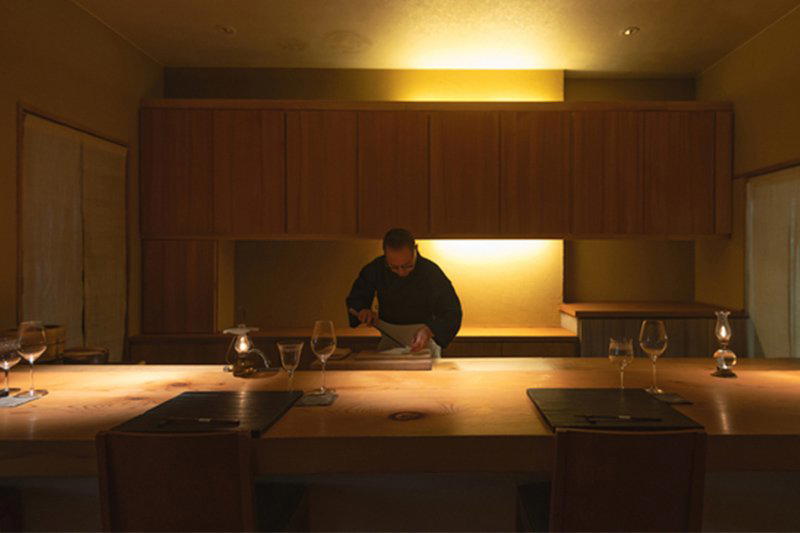
Honmachi is not the stage-set version of Japanese dining that visitors often imagine from Kyoto lanes or Ginza counters. In Nobeoka, the more persuasive restaurants tend to read as working-city rooms: modest frontage, domestic scale, and a stronger connection to the sea and surrounding prefecture than to restaurant theatre. Zenryomaru belongs to that register. Its house-restaurant setting matters because it keeps the frame local: a Japanese cuisine address in Miyazaki where fish is the declared center of gravity and the room supports both counter seating and more enclosed formats.
The useful way to read the restaurant is through sourcing rather than ceremony. Miyazaki sits on a coastline with deep fishing culture, and Nobeoka’s dining identity is shaped by that geography as much as by any chef-led tasting-menu trend. The restaurant’s public positioning is explicit about fish, and the drinks list follows the same regional logic: sake and shochu sit alongside wine, a combination that suits a table where seafood, seasoning, and texture do more of the work than luxury garnish.
Fish-led Japanese cooking in a city better known for local regulars than destination dining
Nobeoka’s restaurant scene has a wide price spread. At one end, places such as Naochan and Kurobee sit in the everyday bracket, where value and repetition define the habit. At the other, Zenryomaru prices dinner in the JPY 10,000 to JPY 14,999 range, with review-based spending shown higher, placing it in a different decision category. This is not a casual add-on between errands; it is the kind of dinner that asks the traveler to treat Nobeoka as a food stop in its own right.
That difference is reinforced by recognition. The restaurant has received Tabelog Bronze recognition for 2024, 2025, and 2026, and was selected for Tabelog Japanese cuisine WEST 100 in 2023 and 2025. In Japan, where Tabelog’s user culture can be demanding and regional lists are heavily scrutinized by diners, those signals carry more weight than broad praise. They place the restaurant within a western Japan Japanese-cuisine conversation rather than only a local directory.
The ingredient angle is also what separates this address from many higher-spend Japanese restaurants in larger cities. Tokyo and Osaka often convert regional product into polished metropolitan formats; Nobeoka has less distance between source and table. The point is not that a smaller city automatically cooks better. It is that fish-led Japanese cuisine here can feel less abstract, more tied to the purpose of eating in a coastal prefecture: season, catch, rice, drink, and company.
The room favors serious conversation over spectacle
The physical format gives diners several ways to read the evening. Counter seating points toward observation and pace, while tatami and sunken seating make the restaurant usable for business dinners or groups that want privacy. Private rooms and private use are available, and the whole room is non-smoking, a practical detail that matters for travelers who want the meal to stay focused on aroma and pacing rather than the compromises of older izakaya culture.
That balance helps explain why the restaurant works for a narrower audience than a general Nobeoka recommendation. Travelers looking for a quick bowl, a low-cost set meal, or a drop-in drinking room will find the city has easier options. Those planning around regional Japanese cooking, particularly seafood, should read Zenryomaru against the more casual local map: CERCA TROVA, チェルカ トローヴァ, and the city’s lower-priced counters occupy different roles. The comparison is useful because it clarifies intent. This is not Nobeoka as a snack stop; it is Nobeoka as a dinner plan.
The drinks program also broadens the table. Sake is the obvious partner for fish-led Japanese cuisine, while shochu gives the meal a Kyushu accent that should not be treated as secondary. Wine adds another route through the menu, especially for diners who prefer acidity and temperature contrast with seafood. The restaurant’s strength is not in presenting a single rigid script, but in giving a coastal Japanese meal enough structure to feel considered without turning it into metropolitan performance.
How to place it within a Nobeoka itinerary
For travelers building a food-focused route through the city, the restaurant belongs near the center of the evening rather than at the margin. Use Our full Nobeoka restaurants guide to map it against casual meals, then treat the supporting guides as context rather than filler: Our full Nobeoka hotels guide, Our full Nobeoka bars guide, Our full Nobeoka wineries guide, and Our full Nobeoka experiences guide help frame the city beyond dinner.
Readers comparing Japanese dining styles across the country can also place this meal beside other EP Club entries: -Grilled beef Sukiyaki- KAMAKURA TANUKIAN 鎌倉 たぬき庵 in Kamakura for beef-led set-piece dining. 鮪と炭火焼き うお炭 秋葉原店 in Tokyo for tuna and charcoal in a metropolitan setting.cafe in Osaka for urban café culture.know in Kumamoto for another Kyushu reference point, (Shoku) Vietnam in Kawasaki for cross-cultural casual dining, [Curry Senmon Ten] Maruyama Kyoju. in Sapporo for specialist comfort food, [ki:] in Kyoto for a Kyoto contrast, Jōdo Saké Bar in Los Angeles for sake culture abroad, and Onigiri Time in Pasadena for Japanese food translated into a different daily-use format.
The verdict is simple without being soft: Zenryomaru is for diners who care where a Japanese meal comes from. Its awards give the restaurant external credibility, but the stronger argument is geographic. In Nobeoka, fish-led cooking does not need to borrow prestige from bigger cities; it has its own reason to exist.
Frequently asked questions
Is Zenryomaru suitable for children?
Zenryomaru is a reservation-only Japanese restaurant in Nobeoka, with counter seating, tatami room, and sunken seating. Those details are not published. Check the venue's official channels for the latest details.
How would you describe the vibe at Zenryomaru?
The room is set up as a house restaurant in Honmachi, with counter seating, private rooms, and a non-smoking layout. That points to a quiet, conversation-led dinner rather than a casual drop-in spot.
What are the operating hours at Zenryomaru?
Hours at Zenryomaru: Mon, Tue, Wed, Thu, Fri, Sat 18:00 - 22:00 L.O. 21:30.
Where do I go for Zenryomaru?
Zenryomaru is located in Nobeoka.
What's Zenryomaru best at?
Its strongest case is fish-led Japanese cooking, backed by Tabelog Bronze awards in 2024, 2025, and 2026, plus selection for Japanese cuisine WEST Tabelog 100 in 2023 and 2025. The restaurant also runs by reservation only, which suits a more controlled dinner format.
Can Zenryomaru handle vegetarian requests?
The public record highlights a focus on fish, so vegetarian diners should plan carefully. With reservation-only service in Nobeoka and no menu details published here, the practical move is to ask in advance before booking. Check the venue's official channels for the latest details.
Comparable Spots, Quickly
Comparable venues by cuisine and price in the same metro.
| Venue | Cuisine | Price | Awards | Notes |
|---|---|---|---|---|
| ZenryomaruThis venue (the venue you are viewing) | Japanese Traditional Fine Dining | $100–150 | Tabelog Bronze #535 | Not listed |
| チェルカ トローヴァ | Modern Italian with Local Miyazaki Ingredients | $100–150 | Tabelog Silver #12 | Nobeoka |
| CERCA TROVA | Modern Italian with Local Miyazaki Ingredients | $100–150 | Tabelog Silver #12 | Bakuro-cho |
| Naochan | Traditional Chicken Nanban & Japanese set meals | $10–20 | Tabelog 100 #29 | Nobeoka |
| Kurobee | Japanese Dumpling House | $1–10 | Tabelog 100 #46 | Shinmachi |
| Jimgu | Farm-Driven Innovative Japanese | $100–150 | Relais Chateaux Award · Tabelog Bronze #146 | Yufuin |
Recognition history
Dated appearances from independent guides and award organizations, with the underlying list record or original source where available.
Tabelog Bronze #535
Tabelog
Full recognition history (3 entries)
Tabelog Bronze
Tabelog
Tabelog 100 #27 · No. 27
Tabelog · Tabelog 100 - Japanese cuisine - WEST - 2025
Continue exploring
More in Nobeoka
Details
- Quiet
- Intimate
- Elegant
- Minimalist
- Solo
- Special Occasion
- Chefs Counter
- Sake Program
- Local Sourcing
- Counter Dining
Current opening hours
- Monday
- 6–9 PM
- Tuesday
- 6–9 PM
- Wednesday
- 6–9 PM
- Thursday
- 6–9 PM
- Friday
- 6–9 PM
- Saturday
- 6–9 PM
- Sunday
- Closed
Hours can change for holidays and private events. Hours as of .
Minimalist and serene with emphasis on purity and simplicity, fostering a unified host-guest experience through silence.