Versailles
Our verdict
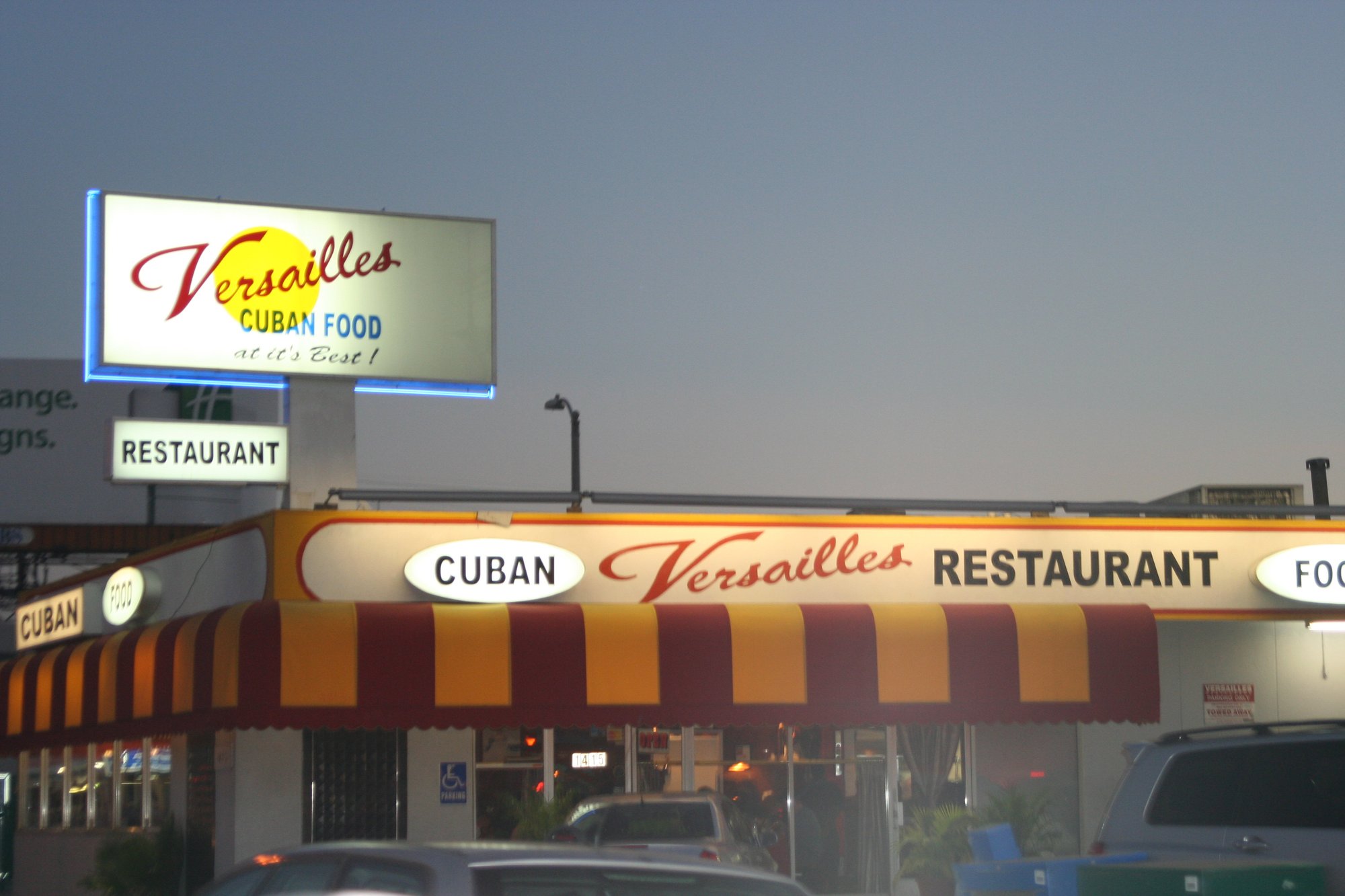
Versailles on South La Cienega is one of Los Angeles's most enduring Cuban restaurants, operating in a city where Latin American cooking rarely receives the critical attention its depth deserves. The kitchen runs on a roster of slow-roasted and garlic-forward dishes that have anchored the address across decades. A practical, no-ceremony room that rewards regulars and first-timers alike.

Pearl is the En Primeur Club membership app, where members save venues, book tables and use the concierge.
The menu
What to order
- Versailles Garlic Chicken
- Roast Pork
- Sandwich Cubano
Cuban Cooking in a City That Rewards Persistence
Los Angeles has always been better at absorbing cuisines than celebrating them. The city's Cuban food scene is a case in point: significant, historically rooted, and largely ignored by the critical apparatus that tracks tasting menus and omakase counters. Versailles, at 1415 S La Cienega Blvd, has operated within that gap for decades, serving a style of Cuban cooking that asks nothing of its audience except an appetite. The room is functional rather than designed, the service transactional rather than theatrical, and the food direct in a way that the more decorated end of the Los Angeles restaurant scene rarely manages.
In a city where the $$$$ tier is dominated by extended tasting formats, counters like Hayato or Kato operate in a register of precision and restraint that feels almost architectural, Versailles represents the opposite pole. The logic here is abundance and repetition: dishes that have been made the same way across years, served quickly, and consumed without ceremony. That consistency is its own form of craft, even if it never attracts a Michelin star.
The Room and What It Signals
Walking into Versailles, the first thing the space communicates is that the room is not the point. The lighting is practical, the tables close, and the ambient noise level rises quickly when the dining room fills. This is not the studied casualness of a restaurant that has hired a designer to make it look accidental, it is a working Cuban diner that has not felt the need to perform otherwise. In a Los Angeles dining culture increasingly oriented around atmosphere as product, that indifference reads almost as a statement.
The wall decor references Cuban imagery in a way that feels habitual rather than curated. The service team moves efficiently and without extensive explanation. The contrast with the contemporary format restaurants that dominate critical coverage in this city, places like Somni, where the front-of-house choreography is as considered as the kitchen output, could not be more pronounced. Versailles exists in a different tier of hospitality logic entirely, one where the value proposition is volume, speed, and price-to-portion ratio rather than sequence and narration.
The Kitchen's Core Logic
Cuban cooking in the continental United States carries the weight of diaspora. What gets served in Los Angeles, Miami, or New York under the Cuban label is almost never static, it reflects generational adaptation, ingredient availability, and the preferences of communities that have been far from the island for two or three generations. At Versailles, the garlic roast chicken and the lechon asado (slow-roasted pork) function as the gravitational center of the menu. Both dishes rely on mojo, the citrus-garlic sauce that is the primary flavor architecture of Cuban-American cooking, used here in quantities that leave the table smelling of it long after the plates have been cleared.
The black beans arrive thick and properly seasoned, the rice cooked without pretension. Plantains appear in both forms, tostones, fried twice and pressed flat, and maduros, the ripe sweet version that functions as counterweight to the salt and acid elsewhere on the plate. This is food designed around balance within a plate rather than progression across a meal, which makes it structurally different from the tasting-menu logic that governs much of what gets reviewed at the higher end of the city's dining spectrum.
For comparison, the editorial attention directed at restaurants like Osteria Mozza or Providence reflects a critical framework built around ingredient sourcing, technique visibility, and chef identity. Versailles operates outside that framework almost entirely, which means it rarely surfaces in the same conversations, but also means it has maintained a loyal local customer base without depending on review cycles or award seasons to sustain it.
Team Dynamic and Service Structure
The editorial angle around team collaboration, the interplay between kitchen, floor, and any drinks program, takes a different shape at Versailles than it does at a restaurant where those roles are clearly delineated and formally staffed. The front-of-house at a Cuban diner of this type functions primarily as a logistics operation: getting food to the table while it is hot, managing turnover, and handling a volume of covers that would strain a more elaborate service model. There is no sommelier program to speak of, no pairing suggestions, no captain explaining the provenance of an ingredient. The drinks list runs to Cuban beers, sangria, and basic sodas, functional rather than curated.
What holds the operation together is a kind of institutional knowledge: a team that knows the menu thoroughly enough to move it without confusion, and a kitchen whose output is consistent enough not to require explanation. At the level of ambition that Le Bernardin or Alinea occupy, team collaboration is a formal choreography. Here, it is more pragmatic, closer to the working rhythm of a restaurant that has been doing the same thing long enough to do it without thinking.
Where Versailles Sits in the Broader American Dining Map
Cuban cooking has never achieved the critical traction in American fine dining that, say, Japanese or French cooking has. There is no Cuban equivalent of the kaiseki counter or the classical French brigade operating at the level of The French Laundry or Addison. The cuisine's American profile remains largely in the mid-market and casual tier, which means that places like Versailles compete less against Blue Hill at Stone Barns or Single Thread Farm and more against the general gravitational pull of Los Angeles's sprawling, diverse, and deeply competitive casual dining sector.
What distinguishes the longest-running Cuban addresses from newer entrants is precisely what critics often undervalue: durability. A restaurant that has operated at the same address for decades in a city with high turnover and rising real estate costs is demonstrating something that a single great review cannot confer. The same observation applies to places like Emeril's in New Orleans or Bacchanalia in Atlanta, institutional longevity in the American restaurant context is itself a form of credential, even if it rarely gets framed that way.
Planning Your Visit
Versailles on La Cienega is a walk-in-friendly operation for most services, though weekend evenings fill quickly and a short wait is common. The address is accessible by car, La Cienega runs as a major north-south corridor through the mid-city area, with street and lot parking available nearby. The meal runs fast by design; this is not a restaurant that expects long table holds. Budget accordingly for a mid-range spend per head that reflects the format: generous portions, direct pricing, no tasting menu surcharges. For those building a broader Los Angeles itinerary that includes the more demanding reservation windows of places like Atomix-tier prestige dining or the structured formats of internationally referenced kitchens, Versailles functions well as a counterpoint, the kind of meal that resets expectations without demanding anything in return except attention to what is on the plate.
Frequently asked questions
Where do I go for Versailles?
Versailles is located at 1415 S La Cienega Blvd, Los Angeles, CA 90034, Los Angeles.
Do I need a reservation at Versailles?
Versailles on La Cienega at 1415 S La Cienega Blvd operates largely as a walk-in restaurant, which is part of what keeps it accessible to the neighbourhood. Weekend evenings are the exception, a short wait is common from Friday through Sunday, and arriving before the dinner rush is the practical workaround.
What's the best thing to order at Versailles?
Versailles is known for its garlic chicken, the dish that most regulars return for. The Cuban kitchen here leans on a small, confident menu rather than breadth, so ordering what the kitchen has done longest is the reliable move. The La Cienega location is the address that built the reputation.
Do I need a reservation for Versailles?
Reservations are recommended for Versailles in Los Angeles. Confirm current policy via the venue's official channels.
What's the defining dish or idea at Versailles?
The defining idea is restraint applied to diaspora cooking: a Cuban menu that doesn't chase trend or adapt to Los Angeles tastes, but holds to the logic of the original cuisine. The garlic chicken, marinated, roasted, and served without architectural plating, is the clearest expression of that position. The room reinforces the point; nothing about the space competes with what's on the plate.
Price and Positioning
Comparable venues nearby, for context on price, style, and recognition.
| Venue | Cuisine | Price | Awards | Notes |
|---|---|---|---|---|
| VersaillesThis venue (the venue you are viewing) | Classic Cuban | $20–30 | Not listed | Not listed |
| Sabor Colombiano | Authentic Colombian | $20–30 | Not listed | Westlake, Authentic Colombian |
| Rosalind's | Authentic Ethiopian Cuisine | $20–30 | Not listed | Little Ethiopia, Authentic Ethiopian Cuisine |
| The Milky Way | New American Kosher Dairy | $30–50 | Not listed | South Robertson, New American Kosher Dairy |
| Zira Uzbek Kitchen | Authentic Uzbek | Not listed | Michelin Plate | Melrose, Authentic Uzbek |
| California Market | Korean Gimbap & Udon | $10–20 | Not listed | Wilshire Center, Korean Gimbap & Udon |
Continue exploring
More in Los Angeles
Restaurants in Los Angeles
All restaurants in Los Angeles →
Bars in Los Angeles
All bars in Los Angeles →
Hotels in Los Angeles
All hotels in Los Angeles →
Wineries in Los Angeles
All wineries in Los Angeles →

Details
- Lively
- Casual
- Family
- Group Dining
- Casual Hangout
- Standalone
- A La Carte
- Vegetarian Friendly
Current opening hours
- Monday
- 11 AM–9 PM
- Tuesday
- 11 AM–9 PM
- Wednesday
- 11 AM–9 PM
- Thursday
- 11 AM–9 PM
- Friday
- 11 AM–10 PM
- Saturday
- 11 AM–10 PM
- Sunday
- 11 AM–9 PM
Hours can change for holidays and private events. Hours as of .