Tiki Kai
Tiki Kai sits on Pier Avenue in Hermosa Beach, where the South Bay's beach-casual dining culture meets the kind of tropical-themed bar format that has returned to relevance across coastal California. The address places it squarely in the pedestrian corridor connecting the strand to local nightlife, making it a natural stop within a compact, walkable dining scene that includes neighbors like Baran's 2239 and Martha's Hermosa Beach.
Pearl is the En Primeur Club membership app — saves, bookings, and concierge access live there. Same editors, same standards.
- Address
- 73 Pier Ave, Hermosa Beach, CA 90254
- Website
- tikikai.com
- Directions
- Get directions
 Saves & bookings on Pearl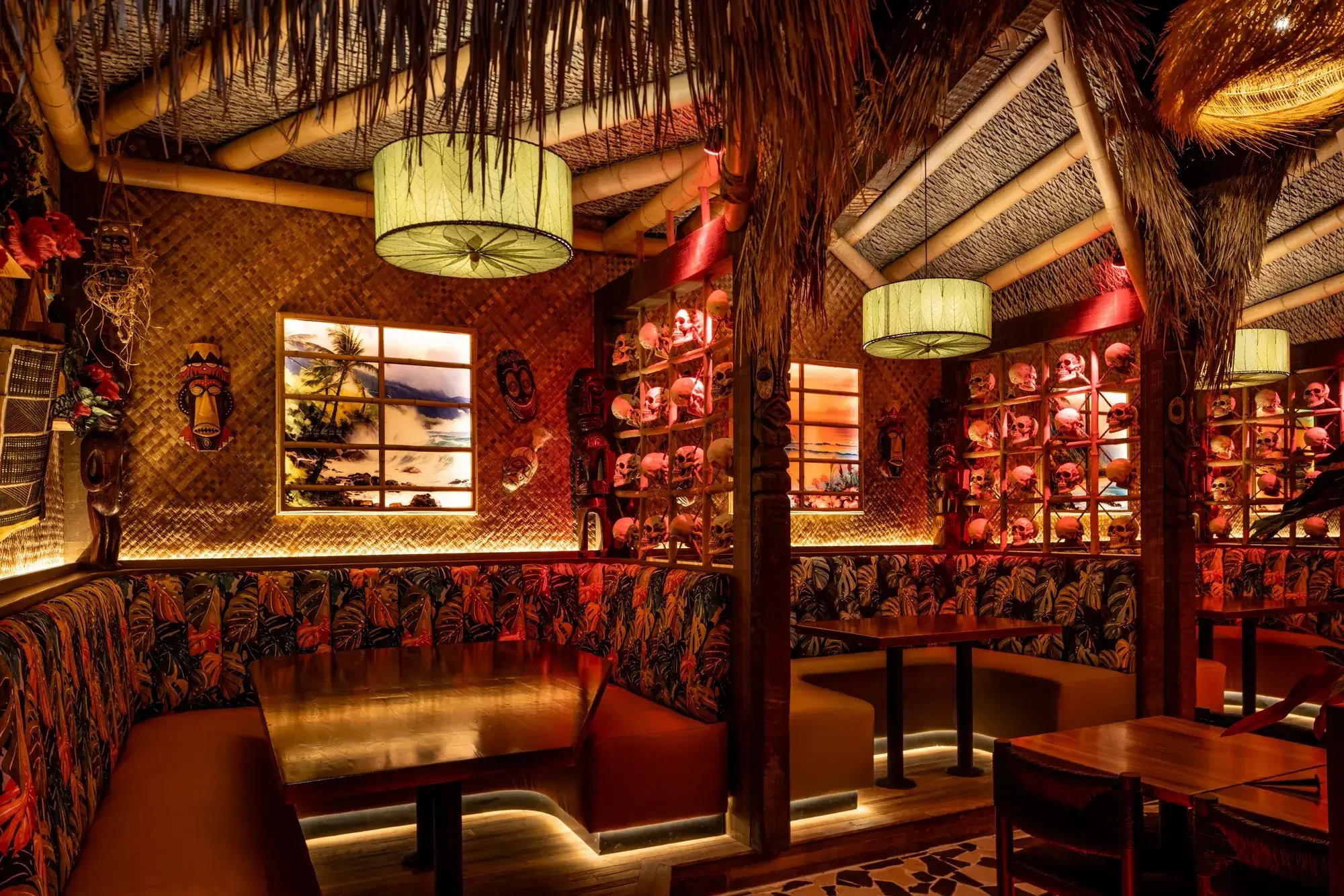
Where Pier Avenue Meets Tropical Format
Hermosa Beach's Pier Avenue corridor operates on a different register than the fine-dining blocks of nearby Manhattan Beach or the sprawling restaurant rows of Redondo. Here, the architecture is low, the foot traffic is high, and the venues that endure tend to do so by reading the room correctly: casual enough for post-beach visits, focused enough to hold a crowd that has options within a short walk. Tiki Kai, at 73 Pier Ave, sits inside that logic. The tropical bar format it occupies has had a complicated arc in American drinking culture, dismissed through the 1990s as kitsch, then quietly rehabilitated by a craft cocktail generation that recognized the technical depth hiding beneath the paper umbrellas.
That rehabilitation has been uneven. In cities like San Francisco and New York, the tiki revival arrived with elaborate mise-en-scène and house-made orgeat. On the South Bay coast, the format tends to land differently, more neighborhood, less theater, with the Pacific as a built-in backdrop that renders some of the genre's manufactured escapism redundant. Hermosa Beach is a particularly honest test case for this: the strand already delivers the atmosphere, so a venue on Pier Ave either compounds it or fights against it.
The Physical Container and What It Signals
Any tiki-format space begins with the room itself, because the genre lives or dies on spatial commitment. Half-measures, a few rattan chairs, a token rum selection, some bamboo trim, read as costume rather than concept. The spaces that work tend to go further: low lighting calibrated to the color temperature of candles and string lights, enough visual density in the decor to justify lingering, and a bar program that earns the aesthetic rather than borrowing it.
Pier Avenue's pedestrian scale works in Tiki Kai's favor here. The street draws a crowd that is already on foot, already in a social frame of mind, and already accustomed to moving between venues rather than committing to a single destination. That context rewards spaces with strong visual identity, the kind of place that registers clearly from the sidewalk and communicates its offer before anyone crosses the threshold. In a corridor that includes AttaGirl, Decadence, and Mickey's Deli, spatial differentiation matters.
Tiki-format interiors have a specific set of design moves drawn from a mid-century American tradition that drew from Polynesian, Caribbean, and Southeast Asian visual cultures. The canonical elements, carved wooden figures, volcanic rock, woven textiles, dense overhead canopy work, function less as decoration than as acoustic and atmospheric engineering. They absorb sound, create intimacy at table level, and produce the low-ceiling cave quality that makes a room feel like a destination rather than a corridor. When that design logic is applied with discipline, the result is a room that feels genuinely transporting. When it's applied partially, the uncanny valley effect is hard to ignore.
Hermosa Beach's Dining Map and Where Tiki Kai Sits
The South Bay dining scene has changed considerably over the past decade. Baran's 2239 represents the neighborhood's more ambitious end, holding its own against the broader Los Angeles restaurant conversation. Martha's Hermosa Beach anchors the approachable-breakfast-and-lunch tier with consistent local loyalty. The corridor as a whole has moved away from purely transactional beach-town dining toward a broader range.
Within that map, a tiki-format bar occupies a specific niche: it is not competing with the fine-dining tier that includes, at the national level, venues like Providence in Los Angeles or Addison in San Diego, nor is it in the same conversation as destination restaurants like The French Laundry in Napa or Lazy Bear in San Francisco. The competitive set is local and social: the question is whether the drinks program and the room justify choosing this address over the next one on the street.
That is actually a harder test than it sounds. Hermosa Beach visitors are generally not making a single destination decision the way someone booking a table at Alinea in Chicago or Atomix in New York City might be. They are making a series of quick, low-friction choices across an evening. The venues that capture and hold that attention tend to have a strong first impression, a drinks program that rewards staying rather than moving on, and a social energy that is self-sustaining rather than dependent on a single busy night.
The Tiki Format's Broader Relevance
The return of the tiki bar as a credible format in American drinking culture is worth taking seriously as context. At the ambitious end of the spectrum, bars in Los Angeles and New York have demonstrated that rum-forward tropical cocktail programs can carry technical complexity, multiple base spirits, house-made syrups, acid-adjusted citrus, and layered presentations that use vessel choice and garnish as part of the flavor architecture. The format has also benefited from a broader diversification of premium spirits: aged rums from Jamaica, Barbados, and Martinique have developed a collector tier that parallels single-malt whisky culture, giving serious bar programs new source material to work with.
Whether any given venue in the tiki format chooses to operate at that level of ambition is a program decision that determines its competitive position. A bar on Pier Avenue in Hermosa Beach is not automatically in the same conversation as Le Bernardin in New York City or Emeril's in New Orleans, nor should it be. But within the beach-bar format, there is still a meaningful spectrum between a perfunctory Mai Tai and a drinks program that uses the tiki idiom as a serious starting point.
Planning Your Visit
Tiki Kai's location at 73 Pier Ave places it within easy walking distance of the Hermosa Beach Pier and the strand, making it a natural stop on any evening that begins or ends at the beach. Pier Avenue is compact and pedestrian-friendly; parking is more useful if approached from the side streets off Pacific Coast Highway than attempted on Pier itself during busy evenings. For a fuller picture of the neighborhood's dining options before planning your route, neighboring venues include Baran's 2239 and Martha's Hermosa Beach for those building a longer evening. Given the format and the beach-town setting, dress expectations run casual. Those interested in broader California dining, from Single Thread Farm in Healdsburg to Blue Hill at Stone Barns in Tarrytown for those extending further, will find the South Bay a notably different register: neighborhood-scaled, beach-oriented, and best experienced at the pace the street naturally sets.
The Short List
Comparable venues nearby, for context on price, style, and recognition.
| Venue | Cuisine | Price | Notes |
|---|---|---|---|
| Tiki KaiThis venue — the venue you are viewing | Hermosa Beach, Hawaiian Tiki | $$$ | Not listed |
| Palmilla Cocina Y Tequila | Not listed | $$$ | Pier Avenue, Sonoran-Baja Mexican Cocina y Tequila |
| Baran's 2239 | Hermosa Beach, Modern American | $$$ | Not listed |
| Sushi | Bar Hermosa Beach | Hermosa Beach, Omakase Sushi Bar | $$$$ | Not listed |
| AttaGirl | Hermosa Beach, California Mediterranean | $$$ | Not listed |
| Steak & Whisky | Not listed | $$$ | Hermosa Beach, California Modern Steakhouse |
Continue exploring
More in Hermosa Beach
Restaurants in Hermosa Beach
Browse all →
Bars in Hermosa Beach
Browse all →
Hotels in Hermosa Beach
Browse all →
Wineries in Hermosa Beach
Browse all →
At a Glance
- Whimsical
- Lively
- Trendy
- Energetic
- Date Night
- Casual Hangout
- Group Dining
- Terrace
- Craft Cocktails
Current opening hours
- Monday
- 4–11 PM
- Tuesday
- 4–11 PM
- Wednesday
- 4–11 PM
- Thursday
- 4–11 PM
- Friday
- 4 PM–12 AM
- Saturday
- 10 AM–12 AM
- Sunday
- 10 AM–11 PM
Hours can change for holidays and private events. Last verified .
Dimly lit dining room with black lava rock walls, thatched-roof booths, and a dramatic tropical patio lounge.