
The Sunday Times Ireland’s 100 Best Restaurants
Our verdict
Three Leaves has grown from a Blackrock Market stall to a multi-room restaurant at the heart of that same market, carrying awards for its cooking and a devoted southside following along with it. The kitchen's approach draws on South Indian culinary tradition with a generosity and precision that has made it many Dubliners' default answer to the question of where to eat well without ceremony.

Pearl is the En Primeur Club membership app — saves, bookings, and concierge access live there. Same editors, same standards.
- Address
- Unit 30, 19A Main St, Blackrock Market, Blackrock, South, Co. Dublin, A94 C8Y1, Ireland
- Phone
- +353 87 769 1361
- Hours
- Mon–Wed ClosedThu 12–3 PMFri 12–3 PM, 5:45–10 PMSat 12–5:30 PMSun 12–4:30 PM
- Website
- 3leaves.ie
- Directions
- Get directions
- Booking
- Book on ResDiary
A Market Address That Has Earned Its Place
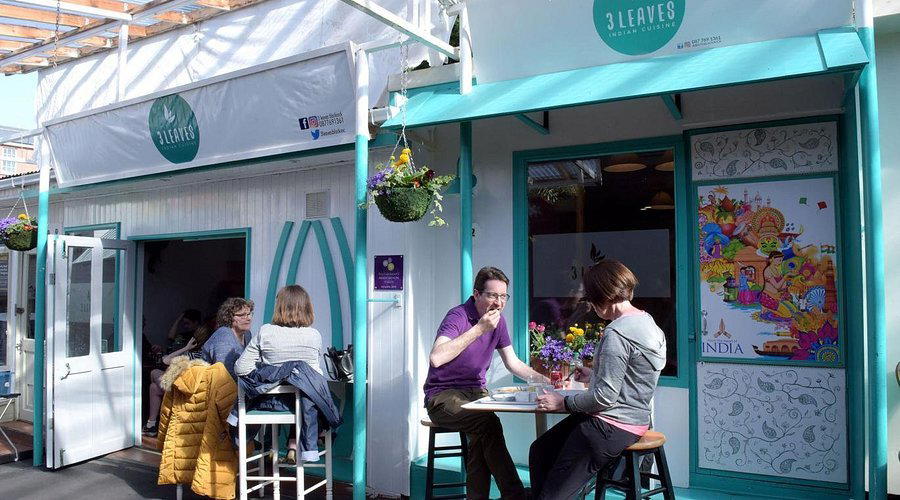
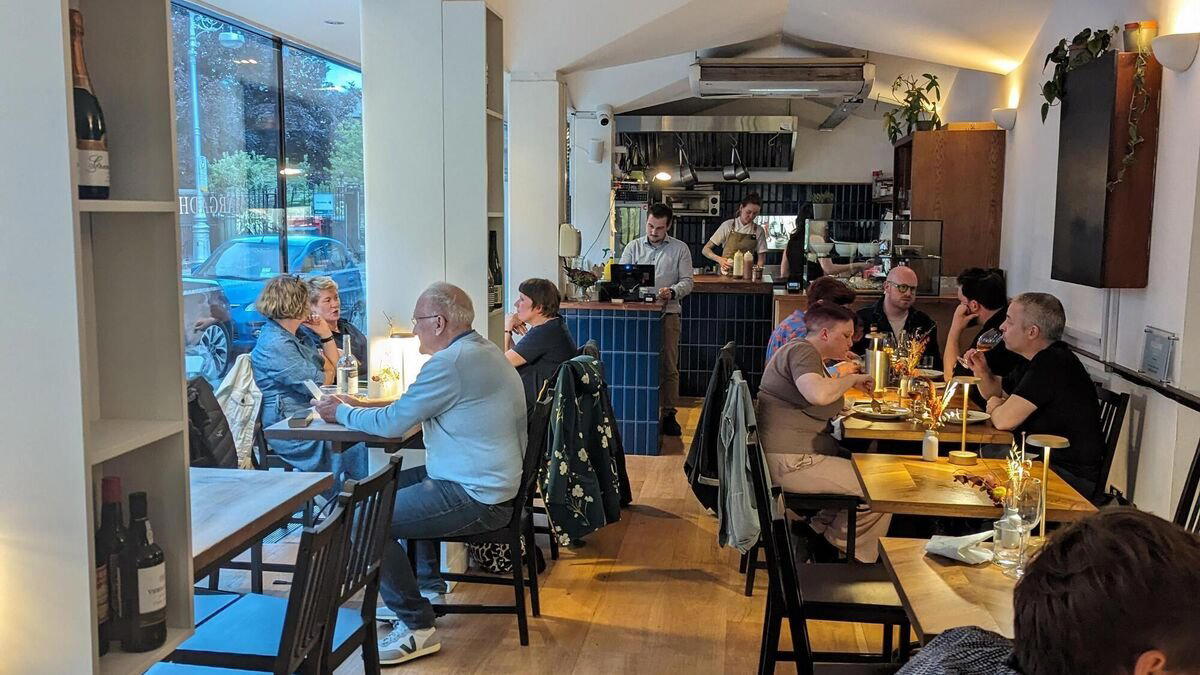
Blackrock Market has always operated on its own logic: a warren of independent traders tucked behind the main street, drawing a crowd that knows what it is looking for. Within that context, Three Leaves occupies a position that most restaurants in a conventional high-street setting would take years to establish. The dining rooms — a series of bright, interconnected spaces that replaced what was once a 12-seat operation — carry the relaxed energy of a neighbourhood institution without the self-consciousness that often accompanies that status. Natural light, close tables, and the ambient noise of a full house on a weekend afternoon set the tone before a dish arrives.
The restaurant's trajectory tells you something useful about how independent dining survives and compounds in Ireland. Three Leaves began as a market stall, expanded into a small fixed space within the same market, and has since grown into its current, more comfortable configuration at Unit 30, 19A Main St, Blackrock Market. That kind of gradual, in-place growth is relatively rare. Most restaurants that start small either close or relocate; Three Leaves did neither, which is itself a signal about the depth of its local following.
The Cooking and Where It Comes From
South Indian cooking, in its most considered forms, is built around a sourcing logic that runs deeper than most European culinary traditions acknowledge. Spice provenance, the freshness of curry leaves, the specific milling of rice and lentils for fermentation-based dishes, these are variables that affect outcomes dramatically. The cooking at Three Leaves, under Santosh Thomas, reflects that awareness. The kitchen's reputation has been sustained not by a fixed menu but by a consistency of approach, and the awards for leading ethnic cooking that it has accumulated over time are a marker of sustained quality rather than a single standout season.
What the awards record also signals is positioning within Dublin's broader dining map. Ireland's most-discussed restaurant kitchens, places like Aniar in Galway, Bastion in Kinsale, or Chapter One by Mickael Viljanen in Dublin, operate within a European fine-dining framework where provenance is framed through a local-produce lens. Three Leaves works from a different tradition, one in which sourcing decisions are shaped by the flavour requirements of South Indian cuisine rather than by the proximity principle. Getting the right ingredients is the point; the geographical origin follows from that, not the other way around.
This is worth understanding as a distinction. Across Ireland, a generation of kitchens, from Terre in Castlemartyr to Chestnut in Ballydehob, has made Irish land and sea the explicit subject of their menus. Three Leaves makes no such argument, and it does not need to. The sourcing intelligence at work here is different in kind: it belongs to a culinary tradition in which the spice rack is as consequential as the protein, and in which the quality of foundational ingredients like tamarind, coconut, and dried chillies determines the register of the dish. That is a sourcing conversation that rarely gets the editorial attention it deserves in the Irish context.
Service as a Structural Element
The front-of-house approach at Three Leaves is attributed in part to Milie Mathew, whose service style has been described consistently as warm and disarming. In the context of a market restaurant where the physical setting could easily read as casual-only, the quality of service becomes a structural element that raises the overall register. Good service in this kind of space does something specific: it signals that the kitchen is being taken seriously even when the surroundings do not demand it. That signal matters to a diner deciding how much attention to pay to what arrives on the plate.
Within the Blackrock dining scene, Three Leaves occupies a different register from its nearest neighbours. Liath and Volpe Nera operate at the formal end of the local market, with tasting menus and European fine-dining frameworks. Three Leaves is neither informal nor fine-dining in the conventional sense; it sits between those poles, with cooking that rewards attention and a room that does not demand it. That positioning has proved durable.
Planning a Visit
Three Leaves is located within Blackrock Market, accessible from Main Street, Blackrock, on the southside of Dublin. The market setting means the restaurant operates on its own schedule, and given the consistent demand the kitchen attracts, booking ahead is advisable rather than optional for weekend sittings. The 12-seat origins of the space have given way to a more comfortable configuration, but the restaurant is not large, and the combination of local regulars and visitors from across Dublin means tables fill. For those building a broader southside day, Blackrock is well-served by the DART rail line from central Dublin, making the area easy to reach without a car. The full Blackrock restaurants guide covers the neighbourhood's range in detail, and the experiences guide and bars guide are useful additions if you are planning a full afternoon or evening.
For those travelling beyond Blackrock, the dede in Baltimore, Homestead Cottage in Doolin, and House in Ardmore represent comparable moments of cooking that works from a strong sense of identity rather than a borrowed template. Further afield, Campagne in Kilkenny offers a useful reference point for what sustained, independently-minded cooking looks like over the long term. And if the interest is in how other cultures handle ingredient-led precision at a high level, Le Bernardin in New York City and Atomix in New York City represent contrasting but instructive international benchmarks.
For accommodation and further exploration in the area, the Blackrock hotels guide, wineries guide, and experiences guide are available for planning context.
Frequently asked questions
Is Three Leaves good for families?
The market setting inside Blackrock Market keeps the tone relaxed, and the connected rooms are more accommodating than a formal tasting-menu counter. The 12-seat origins mean the space has grown thoughtfully rather than being built for high-volume turnover, which tends to suit a calmer family meal. Booking ahead is still advisable given the demand the kitchen has built over more than a decade.
What should I expect atmosphere-wise at Three Leaves?
Three Leaves occupies a series of bright, connected rooms within Blackrock Market, off Main Street on Dublin's southside. The approach is neighbourhood rather than ceremonial — close-set tables, a casual market address, and front-of-house service from Milie Mathew that has been consistently described as warm and disarming. It draws a local crowd that returns regularly rather than one chasing a formal occasion.
Does Three Leaves have a Michelin star or similar recognition?
Three Leaves has received recognition including: We have yet to meet a single soul who hasn’t fallen under the spell of Three Leaves. Milie Mathew and Santosh Thomas have come a long way over the past decade, growing their restaurant from a market stall to a tiny, 12-seat space, to a comf….
What's the signature dish at Three Leaves?
Awards recognition for Three Leaves has been directed at Santosh Thomas's South Indian cooking as a whole, with the kitchen repeatedly cited for best ethnic cooking rather than for a single standout plate. The menu evolves, so no fixed dish defines the offer. The consistent thread is a sourcing and cooking sensibility rooted in South Indian tradition rather than a crowd-pleasing pan-Indian approach.
Where exactly is Three Leaves?
Three Leaves is located at Unit 30, 19A Main St, Blackrock Market, Blackrock, South, Co. Dublin, A94 C8Y1, Ireland, Blackrock.
Is Three Leaves reservation-only?
Given the small capacity and over a decade of demand, booking ahead is strongly advised. Three Leaves grew from a market stall to a 12-seat room before reaching its current size, and the loyal southside following means walk-in availability is unreliable. Contact details are not listed publicly, so booking through Blackrock Market directly or via any listed platform is the practical route.
Comparable Spots, Quickly
| Venue | Cuisine | Price | Awards |
|---|---|---|---|
| Three LeavesThis venue — the venue you are viewing | Modern Indian Street Food | $20–30 | The Sunday Times Ireland’s 100 Best Restaurants |
| Patrick Guilbaud | Irish - French, Modern French | Not listed | Michelin 2 Star |
| Aniar | Modern Irish, Modern Cuisine | Not listed | Michelin 1 Star |
| Bastion | Progressive American, Modern Cuisine | Not listed | Michelin 1 Star |
| LIGИUM | Creative | Not listed | Michelin 1 Star |
| Host | Nordic, Modern Cuisine | Not listed | Not listed |
Recognition history
Dated appearances from independent guides and award organizations, with the underlying list record or original source where available.
The Sunday Times Ireland’s 100 Best Restaurants
The Sunday Times
Continue exploring
More in Blackrock
Restaurants in Blackrock
Browse all →
Bars in Blackrock
Browse all →
Hotels in Blackrock
Browse all →
Wineries in Blackrock
Browse all →
Details
- Cozy
- Intimate
- Modern
- Date Night
- Casual Hangout
- Open Kitchen
- Byob
- Street Scene
- A La Carte
- Small Plates
- Vegetarian Friendly
- Vegan Options
Current opening hours
- Monday
- Closed
- Tuesday
- Closed
- Wednesday
- Closed
- Thursday
- 12–3 PM
- Friday
- 12–3 PM, 5:45–10 PM
- Saturday
- 12–5:30 PM
- Sunday
- 12–4:30 PM
Hours can change for holidays and private events. Last verified .
Intimate market space with warm welcoming service, basic seating, and lively kitchen energy.